10 Surprising Boa Constrictor Facts

Boa constrictors have a reputation as fearsome squeezers, but the truth about how they hunt, grow, and give birth is far more fascinating than the movie version. Here are ten facts that show just how remarkable these New World giants are.
-
They squeeze in time with your heartbeat. Research on constriction found that boas don't just clamp down and hold: they continuously adjust their coils to match the prey's heartbeat, tightening further every time they sense a beat. This cuts off circulation fast, causing the prey to lose consciousness within seconds rather than slowly suffocating as long assumed.
-
They give birth to live young, not eggs. Unlike most snakes, boa constrictors are viviparous, meaning babies develop inside the mother and are born fully formed and ready to survive on their own. A single litter can hold anywhere from 10 to 64 babies, about 25 on average, with numbers varying by region and the mother's size.
-
Newborns get zero parental care. The moment they're born, baby boas slither off on their own to hunt, hide, and fend for themselves. There's no nursing, no guarding, and no guidance from mom after birth.
-
Females dwarf males in the wild. Adult boas can reach about 13 feet, and it's almost always the females at the top end of that range. The size gap is thought to help females carry and nourish large litters of developing young.
-
They track prey with their tongue, not their eyes. Boas flick their forked tongues to collect scent particles from the air and press them into the Jacobson's organ on the roof of the mouth, building a detailed chemical picture of what's nearby. This lets them locate a warm-blooded meal in pitch darkness without ever needing to see it.
-
They hunt without heat-sensing pits. Many of their relatives in the boa family have heat-sensing pits along the lips, but boa constrictors do not. They make up for it with that chemical tracking and good eyesight, which is enough to find a meal at night.
-
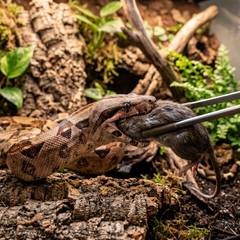
They carry zero venom and never needed it. Boa constrictors have no venom glands at all; every meal is subdued purely through muscular force. Their entire hunting strategy relies on patience, ambush timing, and raw constriction power.
-
They're natives of the Americas, not Africa or Asia. Wild boa constrictors range from Mexico down through Central and South America, with additional populations scattered across Caribbean islands. That New World origin is a key difference from pythons, which are native to Africa, Asia, and Australia.
-
They can live three decades in the wild. A healthy wild boa constrictor can survive 20 to 30 years, hunting rodents, birds, bats, lizards, and other small mammals along the way. That's an unusually long lifespan for a reptile of its size.
-
Their calm nature made them a top pet snake. Despite their impressive length, boas are typically slow-moving and even-tempered, and their adult size stays far more manageable than that of giant pythons. That combination of a mellow personality and a reasonable enclosure footprint has made captive-bred boas one of the most popular large snakes in the pet trade.
Boa constrictors are ambush hunters that can wait motionless for hours, or even days, near a game trail or burrow entrance before striking, conserving energy until exactly the right moment.
Squeezing in time with a heartbeat is the one that stuck with me. What got you? Say so in the comments.
The one thing almost everyone gets wrong about a boa is how it actually kills. Constriction does not crush or suffocate anything, and the measurements are not close.
Sources & Further Reading
Last reviewed 5 Jul 2026 · 4 sources
- Animal Diversity Web, University of Michigan: Boa constrictor
- Smithsonian's National Zoo: Boa Constrictor
- Boback SM, Hall AE, McCann KJ et al. (2012). Snake modulates constriction in response to prey's heartbeat. Biology Letters 8(3):473-476
- Boback SM, McCann KJ, Wood KA et al. (2015). Snake constriction rapidly induces circulatory arrest in rats. Journal of Experimental Biology 218(14):2279-2288
More on the Boa Constrictor
Boa Constrictor care guide
🐍 How Much Does a Boa Constrictor Really Cost?
🐍 How to Handle a Boa Constrictor Safely: Size Changes Everything
🐍 Common Boa Constrictor Health Issues
🐍 Boa Constrictor Enclosure Setup: Sizing for the Adult It Will Become
🐍 Boa Enrichment: A Big Snake in a Box Is Still a Snake in a Box

Written by Michael Ryan
Mike keeps two rescued bearded dragons, Dex and Cera, and writes the care guides on BeastlyFacts from his own research and mistakes. He is not a veterinarian.
More about Michael Ryan →