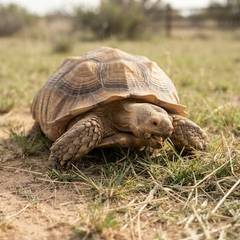
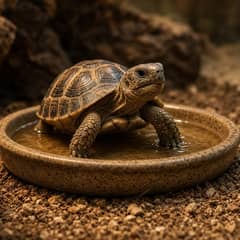
Tortoise Sexing, Eggs, and Egg Binding
On This Page▾

Most new tortoise owners only start caring about sex once they notice one behavior: a tortoise that won't stop digging. By then it's worth already knowing which one you have, because the two questions are really one question asked at different times. A keeper convinced they've got a male is the one caught flat-footed when that same animal turns out to be female and starts restlessly digging test holes in the corner of the enclosure, sometimes with no other tortoise anywhere in the picture. This guide covers both halves: the physical cues used to sex a tortoise or box turtle, and what follows once you actually have a female, including the single most common surprise, and the one distinction that matters most if she ever seems stuck. It's scoped to land tortoises and box turtles specifically, since the cues below and the nesting biology that follows come from sources documenting that group. An aquatic species like a red-eared slider shares the same underlying reproductive biology but nests in a different way entirely, so treat this as a tortoise and box turtle guide rather than a universal chelonian one.
How to Tell a Tortoise's Sex
The standard external cues work across terrestrial turtles and tortoises, and they hold up reasonably well once an animal is grown:
- Plastron shape. The plastron, the flat underside of the shell, is concave in males and flat in females. This is usually the single most useful cue on an adult, since a female's flatter plastron leaves room for eggs to pass, while a male's concave plastron helps him stay balanced on top of a female's domed carapace during mating.
- Tail length and vent position. Males have a longer tail, and the vent, the opening where the reproductive and waste tracts empty, sits farther out toward the tip of that longer tail. In a female, the shorter tail puts the vent closer to the edge of the shell itself.
- Gular scales. Some male tortoises also carry a noticeably larger pair of gular scales, the scutes at the very front edge of the plastron, which some species use to spar with rival males.
None of these are precision instruments. Determining sex in reptiles this way is tricky and, in most cases, is best left to a vet, a herpetologist, or an experienced breeder or dealer. That's especially true on a small or young animal, where the plastron hasn't developed much concavity yet and the tail difference is subtle at best, so a confident call on a juvenile is more guess than measurement even when someone sounds certain. The safer habit is to treat an early call as provisional and revisit it as the animal grows, rather than locking in an assumption from a single look at a still-developing shell. The cues describe terrestrial turtles and tortoises as a group, which is why the same plastron, tail, and vent comparisons apply to a box turtle as much as to a Testudo tortoise, and a Russian tortoise of either sex needs the same enclosure.
| Feature | Typical Male | Typical Female |
|---|---|---|
| Plastron shape | Concave | Flat |
| Tail length | Longer | Shorter |
| Vent position | Farther from the shell margin, toward the tail tip | Closer to the shell margin |
| Gular scales | Often larger, in some species | Typically smaller |
Getting this right, or at least getting a confident answer from someone experienced, is what makes the rest of this guide relevant. A male tortoise doesn't need any of the preparation that follows. A female does, whether or not she's ever shared an enclosure with a male.
A Female Doesn't Need a Male to Lay
This is the part that surprises the most new keepers. A review of reproductive tract disorders in chelonians, published in the journal Animals, notes that unfertilized eggs may be produced and laid even without mating having occurred. A female tortoise's body builds eggs on its own reproductive cycle, and if there's no male to fertilize them, she still has to pass them. They won't hatch, but biologically her system doesn't know or care whether a male was ever involved. The same review adds the nuance that it is usually fertilized eggs that get deposited, so an unmated female is likelier to retain a clutch than a mated one, which is exactly why the nest site has to be there in advance.
That means a single pet tortoise, kept entirely alone, can still go gravid and lay a full clutch. It's not a sign anything is wrong with her, and it's not a rare fluke. It's simply what happens on a hormonal cycle that runs independent of whether mating occurred. The practical upshot is that every female owner, not just breeders, needs a plan for what happens when that cycle produces eggs she has to put somewhere.
Give Her a Nest Site Before She Needs One
The mistake that causes the most trouble is entirely about timing: waiting until a tortoise is visibly restless and digging before scrambling to provide somewhere appropriate to lay. By then she may already be past the point where a rushed setup helps.
The same Animals review lists an absent or inadequate nesting site as one of the nonobstructive causes of egg retention in chelonians, meaning it's a husbandry gap, not a physical blockage, and one that's entirely preventable. A separate 2025 review in Veterinary Sciences, covering dystocia pathophysiology and management, notes that providing a quiet, suitable nesting area with an appropriate substrate may be enough on its own to let normal egg-laying happen in these nonobstructive cases. In other words, the fix for a tortoise that can't find anywhere to dig is often just giving her somewhere to dig, arranged well before she needs it rather than as an emergency reaction.
What that nest area needs isn't a precise, universally agreed depth in inches, species and enclosure size vary too much for one number to be honest. What matters is that the substrate is deep and loose enough for her to dig a body-length hole and fully bury the clutch afterward, and that it's in place and available continuously, not assembled after she's already started pacing corners. If your enclosure's everyday substrate doesn't allow for that kind of digging, a dedicated deeper section or a separate container filled well beyond the normal floor depth is the more reliable approach.
Restlessness and increased digging are the visible signs that she's building toward laying, and that same restlessness also shows up, per the Animals review, as one of the earliest signs vets watch for in true dystocia. That overlap is exactly why the digging itself isn't the useful signal. What tells the two apart is covered next.
If there's genuinely nowhere acceptable to dig, she doesn't necessarily lay somewhere unsuitable. She may simply hold the clutch. The same review notes that chelonians can voluntarily retain eggs in the oviduct for up to six months, waiting for conditions that meet her own standard for a nest site. That's a remarkable amount of patience, but it isn't unlimited, and eggs held long past a reasonable window carry the same downstream risks as any other form of retention.
Normal Gravid Behavior vs. True Egg Binding (Dystocia)
This is the distinction that matters, more than any symptom checklist on its own. A reptile that is healthy and gravid may not be willing to eat, but should still be bright, active, and alert. A reptile with dystocia is usually anorectic and weak, may show a distended abdomen, and can progress to severe lethargy and become unresponsive. Box turtles show the same normal picture: a healthy, gravid box turtle may not eat for several days or weeks, but she stays bright, active, and alert throughout.
| Sign | Likely Just a Husbandry Problem | Likely Dystocia (Emergency) |
|---|---|---|
| Appetite | Reduced, sometimes absent for days or weeks | Absent, and doesn't return |
| Activity and alertness | Bright, active, responsive despite not eating | Weak, lethargic, or unresponsive |
| Digging and straining | Restless test-digging, may pause and resume over days | Straining continues with no progress toward laying |
| Abdomen | Rounder, otherwise normal | Distended and doesn't change |
| Response to a real nest site | Often resolves once an acceptable spot is available | No improvement even with a good nest site |
The Animals review reinforces why this is genuinely hard to call in chelonians specifically: distinguishing dystocia from a normal reproductive cycle is a particular challenge in this group, precisely because voluntary retention can look identical to a problem for weeks at a stretch. The same review also separates causes into two categories that map directly onto the husbandry-versus-medical question. Nonobstructive causes, an inadequate nest site, wrong temperature or humidity, poor diet, dehydration, are the ones that can improve once the underlying gap is fixed. Obstructive causes, an oversized or malformed egg, adhesions, a misshapen pelvis, or oviductal narrowing, are physical blockages that don't respond to a better setup and need a vet's imaging to confirm.
There's one more wrinkle worth knowing if you keep a species that hibernates or brumates. The Veterinary Sciences review notes that egg retention into late summer or early autumn may reflect physiological preparation for that seasonal slowdown rather than dystocia. Timing alone, in other words, isn't the tell. A tortoise holding eggs going into fall, while otherwise bright and eating, is a different picture from one that's stopped eating and gone flat regardless of the calendar.
The question isn't whether she's straining or how long it's been. It's whether she's still bright, active, and eating between attempts. That single behavioral thread separates a nest-site problem you can fix tonight from a medical emergency that needs a vet.
Do Not Press on a Gravid Tortoise's Belly
It's tempting to check for eggs the way you'd check anything else, with a gentle press. Don't. The Veterinary Sciences review on dystocia includes imaging from a case in which a retained egg showed an impression fracture that the authors attributed to vigorous palpation. A cracked egg inside the body isn't a minor setback, it risks yolk material leaking into the coelomic cavity, which is a genuine veterinary emergency on top of whatever was already going on.
Vets do sometimes check for eggs by hand, but the technique described in the same chelonian review involves placing a finger in the soft tissue pocket in front of the hind leg and gently swinging the animal, a careful, trained method aimed at feeling for firm, calcified masses without applying direct pressure to the shell area over them. That's a different thing entirely from an owner pressing on a suspected gravid tortoise's belly at home. If you think she's carrying eggs and something seems off, the right move is a vet visit and imaging, not a hands-on check of your own.
Getting Help: What a Vet Actually Does
When a tortoise does need veterinary care for retained eggs, treatment depends heavily on whether there's a physical blockage. Supportive therapy for reptile dystocia runs to IV or intra-osseous fluids, calcium injections, vitamin supplementation, and hormone injections such as oxytocin, which can stimulate the oviduct to contract and help her pass the clutch on her own. That approach fits the nonobstructive cases described above, the ones where the underlying issue is husbandry or a metabolic gap rather than a physical blockage.
Dosing isn't something to estimate. The Veterinary Sciences review lists a published oxytocin range specifically for Hermann's tortoises, of roughly 1.5 to 3 IU/kg, which only underscores the point: that number came from a clinical review meant for veterinarians managing a specific species under monitoring, not a figure to reproduce at home for a different tortoise, and it says nothing about the right dose in a box turtle or a sulcata. When the cause is instead a genuine obstruction, an oversized or malformed egg, adhesions, or a misshapen pelvis, the same review's causal framework points away from medical management and toward surgery, since no amount of oxytocin fixes a physical blockage. That's also why imaging comes before treatment rather than after: a vet needs to know which category a case falls into before picking a plan, not guess based on how long she's been straining.
A difficult clutch can leave infections and complications behind, and the broader illness signs are the ones in the box turtle and Russian tortoise health guides. A keeper with bearded dragons alongside a tortoise shouldn't assume the two overlap: a bearded dragon lay box is built around a lizard's much shallower digging, which doesn't transfer to a tortoise's deeper, slower nesting habits.
A gravid chelonian isn't necessarily in a hurry. The same biology that lets a tortoise voluntarily hold a clutch for months while waiting on the right nest site is part of what makes dystocia so hard to catch early in this group, patience and pathology can look identical from the outside for longer than most owners expect.
The Real Takeaway
Sex a tortoise using the plastron, tail, and vent cues, hold that answer loosely on a young or small animal, and get a real opinion from someone experienced if it matters for housing decisions. Once you know, or suspect, you have a female, the job shifts to having a nest site ready before restlessness ever shows up, since a female with no male anywhere nearby can still produce and pass a clutch. When digging turns into more than routine restlessness, the calendar and the straining itself matter far less than whether she's still bright, active, and eating. That single thread, not the duration of digging, is what tells a husbandry fix apart from a same-day vet visit.
Sources & Further Reading
Last reviewed 4 Sep 2026 · 4 sources
- Merck Veterinary Manual: Description and Physical Characteristics of Reptiles
- VCA Animal Hospitals: Reptiles, Dystocia; Box Turtles, Problems
- Lubian et al., "Disorders of the Female Reproductive Tract in Chelonians: A Review," Animals, 2025, 15(9):1275, DOI: 10.3390/ani15091275
- Morel et al., "Biochemical and Hepatic Determinants of Reproductive Failure in Reptiles: A Review of Dystocia Pathophysiology and Management," Veterinary Sciences, 2025, 13(1):30, DOI: 10.3390/vetsci13010030
Frequently Asked Questions
Can a female tortoise lay eggs without ever being near a male?
Yes. A review of chelonian reproductive disorders in the journal Animals notes that unfertilized eggs may be produced and laid on their own, without a male present. The eggs won't hatch, but her body still builds and passes them on its own schedule, which is why a single female still needs a nest site ready.
How can I tell if my tortoise is male or female?
There are three main cues in terrestrial turtles and tortoises: the plastron (bottom shell) is concave in males and flat in females, males have a longer tail with the vent positioned farther out toward the tip rather than close to the shell margin, and some male tortoises have a larger pair of gular scales at the front of the plastron. None of these are exact measurements, and sexing reptiles this way is tricky and often best left to a vet, herpetologist, or experienced breeder.
Is it safe to press on a tortoise's belly to check for eggs?
No. A 2025 review in Veterinary Sciences documents a retained egg with an impression fracture that the authors attributed to vigorous palpation. A cracked egg inside the body is a real emergency. Leave checking for eggs to a vet, who can confirm with imaging instead of hand pressure.
My tortoise is digging constantly but hasn't laid. Is that egg binding?
Not necessarily. Digging and restlessness are also normal parts of a gravid tortoise searching for an acceptable spot, and some individuals voluntarily hold eggs for up to six months waiting for the right conditions. What separates a husbandry problem from dystocia isn't the digging itself, it's whether she stays bright, active, and eating between attempts, as a healthy gravid reptile does, versus becoming anorectic, weak, or lethargic, which points to a true medical emergency.
What happens if a tortoise has nowhere acceptable to dig a nest?
She may hold the clutch rather than lay it somewhere unsuitable. A chelonian reproductive disorders review lists an absent or inadequate nest site as a nonobstructive cause of egg retention, and a separate dystocia review notes that simply providing a quiet area with the right substrate can be enough to let some of these cases resolve on their own. Left unresolved, prolonged retention carries the same downstream risks as any other form of egg binding.
How is egg binding in a tortoise treated?
It depends on the cause. Supportive care, IV or intra-osseous fluids, calcium and vitamin supplementation, and hormone injections such as oxytocin to help the oviduct contract, covers cases without a physical blockage. Oxytocin dosing is species-specific and a vet decision, not something to estimate at home. When there's an actual obstruction, an oversized or malformed egg, scarring, or a misshapen pelvis, surgery is the usual answer instead.
🐢 How Much Does a Box Turtle Really Cost? (And a Legal Note on Where They Come From)
🐢 How Much Does a Red-Eared Slider Really Cost?
🐢 How Much Does a Red-Footed Tortoise Really Cost?
🐢 How Much Does a Russian Tortoise Really Cost?
🐢 How Much Does a Sulcata Tortoise Really Cost?
🐢 How to Handle a Box Turtle
🐢 How to Handle a Red-Eared Slider
🐢 How to Handle a Red-Footed Tortoise
🐢 How to Handle a Russian Tortoise
🐢 How to Handle a Sulcata Tortoise (While You Still Can)
🐢 Common Box Turtle Health Issues
🐢 Common Red-Eared Slider Health Issues and What Causes Them
🐢 Common Red-Footed Tortoise Health Issues and What Causes Them
🐢 Common Russian Tortoise Health Issues and What Causes Them
Written by Michael Ryan
Mike keeps two rescued bearded dragons, Dex and Cera, and writes the care guides on BeastlyFacts from his own research and mistakes. He is not a veterinarian.
More about Michael Ryan →