How to Handle a Box Turtle
On This Page▾

Box turtles are shy and better observed than handled, though with patience, they can become surprisingly personable animals that recognize feeding time and approach their keeper.
What to Expect
Docile, sometimes shy, and best suited to limited handling rather than frequent physical interaction. Many box turtles learn to associate their keeper with food and will approach or even feed directly from your hand. That is the ideal relationship to build with this species: interaction on the turtle's terms.
The Defensive Move That Gives This Species Its Name
A box turtle's hinged plastron, the bottom shell, lets it seal itself completely inside its shell when threatened. A turtle that retracts fully and holds tight is actually showing a sign of good health and normal defensive instinct, not something to worry about.
The hinge in a box turtle's plastron closes the shell almost completely, sealing out most predators, and it's the literal source of the name "box" turtle, a design very few other turtle species share.
Telling Males From Females
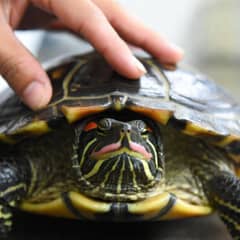
No single trait is fully reliable alone, so check a few together. The tail is the most consistent marker, longer and thicker on males with the vent sitting farther from the body, sometimes beyond the shell's edge, versus a shorter tail and a vent closer in on females. Males also tend to have thicker, more curved hind claws, and often a slightly concave plastron to help with mounting, though it's subtle enough that some males barely show it. Eye color gets mentioned constantly, red or orange in males versus brown in females, and it does hold for eastern and three-toed box turtles, but it isn't universal across every box turtle subspecies, so treat it as a supporting clue rather than the deciding one.
Handling Technique, When It's Needed
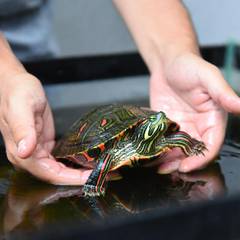
Support the full body with both hands, keep sessions short, and never drop, shake, or flip a box turtle upside down, this causes real stress and can interfere with normal breathing. Wash your hands before and after, and supervise children closely given how easy it is to mishandle an animal this size without meaning to.
A Useful Health Distinction
Normal shyness looks different from illness. A box turtle that's hiding occasionally and otherwise active and eating is behaving typically. Excessive hiding combined with lethargy and reduced appetite is a genuine red flag worth a vet visit, not something to write off as this species just being naturally shy.
Semi-Terrestrial: Neither Fully Aquatic Nor Fully Terrestrial
This is worth understanding clearly since it places box turtles between two other commonly kept chelonians. Unlike the fully aquatic red-eared slider, box turtles spend most of their time on dry land. Unlike the fully terrestrial tortoises, they genuinely need regular access to shallow water for soaking and hydration. This in-between ecology, along with an omnivorous diet very different from a strictly herbivorous tortoise's, shapes the entire setup.
How a box turtle measures up against a leaf-tailed gecko, California kingsnake, and oscar fish is in Leaf-Tailed Gecko, California Kingsnake, Box Turtle & Oscar Fish compared.
Sources & Further Reading
Last reviewed 25 Jul 2026 · 1 source
- PetMD: Common Box Turtle
- Chicago Exotics Animal Hospital: Box Turtle Care
- Box Turtle Site: Is My Box Turtle Male or Female?
❓ Frequently Asked Questions
Are box turtles good pets to handle regularly?
No, not as a routine. They're docile and sometimes shy, and best suited to limited handling. Many box turtles do learn to associate their keeper with food, though, and will approach or even feed directly from your hand.
Why does a box turtle seal itself completely inside its shell?
The hinge in its plastron, the bottom shell, lets a box turtle close up completely when threatened. A turtle that seals tight and holds is showing good health and normal defensive instinct, so it isn't a sign of trouble.
What's the right way to pick up a box turtle?
Both hands under the whole body, and keep the session short. Never drop, shake, or flip a box turtle onto its back: it causes real stress and can interfere with breathing. Wash your hands before and after.
How can you tell normal shyness apart from a sick box turtle?
By what else the turtle is doing. Occasional hiding alongside normal activity and appetite is ordinary for the species. Constant hiding with lethargy and a dropped appetite is a red flag worth a vet visit.
Is a box turtle aquatic like a red-eared slider?
No. Box turtles are semi-terrestrial, spending most of their time on dry land unlike the fully aquatic red-eared slider, but unlike a fully terrestrial tortoise, they need regular access to shallow water for soaking and hydration.
Can a box turtle learn to recognize its owner?
Yes, by association with food. Many box turtles approach their keeper at feeding time and will take a meal directly from a hand. That is the relationship worth building here, on the turtle's terms.
How can you tell if a box turtle is male or female?
Look at more than one trait, no single one is fully reliable alone. Males typically have a longer, thicker tail with the vent positioned farther from the body, sometimes past the shell's edge, plus thicker, more curved hind claws. Eye color is a common but imperfect clue too, red or orange eyes usually mean male and brown eyes usually mean female in eastern and three-toed box turtles, but that pattern doesn't hold for every subspecies.
📰 More on the Box Turtle
📘 Box Turtle care guide
🐢 How Much Does a Box Turtle Really Cost? (And a Legal Note on Where They Come From)
🐢 Common Box Turtle Health Issues
🐢 Box Turtle Enclosure Setup: Land, Water, and Real Space Requirements
🐢 Box Turtle Feeding: The Diet That Changes With Age
🐢 Box Turtle Enrichment: Substrate and a Hide Box Changed Their Bloodwork

Written by Michael Ryan
Mike keeps two rescued bearded dragons, Dex and Cera, and writes the care guides on BeastlyFacts from his own research and mistakes. He is not a veterinarian.
More about Michael Ryan →Comments
No comments yet - be the first!