How to Handle a Russian Tortoise
On This Page▾

Russian tortoises tolerate being picked up, but they are not a species that needs it or seeks it out. Handling is for health checks, soaks, weighing and moving the tortoise, and most of the risk in those moments comes from a fall.
Picking One Up
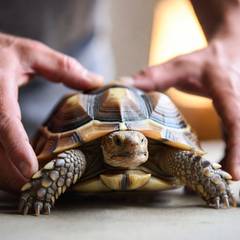
Scoop the tortoise from below with a palm under the plastron instead of grabbing the shell from above, then hold the shell with two hands so the body and legs are both supported. Keep the grip firm but gentle, and work low, sitting or kneeling over the floor or a table. A fall can do serious damage to a tortoise and can be fatal. Wash hands before and after, as with any reptile.
What Normal Looks Like
Most Russian tortoises do not enjoy being picked up, though many come to accept a gentle shell rub and will take food from a hand. In the wild the species is active in two short windows a day, mid-morning and late afternoon, and spends the rest of the time in its burrow, so a captive tortoise that basks, grazes, digs in and disappears for hours is keeping its own schedule rather than sulking.
Courtship is the loudest thing a Russian tortoise does. A male circles a female and bites at her head and legs, then stretches his neck out stiffly, stares her in the eye and jerks his head up and down in quick succession. Mating comes with high-pitched squeaks from the male. In the breeding season males turn on each other and fight hard.
Males and Females
A male has a much longer tail than a female, usually carried tucked to one side, and that is the quickest way to tell them apart once the tortoise is grown. Females run slightly larger, with flared scutes on the shell, and the largest verified animals reach about 22 cm, close to 9 inches, of straight shell length. Sexual maturity comes at around 10 years. A mature female can lay two or three clutches in a season, and hatchlings come out at about 42 to 50 mm of shell and 18 to 23 grams.
Two Tortoises in One Enclosure
Male Russian tortoises do not tolerate each other. During the mating period males fight viciously, and the loser ends up injured, flipped onto his back, or chronically stressed and prone to disease. A male's courtship is rough on females as well: he circles her and bites at her head and legs, and with no place to escape him a female takes that attention constantly.
Females are usually more tolerant of each other, but not always. Some become bullies, and the subordinate female starts hiding most of the day and can become sick from the stress. That is the sign to separate them. A shared enclosure needs extra floor, at least 10 more square feet for each added tortoise, and enough hides, plants and logs to break every sightline, so either animal can get fully out of the other's view. Sexing a Russian tortoise comes before any pairing, because a male housed with a female will probably produce eggs.
Escape-Proofing Checklist
Russian tortoises climb better than their shape suggests and dig persistently, and wild ones dig burrows several meters long. Before trusting an enclosure, check:
- Walls are solid and smooth. Wire, mesh or chain link invites climbing, and a tortoise that can see through a gap will fixate on it and hurt itself trying to get out.
- Nothing makes a ladder. Hides, rocks, water dishes and heaped substrate stay away from the walls, and corners are checked for a foothold.
- Outdoor walls go down as well as up. Sink them at least 12 inches into the ground, in concrete or buried wire mesh, and build them about 2 feet high with a lip of around 4 inches projecting inward along the top.
- The top is covered outdoors. Wide mesh over the pen keeps predators out.
- Tunnels are checked regularly. Walk the perimeter and look for fresh digging along the base.
Pen construction, shade and predators are laid out in full in the outdoor reptile housing guide, which applies directly to a digger this determined.
First-Timer Mistakes
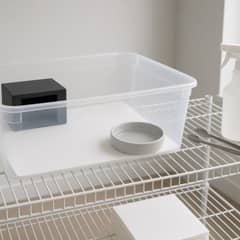
- Housing in a glass aquarium instead of an open-topped table. Glass ventilates poorly, and a tortoise that can see through a wall it cannot pass tends to pace along it.
- Over-humidifying the enclosure. This is an arid-adapted species, and excess moisture causes more problems than it solves.
- Housing two males together, or adding a second tortoise to an enclosure without the extra space and cover to keep them apart.
Size Is the Reason This Works Indoors
A Russian tortoise stays small enough to live indoors for its entire multi-decade life. A sulcata grows into a giant that needs outdoor space and cannot be kept inside long-term, which the sulcata tortoise handling guide shows in practice.
Sources & Further Reading
Frequently Asked Questions
Are Russian tortoises easy to handle?
Tolerant, but not built for it. Treat a Russian tortoise as an observation pet that gets picked up occasionally and for a reason, not as one you handle for its own sake.
Are Russian tortoises good escape artists?
Yes, talented at both climbing and burrowing, better escape artists than their slow reputation suggests. Keep that in mind when judging whether an enclosure is secure.
Can you house multiple Russian tortoises together?
Not two males: they fight, and the loser ends up injured or chronically stressed. Two females often share, but some bully the other into constant hiding, so a shared enclosure needs at least 10 extra square feet per added tortoise and cover that breaks every sightline.
What's the biggest first-timer mistake with Russian tortoises?
Using a glass aquarium instead of an open-topped table. The ventilation is poor, and a tortoise that can see through a wall it can't reach ends up pacing the glass restlessly.
Should a Russian tortoise enclosure be kept humid?
No. This is an arid-adapted species, and over-humidifying the enclosure causes more problems than it solves.
How does handling a Russian tortoise compare to a sulcata?
Size decides it. A Russian tortoise stays small enough to live indoors for its whole multi-decade life, while a sulcata grows into a giant that needs outdoor space and can't be kept inside long-term.
More on the Russian Tortoise
Russian Tortoise care guide
🐢 How Much Does a Russian Tortoise Really Cost?
🐢 Common Russian Tortoise Health Issues and What Causes Them
🐢 Russian Tortoise Enclosure Setup: Compact Housing With Real Requirements
🐢 Russian Tortoise Feeding: Fiber, Calcium, and Growing Slowly
🐢 Russian Tortoise Enrichment: Digging, Grazing, and Exploration
Written by Michael Ryan
Mike keeps two rescued bearded dragons, Dex and Cera, and writes the care guides on BeastlyFacts from his own research and mistakes. He is not a veterinarian.
More about Michael Ryan →