Tortoise Brumation: Which Species, and How to Do It Right
On This Page▾

Brumation is the reptile version of a winter slowdown: cooler temperatures and shorter days push a tortoise into weeks of near-dormancy instead of true hibernation's total shutdown. Done correctly, it costs nothing and can be good for a tortoise's long-term condition. Done on the wrong species, on an unfasted or sick animal, or at the wrong temperature, it is one of the more reliable ways a keeper loses an otherwise healthy pet. This guide is specific to Testudo tortoises, the Russian, Hermann's, and spur-thighed species most commonly kept as pets, and to North American box turtles. It is not a bearded dragon or a snake, and the numbers here don't transfer between them any more than our own bearded dragon brumation guide would apply to a chelonian. Every figure below is attributed to the specific page it came from and scoped to the species that source actually covers.
Which Tortoises Brumate, and Which Never Should
Not every tortoise species evolved with a cold season to sleep through, and forcing one that didn't is a straightforward way to kill it. The species unsuitable for hibernation are leopard tortoises, African spurred (sulcata) tortoises, the Southern Turkish spur-thighed variant, Egyptian, Libyan, and Tunisian Testudo graeca populations, and red-foot and yellow-foot tortoises. These are tropical or subtropical species with no cold-season adaptation, and cold dormancy strips away the heat they depend on to digest and fight infection.
The suitable candidates are most Mediterranean tortoises, Horsfield's tortoise (the Central Asian species sold as the Russian tortoise), and the American desert tortoise. That covers the species this guide is built around: Testudo hermanni (Hermann's), Testudo graeca (spur-thighed, outside the North African populations named above), and Testudo horsfieldii (Russian). A keeper unsure which species a tortoise actually is can check the identifying features against the Russian tortoise, whose illness signs also matter here.
North American box turtles aren't tortoises, but they brumate naturally in the wild across most of the US, so they fall under the same seasonal umbrella. Their protocol has its own numbers for temperature, duration, and fasting length, given in their own sections below. Don't average the two together. The box turtle health issues guide covers everything else that can go wrong with a box turtle across the year.
Even within a suitable species, an individual should only be hibernated if it has had no significant health problems in the previous year and is of a sufficient size, which rules out hatchlings and recently recovered animals regardless of what the species chart says. The size cutoff in practice is about 4 years old: any turtle or tortoise younger than that stays out of brumation entirely, as does any animal currently showing signs of illness.
| Group | Brumate? |
|---|---|
| Russian, Hermann's, spur-thighed tortoise (non-North African) | Yes, if healthy and adult |
| North American box turtle | Yes, with its own protocol below |
| Sulcata, leopard, red-foot, yellow-foot tortoise | No, tropical species, no cold-season adaptation |
| Egyptian, Libyan, Tunisian, S. Turkish spur-thighed variants | No |
| Any species, if sick, underweight, or under about 4 years old | No, regardless of species |
The Pre-Brumation Vet Check Is Not Optional
Every protocol opens with the same step: a vet exam before anything else changes. The pre-hibernation check happens every autumn along with a fecal parasite screen, specifically so a tortoise doesn't go into a three-month cold, low-metabolism period carrying a parasite load or an infection its immune system can no longer fight. Box turtles need the same exam by a qualified reptile vet before brumation starts.
The reasoning connects to what brumation does to the immune system generally. Hibernation is stressful on the body, and sub-clinical illnesses can surface during it, when the animal may become immunocompromised. That is documented in aquatic turtles, and the physiology is the same reason a Testudo tortoise or box turtle needs a clean bill of health first: a mild, easily missed respiratory infection or parasite burden that a warm, active tortoise's immune system was holding in check can become a serious problem once that tortoise's metabolism drops for weeks at 40-something degrees. Skip the vet visit and you're finding out the hard way, mid-brumation, instead of in a heated exam room where something can still be done about it.
A tortoise that is underweight, showing any respiratory symptoms, recovering from a recent illness, or under roughly 4 years old should not brumate this year. That animal overwinters instead in a heated vivarium, with temperatures never dropping below 60°F (15°C), and tries again the following year once it's cleared a vet check.
The Fast: Why Food in the Gut Is the Classic Fatal Mistake
A tortoise digests using body heat it doesn't generate on its own. Cool it down with food still moving through its gut and that food simply stops moving, sitting there to rot and ferment while gut bacteria carry on working in an animal too cold to expel or process the result. That's the mechanism behind what keepers call the classic brumation mistake: stopping heat before stopping food, rather than the other way around.
For Testudo tortoises, the fasting window is 1 to 3 weeks depending on the animal's size, with temperature held at 70 to 80 degrees Fahrenheit throughout that fast so digestion can actually finish. Only once the fast is done does the heat start coming down, by roughly 5°C (9°F) a week, until the tortoise reaches the brumation band, so the cool-down takes a few weeks of its own. Mediterranean species follow the same order: feeding stops first, warmth holds while the gut empties, and the temperature eases down only after that.
Box turtles get a shorter runway: food is withheld for 10 to 14 days before brumation, with a warm water soak every other day during that fasting period to keep the turtle hydrated while its gut empties. Whichever species you're working with, the fast comes first and the heat drop comes only once digestion has caught up, never the other way around.
The Temperature Band, and What Happens Outside It
For Testudo tortoises, the working range is 35 to 50 degrees Fahrenheit, with 41°F as the ideal, and anything below 35°F or above 60°F is unsafe. Held as a constant, that means 2 to 9°C (roughly 35.6 to 48.2°F), as close to 5°C, or 41°F, as the setup can manage. Box turtles run slightly warmer: 45 to 50°F, held for 3 to 4 months.
Both directions of temperature failure carry real risk. Too cold, and a tortoise kept below freezing can lose its eyesight or its life. Too warm, and the tortoise doesn't stay properly dormant: it becomes too active and burns through the fat and liver glycogen reserves it needs intact to get moving again once brumation ends. That's why a probe or a max/min thermometer inside whatever setup you use matters more than the container itself.
Methods: Fridge, Insulated Box, and Why Unmonitored Outdoor Cold Isn't One
There are three approaches, and only two of them are worth using.
Fridge hibernation is good in principle because it holds a steady temperature around 5°C. The catch is that a fridge's internal temperature varies by shelf position, runs drier than a tortoise needs, and ventilates poorly with the door shut. The fix for all three: use a thermal probe or max/min thermometer to confirm the real reading rather than trusting the dial, open the door for about 30 seconds daily for fresh air and a visual check, and keep a topped-up bowl of water in the bottom for humidity. No insulation is needed inside a fridge, though some keepers add substrate so the tortoise can bury itself. The fridge used should have no other job, not cooling food while a tortoise lives in it, both for hygiene and because a door opened for groceries undoes the point of controlling temperature and airflow.
- Very stable, easily monitored temperature
- Cheap if a dedicated small fridge is used
- Direct thermometer placement is simple
- Runs dry, needs an added water bowl for humidity
- Poor passive ventilation, needs a daily door-open
- Temperature varies by shelf position inside the unit
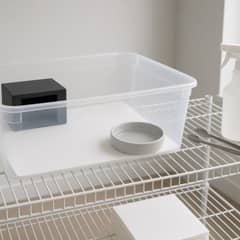
Insulated box hibernation is the other recommended method: a large, rodent-proof outer box, wood or a similarly sturdy material, with the top and any air holes covered in wire mesh to keep vermin out. The base and sides get lined with thick padding, polystyrene or newspaper, and the tortoise itself goes into a smaller inner box with its own air holes, filled one to three-quarters with polystyrene chips, dry leaves, or shredded newspaper. Avoid hay or straw. That inner box then sits inside the outer one, positioned somewhere the temperature actually holds in the target range and where it's easy to open for regular check-ins. Box turtles get a similar small-scale setup: a ventilated plastic container filled two-thirds with a moistened mix of shredded newspaper and peat moss.
What doesn't work is "self-hibernation," a tortoise left to find its own cold spot outdoors or in an unmonitored garage with no way to confirm the temperature it's actually experiencing. The main hibernation risks, dehydration, freezing, and rodent attack, are exactly what an unmonitored outdoor or garage setup can't guard against. If a garage is the only option, it still needs the same probe thermometer and box-in-a-box insulation as an indoor setup, not just a cold corner and a hope.
Weekly Weighing and the Weight-Loss Ceiling
The scale is the main tool for catching a brumation going wrong before symptoms show. Weigh the tortoise on its own or complete with its inner box every one to two weeks. An adult loses about 1 percent of its pre-hibernation weight per month, so a 1,000 gram tortoise losing around 10 grams a month is normal. Anything past roughly 8 to 10 percent total loss is drastic: bring the tortoise out of hibernation immediately, have it checked, and investigate for disease.
Box turtles get a different number: weigh in grams every two weeks, and past a 10 percent loss, stop brumation and get veterinary care. A more conservative line, covering turtles and tortoises together, treats 6 to 7 percent as the acceptable range and anything past 7 percent as a concern. Use that lower threshold as the action point rather than waiting for the higher one.
| Group | Temperature band | Duration | Weight-loss action point |
|---|---|---|---|
| Testudo tortoise (general) | 35-50°F (1.7-10°C), ideal 41°F (5°C) | Ceilings, not targets: no longer than 10 weeks for smaller animals and 14 for large ones, or a shorter 6 weeks to 3 months | ~1%/month; act past 8-10% total |
| Box turtle | 45-50°F (7.2-10°C) | 3-4 months | Act at about 7%; stop by 10% total |
Signs That Mean End Brumation Right Now
Stop and warm the tortoise up immediately, rather than waiting for the next scheduled check, if any of the following show up: weight loss past the action point for its group above, any discharge from the nose, eyes, or vent found during a routine check, the enclosure temperature having dropped below freezing even briefly, or any general signs of illness. None of these are "wait and see" situations. A below-freezing exposure can cost a tortoise its eyesight or its life, which is not a risk worth confirming by waiting for a scheduled weigh-in.
Waking Up: The Gradual Warm-Up and the Immediate Soak
Coming out of brumation isn't as simple as flipping the heat lamp back on. Bring the tortoise out slowly, check it over for discharge from the nose, eyes, and tail end while it's still cool and easy to handle, then leave it at room temperature for the first few hours before any direct heat. Once it's had that adjustment period, give it a warm bath for at least half an hour, repeatable twice daily. The soak isn't optional pampering: it's how the tortoise empties its bladder of the toxic waste that built up over brumation and replenishes water it hasn't had access to in months. Watch for actual urination and defecation in the days that follow; if neither happens, it needs a vet visit to get the tortoise rehydrated and checked. A tortoise that isn't eating or hasn't urinated within about seven days of waking, or that looks ill at any point, needs a vet without delay.
Box turtles follow a similar arc on a shorter clock. The ambient temperature comes up gradually over 4 to 6 days rather than all at once, with a soak every other day through that stretch. Only once the turtle has held at a normal temperature for 3 full days does feeding resume as usual. In both species, feed easy, succulent foods first rather than a full normal diet on day one, then ease back to the regular menu.
For every 10°C (18°F) drop in body temperature, a tortoise's heart rate roughly halves, and by around 4°C (39°F) its respiratory movements become negligible, close to undetectable without careful observation. That's not a sign of distress at a proper brumation temperature, it's the whole point: a tortoise brumating correctly is running its body about as slowly as it's built to run.
Brumation is worth doing right precisely because doing it wrong is so quiet. A tortoise that's too warm, too cold, unfasted, or the wrong species for the process doesn't usually announce the problem loudly until real damage is already done. The vet check, the fast, the thermometer in the box instead of a guess, and the weekly scale are the whole system for catching that early, and none of them are steps worth skipping to save a season.
Sources & Further Reading
Frequently Asked Questions
Which tortoises should never be brumated?
Leopard tortoises, African spurred (sulcata) tortoises, several North African Testudo graeca variants, and red-foot and yellow-foot tortoises should not be hibernated, because they naturally come from climates without a cold season. Any tortoise that is sick, underweight, or a hatchling should also sit the season out regardless of species.
How long can a tortoise fast before brumation?
1 to 3 weeks depending on size, with heat kept on at 70 to 80 degrees Fahrenheit through the fast so the gut can finish digesting before cooling begins. Box turtles get a shorter 10 to 14 day fast. Brumating with food still in the gut is the classic way keepers accidentally kill an otherwise healthy animal.
What temperature does a tortoise need to brumate at?
The working band is 35 to 50 degrees Fahrenheit, with 41 degrees Fahrenheit as the ideal, and anything below 35 or above 60 is unsafe. Box turtles run a touch warmer, 45 to 50 degrees Fahrenheit.
How much weight loss is normal during brumation?
Expect roughly 1 percent of body weight lost per month, with total loss past 8 to 10 percent meaning wake the tortoise immediately and call a vet. Box turtles have a 10 percent stop line, though acting at about 7 percent is the safer choice. Weigh weekly to every two weeks so a problem shows up while it's still small.
Can I brumate my tortoise in a regular kitchen fridge?
A fridge can work, but it needs to be a fridge used for nothing else, fitted with a probe thermometer, opened for about 30 seconds daily for ventilation, and given a topped-up water bowl for humidity. It is never being used to chill food while an animal is inside it.
What do I do when brumation ends?
Warm the tortoise gradually rather than putting it straight under a hot lamp, then give it an immediate warm soak once it's alert. Soak it for at least 30 minutes, repeatable twice daily, and a same-day vet visit if it hasn't urinated or started eating within about a week of waking.
🐢 How Much Does a Box Turtle Really Cost? (And a Legal Note on Where They Come From)
🐢 How Much Does a Red-Eared Slider Really Cost?
🐢 How Much Does a Red-Footed Tortoise Really Cost?
🐢 How Much Does a Russian Tortoise Really Cost?
🐢 How Much Does a Sulcata Tortoise Really Cost?
🐢 How to Handle a Box Turtle
🐢 How to Handle a Red-Eared Slider
🐢 How to Handle a Red-Footed Tortoise
🐢 How to Handle a Russian Tortoise
🐢 How to Handle a Sulcata Tortoise (While You Still Can)
🐢 Common Box Turtle Health Issues
🐢 Common Red-Eared Slider Health Issues and What Causes Them
🐢 Common Red-Footed Tortoise Health Issues and What Causes Them
🐢 Common Russian Tortoise Health Issues and What Causes Them

Written by Michael Ryan
Mike keeps two rescued bearded dragons, Dex and Cera, and writes the care guides on BeastlyFacts from his own research and mistakes. He is not a veterinarian.
More about Michael Ryan →