Common Russian Tortoise Health Issues and What Causes Them
On This Page▾

Russian tortoises are hardy, and most health problems trace back to a handful of husbandry basics, temperature, humidity, and diet, that are within an owner's control.
Metabolic Bone Disease (MBD)
This is among the most common conditions in pet tortoises. Watch for a soft or deformed shell and weak limbs. Caused by inadequate UVB or insufficient dietary calcium. Always see a vet, and treat consistent UVB exposure plus a calcium source like cuttlebone as essential, not optional, from the start; our enclosure setup guide covers the exact UVI target.
Respiratory Infection
Wheezing, nasal discharge, open-mouth breathing, and lethargy. Caused by temperatures running chronically low, excess humidity, or drafts. Always see a vet immediately, this genuinely does not resolve on its own and needs antibiotics. Raise temperature and ensure hydration while arranging care.
Pyramiding gets written up across the hobby as a solved problem with one cause, but it is not completely understood. What is consistent is the timing: it is set during the growing years, and once those raised, cone-shaped scutes form, they are permanent.
Shell Rot
Soft, discolored, or foul-smelling patches on the shell, a bacterial or fungal infection that typically enters through a cut or scrape, often worsened by an overly damp enclosure. See a vet, this can progress to septicemia, a genuine life-threatening emergency, if left untreated.
Shell Trauma
A shell is living bone with a blood and nerve supply, so a crack or a puncture is a wound, not cosmetic damage. The commonest cause is the household dog: chewing a tortoise like a toy leaves puncture wounds or breaks away whole sections of shell, sometimes exposing the organs underneath, and another tortoise's bites land on the neck and feet. A fresh fracture in a well-fed tortoise can usually be repaired, which is why any crack or bleeding is a same-day vet visit. Waiting invites the bone infection that follows. Never leave a tortoise and a dog together unsupervised, whatever the dog's track record.
Pyramiding
Abnormal, raised growth of the shell scutes into cone shapes rather than a smooth carapace. The condition is not completely understood, but it occurs commonly in young tortoises kept at the wrong temperature and humidity, or fed an imbalance of calcium, phosphorus, or protein.
That uncertainty is real rather than a hedge, and the research does not converge on one cause. Our sulcata tortoise health issues guide covers the two studies that disagree most usefully, one pointing at low humidity during growth and the other at growth rate itself. What holds across all of it is that the growing years are when it is decided, and that it is not reversible afterward.
Vitamin A Deficiency
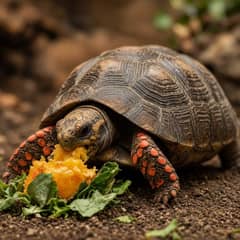
A diet built on iceberg lettuce or a poor-quality commercial food leaves a tortoise short of vitamin A, and the shortage changes the skin and the glands that make mucus. The signs are easy to blame on something else: poor appetite, lethargy, swollen eyelids, often with a pus-like discharge, a swelling at the ear from an abscess, respiratory infection, and kidney failure late on. A vet treats it with vitamin A by mouth or injection, and the diet gets fixed at the same time. Dark leafy greens, weeds, and orange vegetables carry the carotenoids a tortoise turns into vitamin A, which is why a weed-based diet prevents it.
Abscesses
A tortoise abscess is a hard, tumor-like lump rather than a soft pocket, because the pus inside is thick and dry, close to cottage cheese. The classic sites are the ear, which shows as a large swelling on the side of the head just behind the eye, and the mouth, including the roof of it. Many trace back to vitamin A deficiency. They do not drain or resolve on their own: a vet opens and cleans them out, flushes the site, cultures the bacteria, and follows with antibiotics.
Beak Overgrowth
A tortoise's beak grows continuously and wears down on tough food. An overgrown one can come from metabolic bone disease, a misaligned jaw, a diet of soft foods, or an old injury, so a beak that keeps overgrowing is a symptom to investigate rather than a grooming job. Since soft food is one of the causes, the coarse weeds and hay of a proper diet are the prevention. Trimming is a job for a vet: the beak has its own blood and nerve supply, and a bad trim causes severe pain, bleeding and lasting disfigurement.
Parasites
Roundworms and protozoa are fairly common, particularly in wild-caught animals. A fecal test is worth doing for any newly acquired tortoise, whether or not symptoms are present.
Hexamita parva (Kidney and Urinary Tract Infection)
Hexamita parva is a flagellate protozoan, not a worm, and it targets the kidneys and urinary tract rather than the gut. Russian tortoises and other Testudo species are notably affected. A 2018 study of pet tortoises in Germany found the organism invading the renal tubules, and described chronic hexamitosis in chelonians as capable of causing severe tubular-interstitial nephritis, tubular necrosis, and gout, with infections occasionally proving fatal.
Watch for abnormally watery, jelly-like urine alongside soft droppings, both signs the kidneys are already under strain. As the infection progresses it causes real kidney damage, and by the time a tortoise looks visibly unwell the disease is often well established. Diagnosis is by examining a fresh sample of urine or feces under a microscope, since the parasite is motile and easiest to spot before it dies off in an older sample. The reptile stool and urates guide shows what normal and abnormal urates look like side by side.
The parasite spreads when a tortoise ingests cysts shed by another infected animal, so it moves easily through a shared enclosure or water dish. An affected tortoise needs to be isolated from other tortoises immediately, and the same German study recommends a fecal screen for any tortoise before it joins a new group or enclosure. Our chelonian herpesvirus and quarantine guide covers the isolation basics for any new or sick arrival.
Metronidazole is the drug typically used against Hexamita. A reptile veterinarian should set the exact dose and course for your tortoise rather than treating at home from a general figure, since dosing accounts for the individual animal's weight, kidney function, and how advanced the infection is.
Watery or jelly-like urine in a Russian tortoise is worth a vet visit on its own. Isolate the tortoise from any others while you wait for results.
Bladder Stones (Urolithiasis)
Bladder stones, also called uroliths, are common in tortoises and are made almost entirely of urate salts, the same waste compound a tortoise's kidneys are meant to flush out. A 2021 survey of 101 tortoises treated at three Japanese veterinary hospitals found Russian tortoises accounted for 8.9% of urolithiasis cases, behind only African spurred and Indian star tortoises, and every analyzed stone was pure ammonium acid urate.
Chronic dehydration is the mechanism most often pointed to. Reptile kidneys cannot concentrate urine the way mammal kidneys do, so when a tortoise is not drinking enough, is kept too hot, or has no reliable water source, more water gets pulled back out of the bladder and colon to compensate. That further concentrates and supersaturates the urate already sitting in the bladder, encouraging it to crystallize into a stone. Worth noting, the same Japanese survey could not confirm a link between diet and stone formation in its own cases, several tortoises with appropriate diets still developed calculi, so dehydration and individual physiology likely matter more than food alone. Our reptile stool and urates guide walks through how to tell if a tortoise is staying properly hydrated.
Straining and reduced appetite were the most common signs in that survey, present in roughly half and just under half of cases respectively, but some tortoises showed no outward symptoms at all until the stone was already sizable. Diagnosis is typically by X-ray. Treatment is surgical removal, and the survey found a vent approach, going in through the cloaca rather than cutting into the plastron, succeeded in the large majority of surgical cases and was less invasive than opening the shell.
Choosing a Tortoise and the First Vet Visit
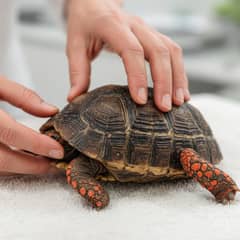
A healthy tortoise is active and alert, feels heavy for its size, and pulls its head and legs into the shell when it is picked up. Pass on one with sunken or closed eyes, any discharge from the nose or eyes, or a listless, inactive manner, and check that the shell is smooth, with no cracks, pitting, missing scutes or soft infected patches. A reptile vet examines a new tortoise within a week of it coming home, with a fecal test for gut parasites, and then at least once a year, with a fecal test at every visit. That first visit does not end quarantine: a new tortoise stays apart from any other chelonian for at least six months, because a herpesvirus carrier can look healthy for months before it sickens a group.
The Husbandry Pattern Worth Remembering
Weak UVB and calcium cause MBD. Cold, damp, or drafty conditions cause respiratory infection, the more urgent condition on this list. Temperature, humidity and diet through the growing years decide whether pyramiding happens. And an unscreened new tortoise brings parasite risk into your collection.
Sources & Further Reading
Last reviewed 5 Sep 2026 · 6 sources
- VCA Animal Hospitals: the Common Diseases of Tortoises and Owning a Tortoise articles
- Merck Veterinary Manual: Parasitic Diseases of Reptiles
- Hallinger et al., "Occurrence of health-compromising protozoan and helminth infections in tortoises kept as pet animals in Germany," Parasites & Vectors, 2018
- Hatt, "Selected Endoparasites in Reptiles," WSAVA World Congress Proceedings, 2010 (VIN)
- Takami et al., "Survey of tortoises with urolithiasis in Japan," Journal of Veterinary Medical Science, 2021
- Margaret A. Wissman, DVM, "Trimming Tortoise Beaks," Reptiles Magazine

A sick Russian tortoise is no time to be scrolling. The Russian Tortoise Care Package puts these red flags, a symptom quick reference and an emergency card on paper, in a 51-page PDF, $8.99.
Frequently Asked Questions
What causes metabolic bone disease in Russian tortoises?
Inadequate UVB or insufficient dietary calcium. A soft or deformed shell and weak limbs are the signs. Always see a vet. Consistent UVB and a calcium source such as cuttlebone are essential from the start, not optional.
Is a respiratory infection an emergency in a Russian tortoise?
Yes. It's caused by temperatures running chronically low, excess humidity, or drafts, and it does not resolve on its own, it needs antibiotics. Always see a vet immediately, and raise temperature and ensure hydration while arranging care.
What is shell rot and how serious is it?
Soft, discolored, or foul-smelling patches on the shell. Bacteria or fungi typically get in through a cut or scrape, and an overly damp enclosure often makes it worse. Untreated it can progress to septicemia, which is life-threatening, so see a vet.
What causes pyramiding in Russian tortoises?
The condition is not completely understood, but it occurs commonly in young tortoises when environmental temperature and humidity are not optimal, or when calcium, phosphorus or protein intake is imbalanced. Correct humidity, temperature and a properly paced diet through the growing years are the practical defense, and it is not reversible once it has happened.
Do Russian tortoises get parasites?
Roundworms and protozoa, fairly common in wild-caught animals especially. Run a fecal test on any newly acquired tortoise, symptoms or not.
More on the Russian Tortoise
Russian Tortoise care guide
🐢 How Much Does a Russian Tortoise Really Cost?
🐢 How to Handle a Russian Tortoise
🐢 Russian Tortoise Enclosure Setup: Compact Housing With Real Requirements
🐢 Russian Tortoise Feeding: Fiber, Calcium, and Growing Slowly
🐢 Russian Tortoise Enrichment: Digging, Grazing, and Exploration
Recommended Gear
As an Amazon Associate I earn from qualifying purchases through the links above, at no extra cost to you.

Written by Michael Ryan
Mike keeps two rescued bearded dragons, Dex and Cera, and writes the care guides on BeastlyFacts from his own research and mistakes. He is not a veterinarian.
More about Michael Ryan →