How to Handle a Sulcata Tortoise (While You Still Can)
On This Page▾

Sulcata tortoises are personable and curious, many hand-feed readily and clearly recognize their keeper over time. There's an honest caveat worth stating upfront though: real handling, picking the animal up, is only practical while it's still a juvenile.
The Size Problem
An adult sulcata weighs 80 to 110 pounds, and males can reach 200. That's well beyond what most people can comfortably or safely lift. Interacting with an adult sulcata means spending time in its space, hand-feeding, and letting it approach and investigate you, not picking it up the way you might a smaller tortoise.
Handling a Juvenile Correctly
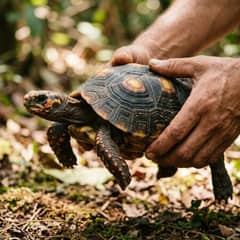
Keep hatchlings and young juveniles low to the ground when you do pick them up. Sulcatas push off powerfully with their strong legs, and a fall, even a short one, risks cracking the shell. Never flip a tortoise onto its back.
A hatchling sulcata is small enough to hold in one hand, but an adult can weigh 80 to 110 pounds, males occasionally reach 200, and typically lives 50 to 70 years, with 70 or more achievable with good care. Almost nothing else sold as a pocket-sized pet grows into something so large, or outlives its owner so routinely.
Moving an Adult
An adult still has to be moved sometimes: to a vet, into a winter shelter, off a yard that flooded. Adults can pass two feet of shell and 100 pounds, and a fall can be fatal, so a move is planned, not improvised.
Short distances, let it walk. A tortoise that follows food will cover a yard on its own. Walk it with a lure of greens along the route you want, and block the gaps it could veer through.
Lifting takes two people. One person on each side, hands flat under the plastron at the front and back bridges, lifting together and keeping the tortoise level. Never lift by the rim of the shell on one side, never by a leg, and never higher than you need to. Set it down feet first onto something solid before letting go.
Longer moves, roll it. Slide the tortoise onto a sturdy board or a furniture dolly, or tip a heavy-duty yard cart on its side, ease the tortoise in, and tip the cart back up. A 100-pound tortoise that rides is far safer than one that is carried.
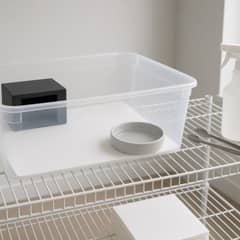
In the car, use a sturdy crate or tub lined with a towel from its enclosure, braced on the floor so it cannot slide. A sulcata should never sit below 70°F for long, so warm the car first in cold weather, and never leave it in a parked car in the heat. The reptile transport rules for trips longer than half an hour, hand warmers included, apply as written. Call ahead so the clinic knows the patient does not fit on an exam table.
First-Timer Mistakes
- Underestimating adult size when choosing an enclosure or planning long-term space. This is the single biggest reason sulcatas end up surrendered to rescues.
- Housing two mature males together. They're territorial, and adult males will fight, causing real shell injuries and chronic stress.
- Treating a young tortoise's manageable size as representative of what's coming. Growth in the first 5 to 10 years is rapid.
Behavior Worth Knowing About
Sulcatas are strong, dedicated burrowers, expect extensive digging and tunneling wherever they're housed. They also ram and bulldoze objects, and sometimes each other, as a dominance display, this is normal behavior, not aggression toward you specifically.
Telling Males From Females
Sexing a sulcata by eye isn't reliable until it's several years old and around 10 to 15 inches in shell length, younger juveniles show no dependable external differences. At that size, check the plastron, the bottom shell: concave on males, flat on females. The tail is the other reliable marker, longer with a spur at the tip on males, short and blunt on females. Compare more than one trait rather than relying on just one, individual features can be misleading on their own.
How This Compares to Smaller Tortoises
A Russian or Hermann's tortoise can live comfortably in a large indoor tortoise table for its entire life. A sulcata is a genuinely different category of commitment: roughly 7 by 3.5 feet indoors while it is still under 10 inches, 8 by 8 as the absolute indoor floor for an adult that should not be indoors at all, and several hundred square feet outdoors. If you're drawn to a pet you can pick up and interact with hands-on for its whole life, rather than just its first few years, a hedgehog is a much closer match, and the hedgehog handling guide shows what that looks like. If you're drawn to tortoises specifically but not prepared for this scale, a smaller species is worth strong consideration instead.
Sources & Further Reading
Last reviewed 24 Sep 2026 · 5 sources
Frequently Asked Questions
Can you pick up an adult sulcata tortoise?
Not safely. An adult runs 80 to 110 pounds, and a male can reach 200. Interaction with a grown sulcata happens at ground level: time in its space, hand-feeding, and letting it come to you.
How do you safely pick up a juvenile sulcata tortoise?
Low to the ground, always. A sulcata pushes off hard with its legs, and even a short fall can crack the shell. Never flip one onto its back.
What's the biggest mistake new sulcata owners make?
Underestimating the adult when choosing an enclosure or planning space. It's the single biggest reason sulcatas end up in rescues. Growth over the first 5 to 10 years is rapid, so the manageable size in front of you says nothing about what's coming.
Can you house two sulcata tortoises together?
Not two mature males. They're territorial, and adult males fight hard enough to cause real shell injuries and chronic stress.
Is digging and ramming normal sulcata behavior?
Yes, both. Sulcatas are dedicated burrowers, so expect digging and tunneling wherever they live. Ramming and bulldozing is a dominance display, not aggression aimed at you.
How can you tell if a sulcata tortoise is male or female?
Not reliably until it's several years old, in the 10 to 15 inch shell-length range, hatchlings and young juveniles can't be sexed by eye. At that size, males have a concave plastron and a longer tail with a spur at the tip, while females have a flat plastron and a short, blunt tail.
More on the Sulcata Tortoise
Sulcata Tortoise care guide
🐢 How Much Does a Sulcata Tortoise Really Cost?
🐢 Common Sulcata Tortoise Health Issues and What Causes Them
🐢 Sulcata Tortoise Enclosure Setup: Indoor Is Temporary, Outdoor Is the Goal
🐢 Sulcata Tortoise Feeding: Schedule, Diet, and Why They Stop Eating
🐢 Sulcata Tortoise Enrichment: A Hundred Pound Grazer in a Back Garden

Written by Michael Ryan
Mike keeps two rescued bearded dragons, Dex and Cera, and writes the care guides on BeastlyFacts from his own research and mistakes. He is not a veterinarian.
More about Michael Ryan →