Sulcata Tortoise Enclosure Setup: Indoor Is Temporary, Outdoor Is the Goal
On This Page▾

Sulcata housing needs change dramatically as the animal grows, and the single most important thing to understand upfront is that indoor housing is a phase, not a permanent solution. Planning for that transition from day one makes everything else easier.
Enclosure Size
A juvenile under 10 inches needs roughly 7 feet by 3.5 feet by 2.5 feet of indoor space, a tortoise table built to that scale works well at this stage. That sounds like a lot for a small tortoise, and it is, this species grows into its space fast. An adult housed indoors long-term would need an absolute minimum around 8 feet by 8 feet, and realistically, indoor-only housing simply doesn't work well for a full-grown sulcata. Outdoor space should provide at least 80 to 100 square feet per tortoise, ideally several hundred.
A guppy, by contrast, thrives for its entire life in a properly cycled 10-gallon tank, the far more modest ceiling the guppy tank setup guide works within. Almost nothing else in the pet trade scales its space requirement the way a sulcata does.
Temperature
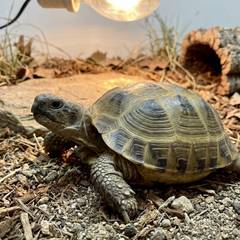
Basking area 95 to 105°F, ambient 80 to 90°F, cool side 75 to 85°F, never sustained below 70°F. Outdoor shelters need lightless heat, a ceramic heat emitter or radiant panel, if nighttime temperatures drop below 50°F, set to maintain 70 to 75°F. In regions with genuinely cold winters, winter housing moves indoors entirely for the season. There is no brumation option here: the Royal Veterinary College names the African spurred tortoise among the species that should never be hibernated, because it comes from a climate with no cold season at all, and cold dormancy strips away the heat it depends on to digest and fight infection.
Humidity
This is where indoor and outdoor housing diverge, and where age matters too. Adults do best in a dry, well-ventilated environment. Hatchlings and juveniles are a different story, they need humid hides, roughly 70% humidity, to support proper shell growth and reduce pyramiding risk. Wild sulcatas achieve this naturally by using humid burrow microclimates even in an otherwise arid habitat.
Wild sulcata tortoises live in some of the hottest, driest habitat around, yet hatchlings and juveniles depend on humid underground burrows to grow a healthy shell. The dry, desert-dweller image most people picture is only half the story.
Substrate
A diggable mix works best: organic topsoil and play sand at roughly 60/40, coconut fiber, or cypress mulch. Depth matters, 6 inches for juveniles, up to 24 inches for adults who genuinely dig and burrow, expect digging to be a daily fact of life. Keep it dry rather than wet, dampness is a direct path to shell rot. Quarantine any new tortoise before introducing it to an established, naturalistic substrate setup.
Lighting
Essential for any indoor housing: a T5 HO UVB bulb in the 10 to 12% range, or a mercury vapor bulb, run on a 10 to 14 hour photoperiod, paired with a basking bulb to hit that 95 to 105°F basking target. Replace the tube every 12 months even while it still lights, because UV output fades well before the visible light does. Outdoors, natural sunlight provides free, genuinely superior UVB, one more reason outdoor access matters as soon as climate and size allow it.
The tube specifics for a sulcata: a T5 HO Arcadia Desert 12% or Zoo Med ReptiSun 10.0 in a reflective fixture, roughly half the length of the enclosure, mounted on the warm side beside the heat lamps. Hang it 9 to 12 inches above the tortoise's back if the light passes through mesh, or 14 to 16 inches with nothing in between; mesh blocks part of the UVB, so mounting inside the enclosure is better even with a screen top. The target is a UV index of 4.0 to 6.0 at the basking spot. Those distances are a starting point: a UV meter such as the Solarmeter 6.5 is the only way to confirm the reading, and it shows the day the tube needs replacing.
The Defining Requirement: Outdoor Space, on a Timeline
Sulcatas grow rapidly for their first 5 to 10 years, which means outdoor housing isn't a someday consideration, it becomes necessary within just a few years of bringing home a hatchling. Escape-proof fencing buried at least 12 inches deep is non-negotiable, sulcatas are dedicated diggers. An opaque barrier 6 to 12 inches high around the enclosure perimeter helps stop pacing behavior along fence lines. If you can't provide meaningful outdoor space within that timeframe, this is genuinely the wrong species, not just a harder version of the right one. The hedgehog enclosure setup guide shows what a dramatically smaller footprint pet's enclosure looks like by comparison.
Sources & Further Reading
Last reviewed 24 Sep 2026 · 1 source
- ReptiFiles: Sulcata Tortoise Care Sheet
- Zoo Med: Sulcata Tortoise
Frequently Asked Questions
How big of an enclosure does a sulcata tortoise need?
A juvenile under 10 inches wants about 7 feet by 3.5 by 2.5 indoors. An adult kept inside would need 8 by 8 feet at an absolute minimum, and in practice indoor-only housing doesn't work for a full-grown sulcata. Outdoors, budget 80 to 100 square feet per tortoise, ideally several hundred.
What temperature does a sulcata tortoise enclosure need?
Basking 95 to 105°F, ambient 80 to 90°F, cool side 75 to 85°F, never sustained under 70°F. An outdoor shelter needs lightless heat once nights fall below 50°F, held at 70 to 75°F. Where winters are cold, the tortoise winters indoors: a Sahel species has no cold-season adaptation, so dormancy is not an option here the way it is for a Testudo.
Does humidity matter for a sulcata tortoise?
Yes, and it depends on age. Adults do best in a dry, well-ventilated environment. Hatchlings and juveniles need humid hides, roughly 70% humidity, to support proper shell growth and reduce pyramiding risk, the same way wild sulcatas use humid burrow microclimates even in an otherwise arid habitat.
What substrate works best for a sulcata tortoise?
A diggable mix: organic topsoil and play sand at about 60/40, coconut fiber, or cypress mulch. Depth counts, 6 inches for juveniles and up to 24 for adults, which dig and burrow in earnest. Keep it dry, since damp substrate leads straight to shell rot.
When does a sulcata tortoise need to move outdoors?
Sooner than most new owners expect. Sulcatas grow fast through their first 5 to 10 years, so outdoor housing arrives within a few years of a hatchling coming home, not someday. Without meaningful outdoor space in that window, this is the wrong species rather than a harder version of the right one.
More on the Sulcata Tortoise
Sulcata Tortoise care guide
🐢 How Much Does a Sulcata Tortoise Really Cost?
🐢 How to Handle a Sulcata Tortoise (While You Still Can)
🐢 Common Sulcata Tortoise Health Issues and What Causes Them
🐢 Sulcata Tortoise Feeding: Schedule, Diet, and Why They Stop Eating
🐢 Sulcata Tortoise Enrichment: A Hundred Pound Grazer in a Back Garden
Recommended Gear
As an Amazon Associate I earn from qualifying purchases through the links above, at no extra cost to you.
Written by Michael Ryan
Mike keeps two rescued bearded dragons, Dex and Cera, and writes the care guides on BeastlyFacts from his own research and mistakes. He is not a veterinarian.
More about Michael Ryan →