Rehousing an Invertebrate: Method, Timing, and Urticating Hair First Aid
On This Page▾

Rehousing is the single most dangerous ten minutes in most invertebrate keepers' routines, not because it happens often, but because a tarantula's entire body plan has almost no margin for the kind of mistake a dog or a lizard would shrug off. It is also, oddly, two separate jobs rather than one. The first job is getting everything ready before the lid ever comes off. The second is the physical transfer itself, the catch cup, the card, and the few seconds where the animal is neither fully in the old enclosure nor the new one. Treating those as one rushed step is where most rehousing injuries, to the animal and to the keeper, actually happen. This guide covers both jobs, the real species differences underneath them, and the first aid for the one hazard that catches new keepers off guard: a New World tarantula flicking urticating hairs at exactly the moment it's being rehoused.
Preparation Is Its Own Job
Do all of this before you touch the animal, not while you're holding a catch cup in one hand:
- Set up and run the new enclosure first. Substrate in, decor placed, water dish filled, and for anything that needs it, humidity and temperature already stable, ideally for a few hours before the move. An animal going into a still-settling enclosure is stressed on top of an already stressful transfer.
- Close every escape route in the room, not just the enclosure. Shut the door, check for gaps under furniture, and clear anything the animal could wedge into if it gets loose mid-transfer, floor vents, open drawers, shoe piles.
- Clear the floor and the surface you're working on. No cords, no stacked books, nothing between the old enclosure and the new one that a dropped cup could catch on.
- Get pets and children out of the room. A curious cat or a kid leaning in for a closer look is a second, unpredictable variable you don't want during a transfer that already has one.
- Stage everything within reach before the lid comes off, the new enclosure open and ready, the catch cup, the card, a spare cup in case the first attempt goes wrong, and a lined tub underneath the whole operation. Once you're mid-transfer, walking away to find a dropped tool is exactly when things go wrong.
Species that climb, arboreal tarantulas especially, add one more prep step: decide in advance whether you're catching the animal in the open or working with a smaller travel container it's already retreated into, since chasing an arboreal species around open decor after the lid is off rarely ends cleanly.
The Catch Cup and Card Method
Once everything is staged, the actual transfer is simple, deliberate, and slow:
- Lower a clear, smooth-sided cup over the animal from above, giving it room to stand normally underneath rather than crowding it.
- Slide a stiff piece of card, or thin rigid plastic, along the surface underneath the cup until it fully seals the opening.
- Lift the cup and card together as one sealed unit, keeping the card pressed flat the whole time.
- Carry the sealed cup low and level to the new enclosure, set it down inside, slide the card back, and lift the cup away, letting the animal walk out on its own rather than being tipped or shaken out.
The animal is never gripped, scooped by hand, or picked up directly at any point in this sequence. The cup and card do all the containing, and your hands never need to be closer to the animal than the outside of a clear plastic cup.
Work Inside a Larger Tub, and Stay Low
Run the whole transfer over a large, smooth-sided tub, or in a bathtub for bigger species, rather than on an open tabletop. If the card slips or the seal breaks for a second, the animal lands inside a contained space instead of on the floor or off the edge of a table. A tub also gives you a defined boundary to work within if the animal does bolt, instead of an entire room.
Stay low while you do this, cup and hands close to the tub floor rather than transferring at chest or shoulder height. This is not a minor technique preference. A fall from a height that would mean nothing to almost any other pet can rupture a tarantula's abdomen, which is frequently fatal, and there is no real margin for error in how far that fall can be. Working a few inches above a lined tub instead of a few feet above an open floor is the single biggest thing you control here.
What to Actually Do When It Bolts
An animal bolting mid-transfer is startling, but the response is almost entirely about what not to do:
- Don't grab it. A reflexive grab is how a keeper ends up with a fall, a bite, or a faceful of urticating hairs, all three of which are worse outcomes than a loose animal inside a contained tub.
- Stay still and let it run. Most bolting invertebrates head for the nearest cover or corner and stop once they feel enclosed again.
- Keep it inside the tub boundary you already set up. This is the entire reason the tub exists, so a bolt has a floor, not a fall.
- Re-approach slowly once it settles, cup first, no sudden movement, and try the catch again.
- If it does get out of the tub, dim the lights, close the door, and give it a few minutes to settle somewhere before trying again, rather than chasing it around the room.
A fast-bolting species, particularly the quicker Old World tarantulas, makes all of this more likely on any given attempt, which is exactly why those species are usually rehoused with less open-air handling in the first place, covered below.
Never During a Molt
Never rehouse an animal that is in premolt, mid-molt, or freshly molted. A tarantula's premolt signs, a dulled abdomen, reduced appetite, and a bald patch on the abdomen from kicked-off urticating hairs, mean it should be left alone until the molt is complete. A freshly molted tarantula has a soft exoskeleton and soft fangs for days to weeks afterward, and disturbing, handling, or moving it in that window risks real physical damage the animal can't defend against. Our invertebrate molting guide covers what normal premolt and post-molt behavior looks like across species in more depth, and is worth checking before any rehousing decision if the animal has looked at all off lately.
Species Differences
A docile terrestrial tarantula, an arboreal tarantula, a fast Old World species, a scorpion, a mantis, and a millipede are not the same rehousing job, even though the catch-cup principle underlies most of them:
| Type | Typical approach | Main risk during the transfer |
|---|---|---|
| Docile terrestrial tarantula (e.g. Chilean rose hair) | Standard catch cup and card, low over a lined tub | Fall risk to the abdomen; New World species may flick urticating hairs |
| Arboreal tarantula | Cup positioned at the animal's level on vertical decor, or pre-staged in a travel container before the enclosure change | Faster to bolt upward and drop from height than a terrestrial species |
| Fast Old World tarantula (e.g. Poecilotheria, baboon spiders) | Minimal open-air handling; often moved already sealed in a smaller container | No urticating hairs, but a quicker, more defensive bite |
| Scorpion | Long tongs or a sealed transfer container, never bare hands, kept low over a soft surface | Venomous sting, and a fall that can injure it |
| Mantis | Gentle cup-and-lid transfer; mantises will often climb onto an offered surface | Fragile legs and wings can be crushed by a closing lid or a rough grip |
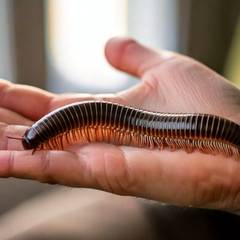
| Millipede | Slow enough to nudge into a cup with a soft brush | Defensive chemical secretion on skin or eyes if squeezed or handled roughly, not hairs |
Tarantulas and scorpions are both arachnids, which is why the fall-risk and low-and-slow principles carry over between them, but a scorpion's sting means the actual point of caution shifts from gravity to venom. A mantis is an insect, built around fragile flight and grasping structures rather than a vulnerable abdomen, so the caution there is about crushing, not falling. A millipede is a myriapod, not an arachnid or insect at all, and its defense is a secreted chemical rather than anything projectile, which is why its first aid, covered below, looks nothing like a tarantula's.
A millipede's defensive secretion and a tarantula's urticating hairs solve the same problem, deterring a threat without a bite or sting, through two completely different mechanisms: one is a barbed physical projectile, the other a caustic chemical release. Treating them the same way in a first-aid moment would mean doing the wrong thing for one of them.
Urticating Hairs: Which Tarantulas, and How They're Flicked
Urticating hairs are a New World tarantula trait specifically, found in species native to the Americas, including the Chilean rose hair. Old World species like Poecilotheria and the various baboon spiders never developed them and lean on a fast, more assertive bite instead, a distinction our tarantula handling guide covers from the handling-risk side. When a New World tarantula feels threatened, rather than bitten, mid-rehousing is a common trigger, it uses its hind legs to kick barbed hairs off its abdomen toward the perceived threat, which is exactly the moment a keeper's face is often closest to the enclosure.
Those hairs are barbed at a microscopic level. A 2012 case report in the New Zealand Medical Journal, "Tarantula hair keratitis" by Simran Singh Mangat and Bill Newman, examined a 12-year-old boy whose tarantula sprayed hairs into his eye while he scooped it up without gloves or eye protection. The authors describe tarantula urticating hairs as having a barbed appearance under electron microscopy, a feature that lets them migrate through ocular tissue rather than staying put, penetrating the corneal epithelium into the stroma and, in some cases, further through Descemet's membrane into the eye's anterior chamber. That migration is what makes tarantula hair eye exposure a genuinely documented condition, ophthalmia nodosa, a granulomatous reaction to embedded hairs that can produce chronic inflammation if the hairs aren't found and removed early. Our tarantula handling guide flags this risk; this section is about what to actually do if it happens.
First Aid: Skin, Eyes, and Airway
None of this replaces a doctor. It's what to do in the minutes right after an exposure, before you get to one.
Skin. A clinical NIH resource on tarantula spider toxicity describes removing embedded hairs with tape, pressed onto the affected skin and lifted away, noting that this has been reported to reduce itching and that multiple applications are often needed to get most of the hairs out. The National Capital Poison Center's guidance on tarantula hair exposure independently describes the same tape-based removal for skin contact. Neither source describes washing or rinsing the skin as a removal step, which lines up with what the hairs actually are, small barbed splinters rather than a residue, so tape is the documented first move, not water. If irritation continues beyond that first tape pass, or spreads, that part is a question for a doctor, not this page.
Eyes. Stop touching it. The same NIH resource notes that an eye shield can help prevent a person from reflexively rubbing the affected eye, since rubbing can drive embedded hairs deeper and worsen the damage, and that ophthalmology consultation should follow because early removal of the hairs reduces the odds of the longer-term complications described above. There isn't a documented rinse step for embedded tarantula hair the way there is for some other eye exposures, so the actual first aid here is short: don't rub it, cover it if you can without pressing on the eye, and get to an ophthalmologist or an emergency department the same day rather than waiting to see if it settles on its own.
Airway. If hairs are inhaled during a rehousing session, and this is part of why the preparation step matters, working in a poorly ventilated space with your face close to an agitated New World tarantula raises the odds of it, the same NIH resource notes that respiratory symptoms from urticating hair exposure can progress to the point of needing airway management in more severe cases. Any wheezing, throat tightness, or real difficulty breathing after a suspected exposure is a same-day emergency room visit, not a wait-and-see situation. Working with the room ventilated and, for a keeper handling New World species regularly, a simple dust mask during rehousing sessions is a reasonable precaution given that respiratory involvement is a documented possibility, not just a skin and eye issue.
A different hazard applies to millipedes, which don't have urticating hairs at all. A separate NIH clinical resource on millipede toxin exposure describes their defensive secretion as capable of causing burning, itching, blistering, and hyperpigmentation on skin, and on the eyes specifically, keratoconjunctivitis, excess tearing, chemosis, and corneal blistering, rarely progressing to vision loss. Unlike a tarantula's hairs, this is a chemical exposure, and the same source describes the first response as thorough washing of the affected skin with soap and water, and for the eyes, irrigation with saline or water followed by an eye exam. That's the opposite instinct from tarantula hairs, wash a millipede secretion off, don't try to tape it, which is exactly why lumping every invertebrate defense into one first-aid routine is a mistake.
Preparation and the physical transfer are two separate jobs: set the new enclosure up and clear the room before the lid comes off, then use the catch cup and card low over a tub and let a bolting animal settle rather than grabbing it. Never rehouse anything in premolt, mid-molt, or freshly molted. If a New World tarantula flicks hairs during the process, tape for skin, no rubbing and same-day ophthalmology for eyes, and an ER visit for any real breathing trouble. Millipede secretion is a different, chemical hazard, and it gets washed off, not taped.
The Honest Takeaway
Rehousing goes wrong for predictable reasons: rushing the prep, working too high above an open surface, grabbing at an animal that bolts, or moving something that should have been left alone until it finished molting. Slow the whole process down, keep it low and contained, and know before you start what a New World tarantula's defense actually is and what to do about it if it happens. The tarantula enclosure setup guide has the enclosure specifics once the animal is settled in, and the emperor scorpion handling guide covers the sting-first caution this guide only summarizes.
Sources & Further Reading
Last reviewed 14 Sep 2026 · 4 sources
- NIH/NCBI Bookshelf, StatPearls: Tarantula Spider Toxicity (Kong & Hart)
- New Zealand Medical Journal: Tarantula Hair Keratitis (Mangat & Newman, 2012, Vol 125 No 1364)
- National Capital Poison Center: Tarantula and Scorpion Bite/Sting Treatment
- NIH/NCBI Bookshelf, StatPearls: Millipede Toxin Exposure (Lofgran, Marietta & Warrington)
Frequently Asked Questions
What is the catch cup and card method for rehousing a tarantula?
You lower a clear, smooth-sided cup over the animal, then slide a stiff piece of card or thin plastic underneath to seal it in, lifting cup and card together as one unit. The animal is never gripped or picked up by hand, and the whole transfer happens low over a lined tub in case the seal slips.
Can you rehouse a tarantula during a molt?
No. A tarantula in premolt, mid-molt, or freshly molted has a soft, still-hardening exoskeleton and soft fangs, and disturbing it during this window is one of the few genuinely absolute rules in invertebrate keeping. Wait until the new exoskeleton has visibly darkened and the animal is moving and gripping normally again.
What should you do if a tarantula or scorpion bolts during rehousing?
Mostly, nothing sudden. Stay still, let it run to a corner or under cover inside the tub you're already working in, and re-approach slowly with the cup once it settles. Grabbing at a bolting animal is how falls happen, and a fall is what actually injures a tarantula, not the bolt itself.
Which tarantulas have urticating hairs, and how are they used?
Urticating hairs are a New World tarantula trait specifically. Species from the Americas, including the commonly kept Chilean rose hair, can kick barbed hairs off the abdomen with their hind legs and flick them at a perceived threat. Old World species, like Poecilotheria and baboon spiders, never developed this defense and rely on a fast bite instead.
What's the first aid for tarantula urticating hairs in the skin, eyes, or airway?
For skin, press tape onto the area and lift it away to pull the barbed hairs out, which clinical sources describe as reducing the itching; repeat applications are often needed. For the eyes, stop touching it, shield it if you can, and get to an ophthalmologist or emergency care the same day rather than waiting. Any wheezing, throat tightness, or real difficulty breathing after an exposure is an emergency room visit, not a wait-and-see.
Do scorpions, mantises, and millipedes rehouse the same way as tarantulas?
No. A scorpion is moved with long tongs or a sealed transfer container, partly for the sting and partly for the scorpion: a fall can seriously injure it, so work low over a soft surface. A mantis is cup-and-lid transferred gently because its legs and wings are fragile, not because it's fast to bolt. A millipede is slow enough to nudge with a soft brush, but it defends with a chemical secretion rather than hairs, so the handling risk and the first aid are both different.
🦂 How Much Does an Emperor Scorpion Really Cost?
🕷️ How Much Does a Jumping Spider Really Cost?
🦗 How Much Does a Praying Mantis Cost?
🦋 How Much Does a Stick Insect Really Cost? (And a Legal Note to Read First)
🕷️ How Much Does a Tarantula Really Cost?
🦂 Should You Handle an Emperor Scorpion? Rarely, and Carefully
🕷️ How to Handle a Jumping Spider (And Why Its Eyesight Matters)
🦗 Can You Hold a Praying Mantis? Gently, and Rarely
🦋 How to Handle a Stick Insect (And Why You Can Keep More Than One)
🕷️ Should You Handle a Tarantula? Almost Always, No
🦂 Common Emperor Scorpion Health Issues and What Causes Them
🕷️ Common Jumping Spider Health Issues
🦗 Common Praying Mantis Health Issues (Molting Is Where Nearly Everything Goes Wrong)
🦋 Common Stick Insect Health Issues (Molting Is the Biggest Risk)
🕷️ Common Tarantula Health Issues (Prevention Matters More Than Treatment)
🦂 Emperor Scorpion Enclosure Setup: Deep Substrate, High Humidity, No UVB
🕷️ Jumping Spider Enclosure Setup: Small, Simple, and All About Humidity
🦗 Praying Mantis Enclosure Setup: Height, Humidity, and a Mesh Lid

Written by Michael Ryan
Mike keeps two rescued bearded dragons, Dex and Cera, and writes the care guides on BeastlyFacts from his own research and mistakes. He is not a veterinarian.
More about Michael Ryan →