Common Praying Mantis Health Issues (Molting Is Where Nearly Everything Goes Wrong)
On This Page▾

Exotic vets rarely treat invertebrates, so this list leans almost entirely on prevention rather than treatment. Praying mantis health comes down almost entirely to two things: humidity and undisturbed molting. Get those right, and this is a genuinely low-maintenance pet for the short time you'll have it.
Mismolt (Failed Molt)
This is the single biggest cause of death in captive mantises, and it's largely preventable. During a molt, a mantis sheds its entire exoskeleton, and if anything goes wrong during that process, the outcome can range from a permanently twisted limb to death.
Watch for an incomplete shed, limbs that come out twisted or stuck, or a mantis that appears to be struggling and not progressing during what should be a molt.
Causes include humidity that's too low, dehydration, not enough vertical space for the mantis to hang freely while shedding, or physical disturbance, including handling, during the process. The enclosure setup guide puts numbers on that vertical space: three times the mantis's length in enclosure height, four times it in the drop below the perch. This is manageable primarily through prevention, correct humidity and adequate space to hang from. There's little you can do once a molt has failed.
How Many Molts to Adulthood
Each molt is a fresh chance for this to go wrong, and in the species that have been counted a mantis goes through six or seven of them. The Japanese giant mantis, Tenodera aridifolia, passes through seven nymphal instars before adulthood. Females often need one more molt than males: in the grass mantid, females molt seven times on average and males six. The last molt produces the winged adult, and it is final. A mantis does not molt again after adulthood, so a limb lost or bent at the last shed stays that way, while a nymph that loses a limb earlier can regrow it over its next couple of molts.
Hand-Feeding a Mantis After a Mismolt
Normal tong feeding is a delivery method: a live fly held in fine-tip forceps near a healthy mantis, which strikes, grips and eats it on its own. A mantis with bent raptorial arms cannot strike or hold prey, and one with damaged mouthparts cannot chew a whole insect. Hand-feeding does the catching and the first bite for it:
- Pre-kill the prey. A live insect struggling against a mantis that cannot grip it is a hazard.
- Remove the feeder's head and offer the soft, open end of the body to the mantis's mouthparts on a pair of fine-tip feeding tongs, holding it there while the mantis eats.
- Offer water, or diluted honey, on a cotton swab touched to the mouth, since a crippled mantis may not reach droplets on the mesh either.
A nymph may need this only until its next molt or two repairs the limb. An adult that mismolted on its final molt needs it for the rest of its life.
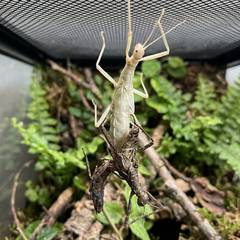
A mantis mid-molt hangs upside down from a branch while its old exoskeleton splits and it pulls itself free entirely, soft-bodied and temporarily defenseless. If it loses its grip during that narrow window, the fall alone can be enough to cause a permanent deformity or worse.
Dehydration
From insufficient misting. Contributes directly to mismolt risk, and is manageable simply by correcting your misting schedule and overall humidity with a reliable mist bottle.
Digestive Infection From Excess Humidity
The opposite mistake causes its own problem. Over-misting combined with poor ventilation invites mold and internal infection, which is often undetectable until it's already fatal. Prevention is a mesh, not solid, enclosure and a properly balanced humidity level, not simply misting as much as possible.
Fall Injuries During Molting
From inadequate hanging space or branches that don't provide secure enough grip. Results in deformity or death depending on severity, and prevention comes down entirely to the enclosure setup, specifically the height and climbing surfaces.
Appetite Changes Worth Understanding Correctly
A mantis that stops eating or occasionally regurgitates isn't always sick. Refusing food is often completely normal pre-molt behavior, not illness. Overfeeding, on the other hand, can itself cause regurgitation. If your mantis seems reluctant to eat, offering a different type of prey sometimes helps, and a small drop of honey can provide a quick energy boost if needed.
The Husbandry Pattern Worth Remembering
Humidity that's too low is the single biggest driver of the mismolt risk that accounts for most mantis deaths. Humidity that's too high, in the opposite direction, invites mold and internal infection instead. And handling or leaving live prey in during the pre-molt window directly risks injury during the animal's single most vulnerable moment. Nearly everything that goes wrong with a pet mantis traces back to getting that balance right. The same prevention-first logic runs the emperor scorpion's health list, where dehydration and molting complications sit at the top for the same underlying reasons.
The Praying Mantis encyclopedia profile has the full natural history.
Sources & Further Reading
Last reviewed 15 Sep 2026 · 5 sources
- Amateur Entomologists' Society: Praying Mantid caresheet
- Reptile Supply: How to Care for Your Chinese Mantis
- Carle, Yamawaki, Watanabe and Yokohari: Antennal Development in the Praying Mantis (Tenodera aridifolia), PLOS ONE
- UF/IFAS Featured Creatures: Grass-Like Mantid, Thesprotia graminis
- Bug Pets: Illness, Infection and Injury in Praying Mantis
Frequently Asked Questions
What's the biggest cause of death in captive praying mantises?
Mismolt, a failed molt, and it's largely preventable. The mantis sheds its whole exoskeleton in one go, and anything that interferes can leave it with a twisted limb, or kill it. The signs: an incomplete shed, limbs stuck or coming out twisted, or a mantis struggling and making no progress through what should be a molt.
What causes a mismolt?
Low humidity, dehydration, too little vertical space to hang freely while shedding, or disturbance, handling included, during the process. Correct humidity and enough space do far more than any attempt to rescue a molt already going wrong, since there's little to be done once it has failed.
Can a praying mantis get sick from too much humidity?
Yes. Too much misting with poor ventilation invites mold and internal infection, often undetectable until it's already fatal. A mesh lid rather than a solid one, plus a balanced humidity level, is the prevention, not misting as heavily as possible.
What causes fall injuries during molting?
Not enough hanging space, or branches the mantis can't grip securely. Depending on severity that means deformity or death, and prevention is all in the enclosure setup: its height, and the climbing surfaces the mantis has to work with.
Is it normal for a praying mantis to stop eating?
Often, yes. Going off food is often normal pre-molt behavior rather than illness, though overfeeding can cause regurgitation on its own. A different prey type sometimes tempts a reluctant mantis, and a small drop of honey can give a quick energy boost if needed.
More on the Praying Mantis
Praying Mantis care guide
🦗 How Much Does a Praying Mantis Cost?
🦗 Can You Hold a Praying Mantis? Gently, and Rarely
🦗 Praying Mantis Enclosure Setup: Height, Humidity, and a Mesh Lid
🦗 Praying Mantis Feeding: Live Prey a Third of Its Length, Every Other Day, and Nothing Left in the Cage
🕷️ 10 Surprising Praying Mantis Facts
Recommended Gear
As an Amazon Associate I earn from qualifying purchases through the links above, at no extra cost to you.

Written by Michael Ryan
Mike keeps two rescued bearded dragons, Dex and Cera, and writes the care guides on BeastlyFacts from his own research and mistakes. He is not a veterinarian.
More about Michael Ryan →