Emperor Scorpion Enclosure Setup: Deep Substrate, High Humidity, No UVB
On This Page▾

Emperor scorpion husbandry is simple once you internalize two priorities: substrate depth for burrowing, and humidity that stays consistently high.
Size
A 10-gallon tank, roughly 20x10x12 inches, is the commonly accepted minimum for one adult. For groups or extra enrichment, step up to 20 to 30 gallons or more, providing more horizontal floor space and, critically, more hides than the number of animals if you're cohabitating. A secure, tight-fitting lid is essential, these are capable climbers and genuine escape artists. Cohabitation is possible but not always successful, and what makes a group work is hide count rather than floor space. It is unusual among predatory arthropods: nearly every other one kept this way will eventually kill its cage mates, and this is one of the few that often does not. Monitor closely for aggression and make sure resources, hides, food, space, are genuinely sufficient for the group. A scorpion joining an existing group spends time in its own enclosure first, with its own tools, until it has fed, drunk and settled, the invertebrate quarantine window that lets mites and slower problems show before they reach the others.
Temperature
An ambient range of 75 to 85°F is the target, with 70 to 90°F as the outer limits as long as a gradient exists. Many keepers use a side-mounted heat mat on a thermostat to create a mild warm side, around 85 to 90°F at its warmest point, while leaving a cooler area available. Avoid high heat, these are tropical forest animals that prefer moderate, stable warmth and have no use for the intense basking many desert reptiles need.
Humidity: The Priority That Matters Most
Target 70 to 90%, and 75 to 80% is the practical sweet spot. That range reflects where the animal comes from: hot, humid forest in western Africa, not the dry country most people associate with scorpions. Achieve this by keeping the substrate damp, not soggy, and misting as needed, often daily or every other day depending on your enclosure's ventilation and your local climate. Monitor with a digital hygrometer instead of by guesswork. Condensation on the walls or visible mold means it's too wet, dry, cracked substrate means it's too dry. Sphagnum moss placed in the enclosure can help retain moisture between mistings.
Substrate: Deep Enough to Burrow In
This is the other non-negotiable. Provide a minimum of 5 to 6 inches of substrate, and deeper is better, since this species uses that depth for burrowing. Coco fiber, peat, soil-based mixes, vermiculite blends, or commercial products all work well. Keep it damp but well-aerated, and refresh it periodically to prevent mold and mite buildup. Avoid pure sand or anything dry and dusty.
Lighting
No UVB is required. Emperor scorpions are nocturnal and don't rely on UV exposure for vitamin D synthesis the way many reptiles do. A normal 12-hour light, 12-hour dark photoperiod works well, using ambient room light or a low-output LED if you want visibility for viewing or to support live plants in a bioactive setup. Avoid bright, continuous lighting, it genuinely stresses a nocturnal animal that's adapted to darkness for most of its active hours.
Some keepers add a UV/black light purely for viewing. It's optional, and its practical use is finding a scorpion that has gone underground without digging up its burrow.
Furnishings and a Few Non-Obvious Details
Multiple hides are important, cork bark, half-logs, broken clay pots, or commercial hides all work, and if housing a group, provide more hides than animals. A shallow water dish, deep enough to drink from but not deep enough to risk drowning, changed regularly. Secure lid and smooth sides to prevent escapes, this species climbs more capably than its size suggests. Minimal disturbance during molting: remove live prey and avoid handling entirely for days to weeks around a molt, since a freshly molted scorpion is soft and defenseless. Bioactive setups work well for this species with a proper cleanup crew and adequate drainage. They rearrange decor, secure anything heavy so it can't tip or fall.
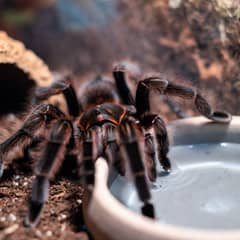
The overall approach, low fuss, no complex lighting, but real attention to substrate depth and moisture, mirrors what works for a tarantula enclosure too.
The Emperor Scorpion encyclopedia profile covers the species itself, beyond keeping one.
Sources & Further Reading
Frequently Asked Questions
What size enclosure does an emperor scorpion need?
A 10-gallon, roughly 20x10x12 inches, is the accepted minimum for one adult. Groups or extra enrichment want 20 to 30 gallons or more, with more hides than animals if you cohabitate. The lid has to be secure and tight-fitting: these are capable climbers and genuine escape artists.
What humidity and temperature does an emperor scorpion need?
Humidity first: 70 to 90%, with 75 to 80% the practical target. Temperature is more forgiving, 75 to 85°F ambient, with 70 to 90°F as the outer limits provided there is a gradient.
How deep should the substrate be?
5 to 6 inches minimum, and deeper is better, because the species uses that depth to burrow rather than decorate. Coco fiber, peat, soil-based mixes, or commercial products all work, kept damp but well-aerated.
Does an emperor scorpion need UVB lighting?
No. They are nocturnal and don't use UV to synthesize vitamin D the way many reptiles do. A 12-hour light, 12-hour dark photoperiod on ambient room light or a low-output LED is enough.
Can you house multiple emperor scorpions together?
Possible, but not always successful. Provide more hides than animals, plenty of floor space, and monitor closely for aggression, particularly around molting time, when cannibalism becomes a real risk.
More on the Emperor Scorpion
Emperor Scorpion care guide
🦂 How Much Does an Emperor Scorpion Really Cost?
🦂 Should You Handle an Emperor Scorpion? Rarely, and Carefully
🦂 Common Emperor Scorpion Health Issues and What Causes Them
🦂 Emperor Scorpion Feeding: Schedule, Diet, and Why Fasting Is Normal
🕷️ 10 Surprising Emperor Scorpion Facts
Recommended Gear
As an Amazon Associate I earn from qualifying purchases through the links above, at no extra cost to you.
Written by Michael Ryan
Mike keeps two rescued bearded dragons, Dex and Cera, and writes the care guides on BeastlyFacts from his own research and mistakes. He is not a veterinarian.
More about Michael Ryan →