Praying Mantis Enclosure Setup: Height, Humidity, and a Mesh Lid
On This Page▾

Mantis enclosures are small, cheap, and simple to set up correctly, once you understand why height matters more than any other dimension for this species.
Enclosure Size
The rule of thumb: length and width should each be at least twice the mantis's body length, and height should be at least three times its length. That height requirement isn't arbitrary, it's directly tied to molting, a mantis needs enough vertical clearance to hang freely and shed its exoskeleton without touching the bottom or sides. A reasonable adult enclosure runs around 8 inches long, 8 inches wide, and 12 inches tall as a minimum. Nymphs do well in something much smaller, a vented 32-ounce deli cup works fine at that stage.
One measurement sits underneath the height rule and is the one to check: the drop from the top of the perch to the floor, which wants to be at least four times the mantis's length. On an 8 by 8 by 12 enclosure with the perch reaching the lid, that drop is 12 inches, enough for a mantis up to about three inches. A larger adult wants a taller box than the stated minimum, which is why the minimum is a floor.
Temperature
Most commonly kept species, Carolina and Chinese mantises among them, do fine at normal room temperature, which in practice means roughly 70 to 80°F. Stay below 88°F. A small heat mat is only necessary if your home runs genuinely cool. Never place a mantis enclosure in direct sunlight: the confined space heats up fast enough to be fatal.
The African mantis, Sphodromantis lineola, the other species most often sold as a first mantis, likes it a little warmer. It does best around 77°F (25°C), within a 72 to 86°F (22 to 30°C) range, with nights no cooler than about 63°F (17°C). In most homes that means the warm end of room temperature, or a small heat source on one side if the room runs cool.
Humidity
The right figure depends on the species, and the spread is wide: a temperate Chinese mantis sits around 50 to 65%, while tropical species like Ghost and Orchid mantises want 70 to 80%. The African mantis sits at the dry end, about 50 to 60%, and is the one species here where misting can drop to about twice a week in an enclosure that holds moisture well. Achieve this with light misting at least once daily, more often in a mesh enclosure, which loses moisture fast. Those droplets are also how a mantis drinks, though heavy standing water is a drowning risk for small nymphs. This is genuinely a balancing act: too dry raises mismolt risk, too wet invites mold and internal infection. Watch your specific mantis's behavior and adjust rather than chasing an exact number blindly.
Substrate
Coconut fiber, plain soil, bark, or even paper towel all work well. Substrate here serves two purposes: giving the mantis stable footing and helping hold humidity at the level you're aiming for.
Lighting
No special lighting or UVB is needed. A normal household light cycle, roughly 12 hours of light a day, is sufficient.
Height is the one dimension a mantis enclosure genuinely can't skimp on. A mantis needs an enclosure roughly three times its own body length tall, with four times its length in clear drop below the perch, just to hang freely and shed its exoskeleton cleanly, far more than the horizontal space it needs day to day.
Diet Basics
Live prey only. Mantises are visual ambush hunters that respond to movement, and most will ignore a dead insect entirely. Fruit flies (Drosophila melanogaster) carry the smallest nymphs, and the progression from there runs through bottle flies, small crickets and appropriately sized dubia roaches as the mantis grows, with larger crickets, waxworms and bottle flies available to a full adult.
Prey size is the rule that matters more than the list: nothing longer than about a third of the mantis's own length. Offer food every other day, as much as the mantis will take in one sitting. The honest range across species runs from every day to every four days, set by the species, the prey, the mantis's size and whether it is already well fed or looking thin.
Two timing rules attach to molting. A mantis going off food is usually about to molt, so stop offering and pull anything live back out: a cricket left in with a soft, newly molted mantis will chew on it. After a molt, wait until the legs and mouthparts have hardened, several hours to a day, before offering anything.
The Requirement That Matters Most: A Mesh Lid and Real Climbing Space
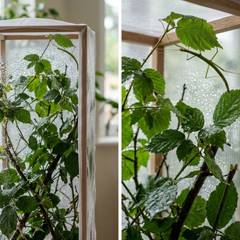
Use a mesh or ventilated lid, never solid glass or plastic, airflow is essential to avoiding the mold and internal infection that excess humidity brings, and that is the failure mode that kills quietly, without a visible symptom until it is too late. Provide branches or mesh material on the sides for the mantis to climb and, critically, to hang upside-down from when it molts. This is one branch or panel doing double duty, not two separate purchases, the same surface the mantis climbs day to day is what it hangs from during a molt. What actually matters for a clean molt is the enclosure's vertical clearance below that perch, not a second dedicated object. Leave the drop below that perch clear, the four-times-body-length figure from the size section, so the mantis has room to shed without anything obstructing it as it hangs and elongates downward.
A pair of fine-tip feeding tongs is also worth having on hand, they make it easy to place feeder insects precisely without disturbing the branch or substrate, and to pull a live insect back out quickly if you need to clear the enclosure before a molt.
The overall approach, low fuss, no complex lighting, but real attention to height and moisture, mirrors a lot of what works for an emperor scorpion enclosure too, both husbandry systems live or die on getting humidity and a safe molting space right.
Sources & Further Reading
Last reviewed 15 Sep 2026 · 3 sources
- Amateur Entomologists' Society: Praying Mantid caresheet
- Reptile Supply: How to Care for Your Chinese Mantis
- Keeping Insects: Taking care of your pet praying mantis; African Mantis (Sphodromantis lineola)
Frequently Asked Questions
What size enclosure does a praying mantis need?
Length and width at least twice the mantis's body length, height at least three times it, which lands an adult near 8 by 8 by 12 inches. Aim for four times its length in the drop from perch top to floor, the measurement a molt depends on. Nymphs do fine in a vented 32-ounce deli cup.
What temperature does a praying mantis need?
The commonly kept species, Carolina and Chinese among them, do fine at room temperature, roughly 70 to 80°F. Stay under 88°F. A small heat mat only matters if the house runs cool. Never set the enclosure in direct sun: a confined space heats fast enough to kill.
What humidity does a praying mantis enclosure need?
Species-dependent, and the spread is wide: a temperate Chinese mantis sits around 50 to 65%, while tropical Ghost and Orchid mantises want 70 to 80%. Mist lightly at least once a day, and read your own mantis's behavior rather than chasing an exact number blindly.
What substrate is best for a praying mantis enclosure?
Coconut fiber, plain soil, bark, or paper towel. It's doing two jobs: stable footing, and holding humidity where you want it.
Does a praying mantis need special lighting?
None. A normal household light cycle, roughly 12 hours a day, covers it, and no UVB is needed.
More on the Praying Mantis
Praying Mantis care guide
🦗 How Much Does a Praying Mantis Cost?
🦗 Can You Hold a Praying Mantis? Gently, and Rarely
🦗 Common Praying Mantis Health Issues (Molting Is Where Nearly Everything Goes Wrong)
🦗 Praying Mantis Feeding: Live Prey a Third of Its Length, Every Other Day, and Nothing Left in the Cage
🕷️ 10 Surprising Praying Mantis Facts
Recommended Gear
As an Amazon Associate I earn from qualifying purchases through the links above, at no extra cost to you.

Written by Michael Ryan
Mike keeps two rescued bearded dragons, Dex and Cera, and writes the care guides on BeastlyFacts from his own research and mistakes. He is not a veterinarian.
More about Michael Ryan →