Guppies Aren't Handled, But They Do Need a Population Plan
On This Page▾

Guppies are fish to watch, and a net is as close as a keeper's hands ever need to come. What every guppy owner needs to understand is breeding, since that is what decides whether the tank stays the size it started.
What Guppies Are Like
Peaceful, active, social fish that do best in groups, never alone. Males are the smaller, more colorful sex, around an inch and a half, while females run larger and comparatively plain, up to about 2.4 inches.
Telling Males From Females by the Fin, Not the Color
Size and color only go so far, especially in a tank of half-grown fish. The reliable tell is the anal fin, the single fin on the underside behind the belly. On a female it is a broad triangle. On a male it grows into the gonopodium, a narrow rod-like fin about 10mm long that the male uses to fertilize the female internally, and which looks like a spike under the belly instead of a fan. A male can swing it forward, and he does it most around females.
The female has her own mark: the gravid spot, a dark patch on the belly just ahead of the anal fin. It shows best on olive, wild-type fish, and darkens late in a pregnancy, when the belly fills with growing young. In a mixed tank, the fin starts to show early. Breeders can sort a brood by sex at about three weeks old, and that is the point to split them if the plan is no more fry.
The Behavior That Matters Most: How Guppies Breed
Guppies are livebearers: females give birth to free-swimming young instead of laying eggs. A brood arrives every 21 to 30 days, about 25 on average at 75 to 81°F, and a female can release up to about 50 young at a time.
A female guppy can store sperm from a single mating for 5 to 10 months and produce multiple separate broods from it, commonly cited as up to 8, without a male present again. Mixed-sex guppy tanks do not stay the size they started, and they grow faster than new owners expect.
When Fry Appear
Adults eat fry, their own parents included, so a brood born into a bare community tank shrinks fast. A pregnant female looks for a quiet spot among plants or roots to give birth. There are three ways to give the young a chance.
Dense cover in the main tank. Java moss, ferns and floating plants give fry gaps too tight for an adult to follow. Some fry survive this way without any intervention, which suits a keeper who wants a few young but not a flood.
A breeding trap. The plastic box with a slotted divider lets newborns drop out of the adult's reach. It is cheap, but many experienced keepers avoid it, because the confined box stresses a heavily pregnant female. If one is used, the stay is short: in once the belly is full and the gravid spot is dark, out once she has finished.
A separate grow-out tank. Fry grow faster in a proper tank than in a trap. Net newborns across with a fine net, or move the female there to give birth and take her out afterward.
Separated fry go back with the adults once they are too big to fit in the mouth of the largest fish in the tank. Until then, a well-fed adult is still a predator.
Managing Population, Practically
The only breeding-free guppy tank is a single-sex one, and males-only keeps the color, since males are the showy sex. A newly bought female may already be carrying stored sperm, so an all-female tank can still produce a few broods. Otherwise plan for fry: grow them out, split them by sex at three weeks, and rehome them as they mature. A shop may take surplus young, but the hobby has no shortage of guppies, so expect little or nothing in exchange. In a mixed tank, two or three females for every male spreads the male's attention so no single female is chased all day.
First Time Keeper Mistakes
- Buying a mixed-sex group with no population plan at all, by far the most common guppy-keeping mistake
- Not cycling the tank before adding fish, leading to ammonia stress right from the start
- Adding too many fish too quickly instead of stocking gradually
How Guppies Compare to Betta and Goldfish
Unlike the betta, which is solitary and territorial, guppies are social and should be kept in groups, and they should never share a tank with a betta or any other fin-nipping species, since a male guppy's long tail is the target.
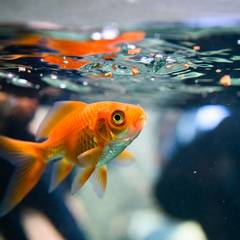
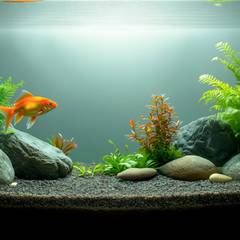
Unlike goldfish, a cold-water species that grows large and needs 20-plus gallons and serious filtration, guppies are small tropical fish, comfortable in a heated 10-gallon tank for a small group. The temperature and size mismatch rules out keeping the two together.
The Guppy encyclopedia profile covers the species itself.
Sources & Further Reading
Last reviewed 18 Jul 2026 · 4 sources
- Practical Fishkeeping: How to breed livebearing fish; The Guppy, first loves never die
- Merck Veterinary Manual: Breeding and Reproduction of Fish
- Aqua-Fish: Guppy Fish Care Guide
- Build Your Aquarium: How to Breed Guppies
Frequently Asked Questions
Do you handle guppies the way you'd handle a hamster or a bird?
No. Guppies are an observation and enjoyment pet, not a hands-on one. If you need to move one, guide it with a net rather than touching it directly, physical contact isn't part of normal guppy care.
How do guppies breed?
As livebearers. A female drops free-swimming young instead of laying eggs, and she can hold sperm from one mating for 5 to 10 months, producing up to about 8 broods from that single encounter with no male present again. Fry survival runs high wherever there is cover for them to hide in.
How do I manage guppy population if I don't want constant breeding?
Keep males and females in separate tanks to avoid breeding entirely, or keep males only for a colorful, breeding-free tank. If you do want controlled breeding, a ratio of roughly one male to two or three females reduces females getting harassed too heavily by mating attempts.
How do you tell a male guppy from a female?
By the anal fin. A female's is a broad triangle. A male's becomes the gonopodium, a narrow rod about 10mm long that looks like a spike under the belly. Pregnant females also show a dark gravid spot just ahead of that fin.
What's the most common guppy-keeping mistake?
Buying a mixed-sex group with no population plan at all, by far the most common mistake. Not cycling the tank before adding fish, which leads to ammonia stress right from the start, and adding too many fish too quickly rather than stocking gradually, round out the list.
Can guppies live with betta fish or goldfish?
Not safely with either. Betta fish are territorial and fin-nipping, a real risk to a guppy's tail, while goldfish are a cold-water species that grows large and needs 20-plus gallons, a temperature and size mismatch for a small tropical fish like the guppy.
More on the Guppy
Guppy care guide
🐠 How Much Does Guppy Ownership Really Cost?
🐠 Common Guppy Health Issues (Water Quality Is the Root of Almost Everything)
🐠 Guppy Tank Setup: Warm Water, Gentle Filtration, and a Plan for Fry
🐠 Guppy Feeding: Schedule, Diet, and Why They Stop Eating
🐠 Guppy Enrichment: The Sex Ratio Is a Welfare Decision
Written by Michael Ryan
Mike keeps two rescued bearded dragons, Dex and Cera, and writes the care guides on BeastlyFacts from his own research and mistakes. He is not a veterinarian.
More about Michael Ryan →