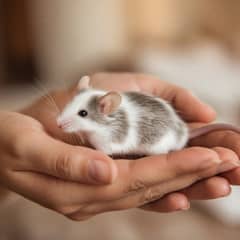
Gerbil vs. Hamster: Which Small Pet Actually Fits Your Schedule
On This Page▾

Both get lumped together as near-identical "starter rodents," and their basic diet needs do overlap, a quality pelleted food suits either species. Where they diverge is day-to-day behavior: whether the animal wants company or solitude, and whether it's awake when you are.
The Comparison
| Gerbil | Hamster | |
|---|---|---|
| Social needs | Social, do best in pairs/groups | Solitary (Syrians), fight if paired |
| Activity pattern | Active day and night, peaks at dawn/dusk | Mainly nocturnal |
| Digging drive | Intense, near-mandatory | Moderate |
| Tail | Furred, tufted tip | Short, mostly bare |
| Lifespan | 2-3 years | 2-3 years |
| Handling tolerance | Generally calm, less nippy | Can nip if startled or woken |
| Best seen during | Daytime and evening | Evening/night only |
| Good first pet for kids? | Yes, more visible activity | Better for older kids/teens |
The Bag Labelled for Both Is Usually a Hamster Bag
The diets overlap less than the packaging suggests. A gerbil wants 18 to 20% protein, and plenty of products sold as "Hamster and Gerbil Food" sit below even the 14% floor for gerbils, because they are formulated for the hamster half of the name. The full analysis to check for is on the bag's guaranteed analysis panel, not its front.
Social Needs Point in Opposite Directions
This is the difference people get wrong most often, and it runs exactly opposite between the two species. Gerbils are naturally social animals that live in family groups and pair-bond, and captive gerbils kept alone without a same-sex partner or sibling group can develop real anxiety and depression-like behavior. Syrian hamsters are the reverse: they're strictly solitary as adults, and buying "two hamsters for company" is one of the most common and preventable hamster-owner mistakes, since housing them together risks a serious, sometimes fatal, fight.
Choose a Gerbil if you want a small pet you can house as a same-sex pair or sibling group rather than keeping solo. Just commit to a real pairing from the start, a lone gerbil is a genuinely worse-off animal, not a simpler one.
One Is Awake When You Are, the Other Isn't
Gerbils are active during both day and night, with activity peaking around dawn and dusk, which means there's a real chance of catching one out and moving during normal waking hours. Hamsters are mainly nocturnal, spending the day asleep and only becoming genuinely active after dark, a pattern that often disappoints a kid expecting an animal that's out and about all afternoon.
A gerbil's drive to dig isn't a minor preference, it's close to a physical need. Wild gerbils build extensive burrow systems, and captive gerbils denied real digging opportunities can develop repetitive, stress-related behaviors as a result, which is why deep, diggable substrate matters for a gerbil enclosure just as it does for a hamster's, where deep bedding is a welfare requirement too.
Handling Goes More Smoothly With One of Them
Gerbils have a reputation as the calmer, less nip-prone of the two, and part of that likely comes down to timing: a gerbil handled during the day is simply awake and alert, not startled out of a deep sleep. A hamster can become just as hand-tame with patience, but handling it during the day, when it would naturally be asleep, is a common way to get an unfairly grumpy reaction. Evening sessions go far better with a hamster than daytime ones.
A Hamster is the better fit if you specifically want a solitary pet and don't mind an evening-only schedule. Work around its nocturnal clock rather than against it, handling one straight out of a daytime sleep is the single most common way to get an unfair nip.
Lifespan Isn't a Deciding Factor Here
Unlike a lot of small-pet comparisons, lifespan doesn't really separate these two: a gerbil's normal lifespan is 2 to 3 years, and a Syrian hamster's is also 2 to 3 years, though the median age at death across all pet hamsters in a large veterinary study was 1.75 years. Neither is a long-term commitment compared to most other pets, so the decision comes down to social needs and activity pattern, not how long you're signing up for.
Bottom Line
Pick a gerbil if you want a more visibly active daytime pet and can commit to housing it with a companion rather than alone. Pick a hamster if a solitary pet fits your household better and you're fine working around a nocturnal schedule. Both are short-lived compared to most pets, so let temperament and activity pattern make the call, not lifespan. The gerbil and hamster encyclopedia profiles cover the Mongolian and Syrian origins behind the colony-versus-solitary split.
Sources & Further Reading
Last reviewed 14 Sep 2026 · 3 sources
Frequently Asked Questions
Can gerbils be kept in pairs, unlike hamsters?
Yes, and this is the single biggest difference between the two. Gerbils naturally live in family groups and pair-bond, and housing a lone gerbil without a same-sex partner or sibling group can lead to real anxiety and depression-like behavior. Syrian hamsters are the opposite: they're strictly solitary as adults and will fight, sometimes fatally, if housed together.
Are gerbils awake during the day, unlike hamsters?
More often than hamsters, yes. Gerbils are active during both day and night, with activity peaking around dawn and dusk, so there's a real chance of seeing one out and active while you're home. Hamsters are mainly nocturnal, spending the day asleep and becoming active mostly after dark, which is a common source of disappointment for kids expecting a daytime pet.
Which digs more, a gerbil or a hamster?
Gerbils, dramatically. Wild gerbils build extensive burrow systems, and the drive to dig is strong enough that captive gerbils denied the chance to burrow can develop repetitive, stress-related behaviors. Hamsters dig and burrow too, but nowhere near as intensely, deep, diggable substrate is a genuine requirement for a gerbil in a way it isn't for a hamster.
Which lives longer, a gerbil or a hamster?
They're close. A gerbil lives 2 to 3 years and so does a Syrian hamster, though hamsters overall die at a median of 1.75. Neither is a long-term commitment next to most other pets, so social needs and activity pattern should decide it.
Which is easier to handle, a gerbil or a hamster?
Gerbils generally have a reputation as the calmer, less nip-prone of the two, partly because they aren't being woken up from a sound sleep the way a hamster handled during the day often is. A hamster can absolutely become hand-tame, but evening handling sessions go far better than daytime ones for exactly that reason.
🐹 How Much Does Gerbil Ownership Really Cost?
🌰 How Much Does a Hamster Really Cost?
🐹 How to Handle a Gerbil (And Why It Needs a Companion)
🌰 How to Handle a Hamster (And Why the Species Matters More Than You'd Think)
🐹 Common Gerbil Health Issues
🌰 Common Hamster Health Issues (Wet Tail Is the One to Know)
🐹 Gerbil Enclosure Setup: Depth Is Everything
🌰 Hamster Enclosure Setup: Bigger and Deeper Than the Starter Kit Suggests
🐹 Hamster Feeding: Schedule, Diet, and Why They Stop Eating
🐹 Gerbil Enrichment: Deep Bedding Alone Does Not Stop the Digging
🐹 Hamster Enrichment: The Bedding Depth Study Everyone Should Know
🐹 Is It Legal to Own a Gerbil? The California Ban Explained
🐹 Are Hamsters Legal? The One State That Says No
Recommended Gear
As an Amazon Associate, we earn from qualifying purchases through the links above - at no extra cost to you.

Written by Michael Ryan
Mike keeps two rescued bearded dragons, Dex and Cera, and writes the care guides on BeastlyFacts from his own research and mistakes. He is not a veterinarian.
More about Michael Ryan →