Hamster Enclosure Setup: Bigger and Deeper Than the Starter Kit Suggests
On This Page▾

Hamster housing standards have shifted significantly in recent years, and the small wire cages sold as "hamster starter kits" fall well short of current welfare recommendations. Getting size and bedding depth right is most of what matters here.
Enclosure Size
Current welfare guidance calls for a genuinely large unbroken floor space, roughly 700 to 775 square inches for a Syrian, around 600 square inches for dwarf species, with more always being better. A 40-gallon breeder tank works well for dwarfs. Syrians do better in something larger still, a 75-gallon tank or a 47-inch cage with acrylic panels on a metal frame, about 1,110 square inches of floor with a base deep enough for 11 inches of bedding. If you're using a wire cage, bar spacing should be no more than half an inch for Syrians and a quarter inch for smaller species, Roborovski especially, since they can squeeze through surprisingly small gaps.
Temperature
65 to 75°F is the comfortable range, kept stable. Below 65°F the room is out of range and appetite and activity start to drop. Below about 41°F (5°C), particularly with short days, a hamster can enter torpor, a hibernation-like state that can be dangerous. Above 80°F risks heat stress. No supplemental heat source is needed in a normal indoor environment, but a digital thermometer makes it easy to confirm the room is actually staying inside that range rather than guessing. Room humidity of 40 to 60% is the target, and the same device reads it.
Bedding: Deeper Than You'd Guess
At least 6 inches of dust-free, paper-based bedding or aspen shavings, and treat that as the floor; 8 inches or more is better, because it leaves room for a deeper layer. In a study of 45 male Syrians, every hamster given 40 cm or more (about 15 inches) built its own burrow and used it, and the researchers concluded that 40 to 80 cm, roughly 15 to 30 inches, seemed to improve welfare. This isn't decorative, it's a welfare requirement. Avoid cedar and pine entirely, the aromatic oils in both irritate the respiratory system.
Hamsters kept on 10 cm of bedding, about 4 inches, gnawed the cage wire significantly more and ran the wheel harder than those given 40 or 80 cm. In a shallow cage, wire-gnawing is a depth problem before it is a toy problem, which is what the bedding-depth study settles.
Lighting
No special lighting or UVB is required. A normal day and night cycle is sufficient, just remember this is a nocturnal species, and bright light during their active hours is more disruptive than helpful.
The Wheel: Solid, Not Wire, and Properly Sized
A solid-surface wheel with no rungs is essential, wire wheels cause foot injuries. Size matters too: Syrians need at least an 8 to 11 inch wheel, dwarfs 6 to 8 inches. A wheel that's too small forces an unnatural, arched running posture that isn't great for the spine over time.
The Non-Obvious Requirement: A Sand Bath
A dust-free, non-clumping sand bath is a genuine species essential, not an optional extra. Hamsters use it to manage coat and skin oils the way a bird uses a dust bath, and skipping it isn't a minor omission.
Cleaning: Spot Daily, Deep Less Often
A hamster's cage smells of its own scent marks and its food stores, and a cleaning routine has to keep enough of both to leave the animal settled.
- Daily: remove soiled bedding and uneaten fresh food, and wash and rinse the water bottle or bowl.
- Weekly for a small cage: move the hamster to a carrier, take out the bedding, wash the cage and accessories with a small-animal habitat cleaner, rinse off every trace of it, and let everything dry fully before fresh bedding goes in. A large enclosure with deep bedding may only need this every few weeks, with spot cleaning in between.
- Every time: set aside a handful of clean nesting material and any dry food hoard, and put them back afterward. Leave an established burrow in place during spot cleans. Return the nest, wheel and bowls to the same spots, since a hamster relies on the layout staying put.
A total strip-out erases the scent marks and the hoard at once, and it can leave a hamster unsettled for days. Clean in the evening, once the hamster is already awake.
Rounding Out the Enclosure
A hideout, a water bottle, and a food dish complete a basic setup. None of it needs to be elaborate, but all of it needs to be there, a hamster with nowhere to hide is a chronically stressed one.
This is also the part of hamster ownership most first-time buyers underestimate: the animal is cheap, but a welfare-appropriate enclosure genuinely isn't, worth keeping in mind if you're also comparing setups for a blue-tongue skink, a White's tree frog, or a Pacman frog side by side.
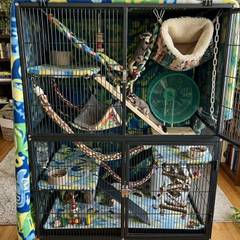
A chinchilla is the step up in both space and commitment: a tall multi-level cage instead of a deep floor, and 10 to 20 years instead of two or three.
Sources & Further Reading
Last reviewed 24 Sep 2026 · 5 sources
- Merck Veterinary Manual: Providing a Home for a Hamster
- LafeberVet: Basic Information Sheet: Hamster
- PetMD: Syrian Hamster Care Sheet
- PDSA: Hamsters as Pets
- Hauzenberger AR, Gebhardt-Henrich SG and Steiger A. The influence of bedding depth on behaviour in golden hamsters. Applied Animal Behaviour Science

The Hamster Care Package carries this setup as a checklist with the targets to hit, in a 47-page PDF you can keep by the cage, $8.99.
Frequently Asked Questions
What size enclosure does a hamster need?
Current welfare guidance puts a Syrian at roughly 700 to 775 square inches of unbroken floor, and dwarf species near 600, with more always better. A 40-gallon breeder suits dwarfs; a Syrian wants something closer to a 75-gallon.
How deep should hamster bedding be?
At least 6 inches of dust-free paper bedding or aspen shavings, which is a welfare requirement rather than decoration. In a bedding-depth study of male Syrians, about 16 to 31 inches (40 to 80 cm) let every hamster dig a burrow and appeared to improve welfare. No cedar or pine: the aromatic oils irritate the respiratory system.
What temperature should a hamster's room be?
65 to 75°F, held steady. Below 65°F the room is out of range and appetite and activity drop; below about 41°F (5°C), especially with short days, a hamster can slip into torpor, a hibernation-like state that can be dangerous; over 80°F risks heat stress. Nothing supplemental is needed in a normal indoor room.
Does a hamster need a special wheel?
A solid-surface wheel with no rungs, since wire wheels injure feet. Size it 8 to 11 inches for a Syrian, 6 to 8 for a dwarf; too small forces an arched running posture that is hard on the spine over time.
Do hamsters need a sand bath?
Yes. It is a species essential, not an extra: hamsters work coat and skin oils out in dust-free, non-clumping sand the way a bird uses a dust bath.
More on the Hamster
Hamster care guide
🌰 How Much Does a Hamster Really Cost?
🌰 How to Handle a Hamster (And Why the Species Matters More Than You'd Think)
🌰 Common Hamster Health Issues (Wet Tail Is the One to Know)
🐹 Hamster Feeding: Schedule, Diet, and Why They Stop Eating
🐹 Hamster Enrichment: The Bedding Depth Study Everyone Should Know
Recommended Gear
As an Amazon Associate I earn from qualifying purchases through the links above, at no extra cost to you.

Written by Michael Ryan
Mike keeps two rescued bearded dragons, Dex and Cera, and writes the care guides on BeastlyFacts from his own research and mistakes. He is not a veterinarian.
More about Michael Ryan →