Zebra Danio
Danio rerio
Beastly Facts · Updated
On This Page▾
Overview
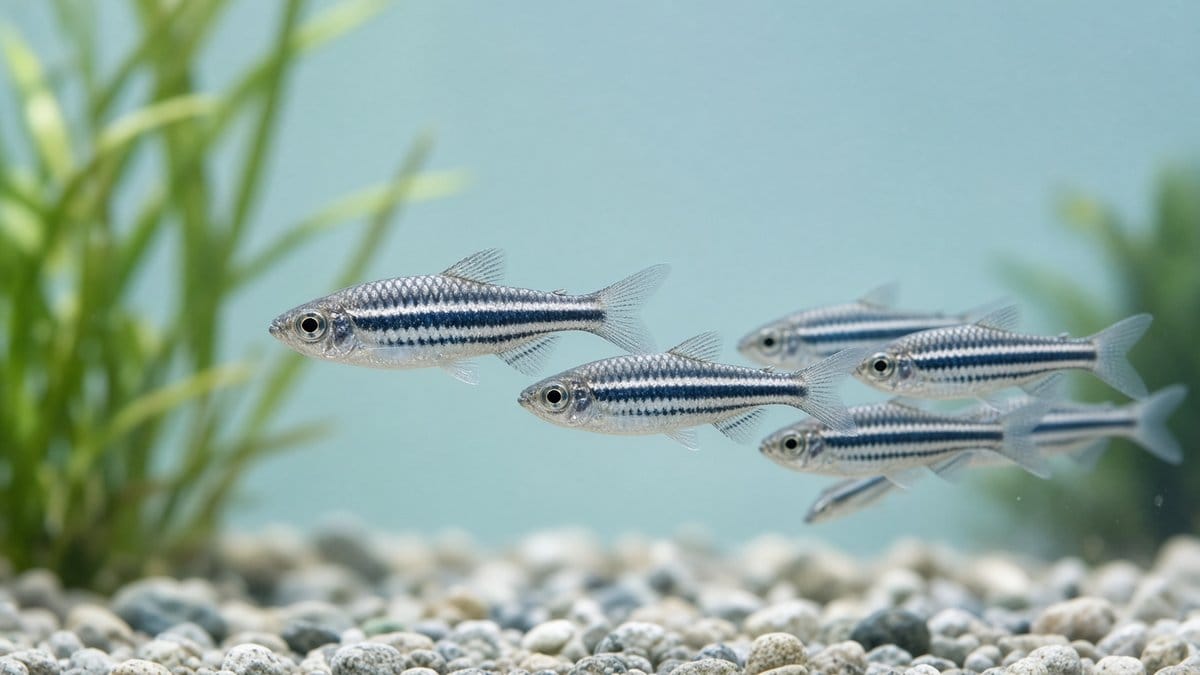
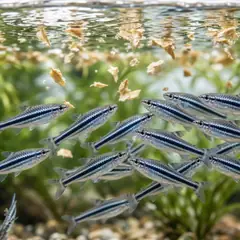
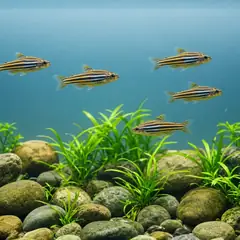
The zebra danio is a small, fast-swimming schooling fish native to the shallow streams, ditches, and monsoon-flooded rice paddies of South Asia. Unlike livebearing guppies and mollies, danios are egg-scatterers: a spawning pair releases eggs into open water or fine-leaved plants, with no nest built and no parental care afterward. Outside the aquarium hobby, the zebra danio is best known as zebrafish, the most widely used non-mammalian vertebrate model organism in developmental biology and genetics research. Its embryos develop transparently outside the mother's body, and roughly 70 percent of human genes have a recognizable counterpart in its genome, a combination that has made it a mainstay of labs studying development, disease, and drug discovery since the 1990s.
Quick Facts
Native Range
South Asia (Ganges and Brahmaputra river basins of India, Bangladesh, and Nepal)
Natural Habitat
Shallow, slow-moving streams and ditches, with seasonal migration into monsoon-flooded rice paddies and marginal pools to spawn
Adult Size
1.5 to 2 inches (4 to 5 cm); the largest on record reached about 2.5 inches (6.4 cm) in captivity
Wild Diet
Zooplankton, small crustaceans, aquatic and terrestrial insects, and mosquito larvae, taken from open water and the surface, plus some algae and plant matter
Wild Lifespan
Around 1 year in the wild; 3.5 years average in captivity, and up to 5.5 years
Conservation Status
Least Concern (IUCN)
History
Francis Hamilton, a Scottish physician working under the East India Company, described the fish in 1822 from specimens collected in Bihar, calling it a beautiful fish with blue and silver stripes along each side. Its second life began at the University of Oregon, where George Streisinger spent the 1970s adapting a pet shop fish to genetics work. In 1981 he published a paper in Nature reporting the first large-scale production of genetically uniform clones of a vertebrate. Early laboratory strains were founded with animals bought from the pet trade or collected in the wild, and Streisinger's methods went on to spread to more than 500 labs in 32 countries.
Compare
Zebra Danio
Human
Adult Size
1.5 to 2 inches (4 to 5 cm); the largest on record reached about 2.5 inches (6.4 cm) in captivity
5-6 feet (150-185 cm); ~135-200 lbs
Wild Lifespan
Around 1 year in the wild; 3.5 years average in captivity, and up to 5.5 years
~73 years (global average)
Wild Diet
Zooplankton, small crustaceans, aquatic and terrestrial insects, and mosquito larvae, taken from open water and the surface, plus some algae and plant matter
Omnivorous - eats just about anything
Native Range
South Asia (Ganges and Brahmaputra river basins of India, Bangladesh, and Nepal)
Global - originated in Africa roughly 300,000 years ago
Natural Habitat
Shallow, slow-moving streams and ditches, with seasonal migration into monsoon-flooded rice paddies and marginal pools to spawn
Everywhere from arctic tundra to tropical megacities
Conservation Status
Least Concern (IUCN)
Least Concern (8+ billion and counting)
Test Yourself
What's the Zebra Danio's native range?
Fun Facts
🐠 The Fish Behind GloFish
GloFish started out as a pollution alarm. Professor Gong Zhiyuan at the National University of Singapore put a fluorescent jellyfish gene into zebra danios, aiming for fish that would glow in response to toxins in the water. A US company licensed the idea, and the first GloFish sold was red, borrowing its glow from a sea anemone gene.
Fillable forms for any pet

Universal Pet Kit
25 pages · PDF · $4.99
Deep Dive

Health and More









Did You Know?
Zebra danios, also called zebrafish, are the most widely used non-mammalian vertebrate in developmental biology and genetics. Their embryos develop transparently outside the mother's body within hours of fertilization, so organs can be seen forming in real time, and roughly 70 percent of human genes have a recognizable counterpart in the zebrafish genome, sequenced in full in 2013. That same genetic malleability is also how GloFish, the first genetically modified animal ever sold as a pet, came to exist: they're fluorescent zebra danios.
Explore More