The Wood Frog Freezes Solid Every Winter, and Thaws Out Fine
On This Page▾

The wood frog is a small brown frog with a dark mask across its eyes, common across most of North America, and completely unremarkable to look at. It is also the only amphibian on the continent that lives above the Arctic Circle, and it manages that by doing something no mammal or bird can survive.
It freezes. Not chills, not slows down. Ice forms through its body cavity, packed around its organs, and up to 70 percent of its total body water becomes solid. Breathing stops. The heart stops. There is no measurable circulation for weeks, and in the far north for months. Then in spring it thaws out and goes looking for a pond.
What Freezing Actually Does to It
Ice formation usually kills animals for two separate reasons. Sharp crystals shred cell membranes, and as water leaves solution as ice, whatever is dissolved in the remaining water gets concentrated to levels that wreck proteins.
The wood frog does not prevent ice. It controls where the ice goes.
Freezing begins at the skin, where contact with frozen ground seeds the first crystals, and spreads inward through the extracellular spaces. Water is deliberately pulled out of the cells and organs to feed that external ice. Measured in Alaskan frogs frozen to minus 16 Celsius, livers lost up to 66 percent of their water, gastrocnemius muscle 54 percent, and gracilis muscle 48 percent. The ice sits in the body cavity and between the tissues. The cells themselves stay unfrozen, just severely dehydrated.
Which raises the second problem. A dehydrated cell is a cell full of concentrated solutes, and that is its own kind of lethal.
Two Chemicals, on Two Different Schedules
The answer is a pair of cryoprotectants, and the timing of each is the clever part.
The first is glucose. When freezing starts, the liver dumps its glycogen stores and converts them to glucose at extraordinary speed, flooding it into the tissues. In frozen Alaskan frogs, liver glucose reached 1,760 micromoles per gram of dry tissue. Plasma glucose during extreme freezing exceeded 1,300 micromoles per milliliter. For scale, these are concentrations that would put a mammal into a diabetic coma. Inside a cell losing water to external ice, that glucose keeps the remaining fluid dilute enough that proteins survive.
Notice this is a reaction. It happens after ice starts forming, triggered by the freezing itself.
The second is urea, and it works on the opposite schedule. Urea accumulates through autumn, well before any ice appears, climbing from around 10 micromoles per milliliter of plasma to between 85 and 187. It is preparation rather than response.
That autumn urea loading is the main thing separating an Alaskan wood frog from one in Ohio. Subarctic frogs accumulate roughly eight times the plasma urea of temperate populations during winter conditioning. The payoff is dramatic.
| Population | Survives freezing to | Autumn plasma urea |
|---|---|---|
| Subarctic (Alaska) | at least minus 16 Celsius | roughly 8x the temperate level |
| Temperate (southern range) | about minus 3 to minus 6 Celsius | baseline |
A 10 to 13 degree gap in lethal limit, within one species, produced mostly by how much urea an animal banked before the cold arrived.
How Long, and How Completely
The Alaskan frogs in the 2014 study were held at minus 16 Celsius for 14 hours. Others went through repeated freeze and thaw cycles ending at minus 8 Celsius for five hours. Those frogs were behaving normally about 30 hours after thawing began, and were still healthy seven weeks later when the study ended.
In the wild the exposure is far longer. Wood frogs overwinter under leaf litter, not underground and not in water, which means they sit through whatever the winter does. In interior Alaska that means months frozen, with repeated partial thaws and refreezes.
Thawing does not happen from the outside in, which is what you would expect if the sun were simply warming the animal. Researchers tracking the order of recovery found the heartbeat resumes within an hour of thawing, reaching near-normal function within a few hours, while spontaneous breathing and hindleg reflexes came back only afterward and not in every frog within the three to four hour observation window. Circulation is restored before the limbs work. The frog reassembles itself from the middle outward.
Why Cryobiologists Care
This is not a curiosity for long. The limiting factor in organ transplantation is time. A donor heart is viable for a few hours on ice, which is why organs are flown across countries in coolers and why usable organs are discarded every year for want of a recipient in range.
Freezing an organ would solve that, and it fails for exactly the reasons wood frog freezing should fail: ice damage and solute concentration. So the frog is now a working model in cryopreservation research, and the questions are specific. How does the liver mobilize that much glucose that fast? What keeps the cells from apoptosis during the ischemic period? Wood frogs have been shown to run an anti-apoptotic response during anoxia and recovery, which is a distinct problem from the ice itself.
Nobody has translated this into a preserved human organ. But the animal is a proof that the thing is possible in a vertebrate, which is more than the field had before.
The Rest of the Wood Frog
The northernmost amphibian in North America. The National Park Service notes they are found above the Arctic Circle in Alaska, farther north than any other amphibian on the continent, including in Gates of the Arctic National Park. Their range runs all the way south to Georgia.
They quack. The breeding call is a soft, low, duck-like clucking, quite unlike the high whistle of spring peepers. It does not carry far, so a chorus can be surprisingly easy to walk past.
They breed in a hurry. Wood frogs are textbook explosive breeders. Hundreds converge on vernal pools within days of the ice going out, breed over roughly a week, and leave. The pools they choose are temporary by design, drying out in summer, which is what keeps fish out of them.
That last detail explains the freezing, in a way. A frog that can thaw earlier than its competitors gets first use of the meltwater pools, in a habitat where the breeding window is only a few weeks long. The freezing is not endurance for its own sake. It is a way of being present the moment the ice goes out.
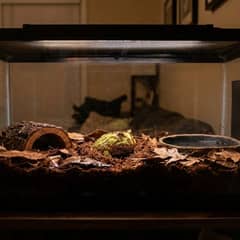
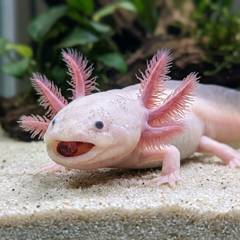
If you keep amphibians, none of this transfers to your animals. The freeze tolerance is a specific adaptation of a specific wild species, and captive amphibians like White's tree frogs and Pacman frogs need stable warmth, while axolotls need cold but never freezing water. Cold is not the same as freezing, and no pet amphibian should ever be tested on the difference.
Sources
Last reviewed 31 Jul 2026 · 10 sources
- Cryoprotectants and Extreme Freeze Tolerance in a Subarctic Population of the Wood Frog, PLOS ONE 9(12):e117234 (Larson, Middle, Vu, Zhang, Serianni, Duman and Barnes, 2014)
- Cryoprotectants and Extreme Freeze Tolerance in a Subarctic Population of the Wood Frog (full text, PMC4331536)
- Enzymatic Regulation of Glycogenolysis in a Subarctic Population of the Wood Frog: Implications for Extreme Freeze Tolerance (PMC3827335)
- Anti-apoptotic response during anoxia and recovery in a freeze-tolerant wood frog (Rana sylvatica) (PMC4811176)
- Resumption of physiological functions in the wood frog (Rana sylvatica) after freezing, PubMed record PMID 1858939 (Layne, Lee and Heil, 1991)
- Cryoprotectant production capacity of the freeze-tolerant wood frog, Rana sylvatica, Canadian Journal of Zoology 71:1181-1188 (Storey and Storey, 1993)
- Lessons from nature: Leveraging the freeze-tolerant wood frog as a model to improve organ cryopreservation and biobanking, Cryobiology (2022)
- Wood Frog (National Park Service, Gates of the Arctic National Park and Preserve)
- Wood Frog (Maine Department of Inland Fisheries and Wildlife)
- The wood frog (Rana sylvatica): An emerging comparative model for anuran immunity and host-ranavirus interactions, Developmental and Comparative Immunology (2023)

Written by Michael Ryan
Mike keeps two rescued bearded dragons, Dex and Cera, and writes the care guides on BeastlyFacts from his own research and mistakes. He is not a veterinarian.
More about Michael Ryan →Comments
No comments yet - be the first!