Is It Legal to Own a Quaker Parakeet? And How to Handle One
On This Page▾

Quaker parakeets are intelligent, social, gifted talkers, and also a bird where a legal check needs to happen before anything else.
The legal picture, state by state
Quakers are restricted or banned in a meaningful number of US states, and the reasoning is concrete: escaped birds form invasive feral colonies that damage crops and build large stick nests on power infrastructure, a real, documented problem, nests were linked to over 1,000 power outages in Florida in a single year, costing hundreds of thousands of dollars.
Thirteen jurisdictions ban it outright, three want a permit, Virginia wants the bird banded, and one is genuinely unresolved. The legal guide works through all 52 against the state codes themselves, which is worth doing before you buy rather than after.
New Jersey is the one on that list that is worth reading twice, because a permit does exist there and it is not a pet permit. N.J.A.C. 7:25-4.8(a) puts Myiopsitta spp. in the potentially dangerous species table, on the agricultural pest limb of the definition instead of the dangerous animal one. A permit can be issued for a potentially dangerous species under 4.8(b), but 4.9(a)3 then says such a species "shall not be kept as a pet, for hobby purposes," and the state's own restricted species notice puts it flatly: potentially dangerous species "may not be kept as pets or for hobby purposes for any reason." The permit runs to zoological holding, scientific holding, and animal exhibitor holders. For a keeper, New Jersey is a ban.
Check directly with your state's wildlife or agriculture agency before buying, since laws in this area do change, and birds have been confiscated and euthanized in states where they're illegal to own.
Handling and temperament
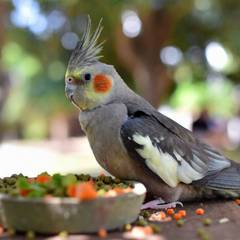
Quakers are playful, clever, and often described as genuine "clowns," typically bonding strongly to one person while remaining reasonable with the rest of the household. They're assertive, not shy, and will clearly signal displeasure, sometimes with a bite, if they feel threatened. Expect real territoriality around the cage, especially during spring breeding season, worth supervising closely around children during that window.
Step-up, bites and the cage
Cage territoriality is the handling problem this species is known for. Most pet birds guard their cage to some degree, and the bites come at predictable moments: a hand reaching in to lift the bird out, to clean, or to change the food and water dishes. Some Quakers become strongly protective of the cage, spring birds most of all. The routine that works around it:
- Let the bird come out first. Open the door and wait for the Quaker to climb onto the door or a perch outside, then ask for the step-up there, so the hand never enters the space it defends.
- Service the cage while the bird is out. Dishes, paper and toys get changed with the Quaker on a play stand or in another room, not watching a hand move through its cage.
- Reward the step-up. A favorite treat kept for training, given the moment both feet land, builds the behavior. Punishment and forced handling make a territorial bird worse.
If it bites, stay calm. A loud reaction, even yelling, teaches the bird that biting gets attention or control. Set it down slowly, walk away, and ask again only once it has settled. A Quaker that keeps biting goes back a step: treats taken calmly from the hand over several days, then one foot and both feet onto a wooden dowel, then the hand. A thick towel protects a hand better than a glove, which frightens most birds. Biting that starts suddenly in a bird that was steady can have a medical cause, and it is worth an avian vet visit before it is treated as behavior.
An unusually good talker for the price
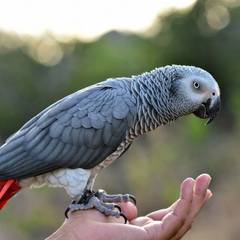
This is a genuine standout trait worth knowing. A Quaker's talking ability and intelligence is often compared favorably to birds many times more expensive, African grey and Amazon parrots among them. Hand-fed Quakers can build large vocabularies, and some start talking before they're even fully weaned.
The nest-building instinct, unlike any other parrot
Here's a genuinely unusual behavioral fact. The Quaker is the only parrot species that builds its own nest rather than nesting in a tree cavity, and in the wild, these twig-woven nests can become massive multi-chambered structures shared by many pairs. Pet Quakers retain this instinct fully, they'll shred and weave any suitable material. Give them safe material to work and they will push it into the cage bars and weave at it for hours, which is the outlet this instinct needs. Watch for cage aggression in spring, and scale the material back if it appears instead of cutting it off entirely. What never goes in is an actual nest box.
Wild Quaker colonies build genuine "apartment complexes" out of sticks, with each breeding pair maintaining its own chamber inside a shared structure that can house dozens of pairs. It's the only nest-building behavior of its kind among parrots, and a caged pet Quaker will attempt the exact same thing with whatever material you leave within reach.
Adding a second bird
A Quaker's cage territoriality makes a slow introduction more important, not less. It runs in stages:
- A vet exam for the new bird as soon as it comes home, before the resident is exposed to it, then 30 to 45 days in a separate room for the full bird quarantine.
- Both cages in one room, a distance apart, so the birds get used to the sight and sound of each other. Move the cages closer over the following days to weeks.
- The first time together happens under strict supervision, and any fighting or bullying means separating them on the spot.
Some birds never accept each other, and a Quaker that keeps attacking a newcomer after weeks side by side keeps its own cage for good.
First-timer mistakes
- Buying before checking state legality.
- Providing a permanent nest box "because they seem to want one," this reliably triggers unwanted hormonal aggression.
- Under-socializing a bird this intelligent, boredom shows up fast as plucking and screaming.
Sources & Further Reading
❓ Frequently Asked Questions
Is it legal to own a Quaker parakeet?
It depends entirely on your state. Quakers are restricted or banned in a meaningful number of US states because escaped birds form invasive feral colonies that damage crops and build large stick nests on power infrastructure. Sources disagree on the exact count, so verify with your state wildlife or agriculture agency before buying.
Which states commonly ban Quaker parakeets outright?
Thirteen, on the statute-by-statute count in the quaker legal guide: California, Colorado, Connecticut, Georgia, Hawaii, Kansas, Kentucky, Nebraska, New Jersey, Pennsylvania, Vermont, Wisconsin and Wyoming. Maine, Rhode Island and Arkansas require a permit, Virginia allows the bird on a condition, and Tennessee is unresolved. Nothing reaches the species in the remaining 34 jurisdictions, New York and Ohio among them.
Are Quaker parakeets good talkers?
Yes, and it's the standout trait of the species. Their talking and intelligence gets compared favorably to birds many times more expensive, African greys and Amazon parrots among them. Some hand-fed Quakers start talking before they're fully weaned.
What is unusual about how Quaker parakeets nest?
It's the only parrot that builds a nest instead of using a tree cavity. Wild nests are twig-woven, multi-chambered, and shared by many pairs. A pet Quaker keeps the instinct and will weave whatever material it can reach.
Should I give my Quaker parakeet a nest box?
No. Keep shredding toys in the play area instead. Heavy nest-style material or a permanent box inside the cage can trigger the hormonal, territorial behavior you don't want to encourage.
📰 More on the Quaker Parakeet
📘 Quaker Parakeet care guide
🦜 How Much Does a Quaker Parakeet Really Cost?
🦜 Common Quaker Parakeet Health Issues
🦜 Quaker Parakeet Cage Setup
🦜 Quaker Parakeet Feeding: Seventy Percent Pellets, a Small Handful a Day, and the Seed Diet Behind the Fatty Liver
🦜 Quaker Parakeet Enrichment: The Only Parrot That Builds a House

Written by Michael Ryan
Mike keeps two rescued bearded dragons, Dex and Cera, and writes the care guides on BeastlyFacts from his own research and mistakes. He is not a veterinarian.
More about Michael Ryan →