10 Surprising Praying Mantis Facts

Praying mantises get recognized instantly for their folded forelegs, but most of what makes them fascinating happens everywhere else on their body.
-
They can turn their head almost all the way around. Mantises are one of the only insect groups with a flexible neck, letting them swivel their head roughly 180 degrees to track movement without repositioning their whole body.
-
They have five eyes, not two. Alongside their two large compound eyes, mantises have three simple eyes called ocelli clustered between them, which mostly sense light levels rather than form images. The big eyes see in 3D. Researchers fitted mantises with tiny colored 3D glasses and played them a "3D insect cinema." The images fooled them into perceiving depth, which settled that mantises judge distance by comparing the views from both eyes.
-
Many hear through a single ear. Other insects with eardrums have them in pairs on the sides of the body, but many mantises have one ear in the midline of the underside, between the hind legs. It is tuned to ultrasound between 25 and 45 kilohertz, the range of hunting bats, and some species abruptly change course in flight when they hear it.
-
Their front legs are built like spring-loaded traps. The spiked raptorial forelegs snap shut in a fraction of a second, and interlocking spines pin prey in place before it has any real chance to escape. The unrelated mantis shrimp evolved the same spring-loaded principle in the ocean and pushed it far harder, with a strike fast enough to crack aquarium glass.
-
Sexual cannibalism is real, but it's less common in the wild than the reputation suggests. Females sometimes eat males during or after mating, but field studies find it happens far less often when mantises aren't confined together in tight, high-stress conditions.
-
Camouflage goes way past plain green or brown. Certain species convincingly mimic orchids, dead leaves, bark, or twigs, so well that prey insects land directly on them mistaking them for a flower or plant matter.
-
A single egg case can hold hundreds of eggs. The foam-like ootheca a female produces hardens into a protective casing, and depending on species it can contain anywhere from a few dozen to several hundred eggs inside.
-
They molt to grow, and molting is genuinely risky. Like other invertebrates, mantises shed their exoskeleton in stages to increase in size, and a mantis that gets stuck mid-molt or falls during the process is one of the more common causes of death in captivity.
-
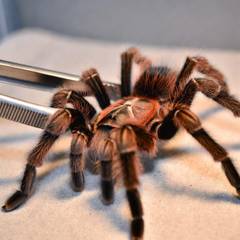
Most pet mantises are only adults for a few months. Total lifespan from egg to natural death typically runs about 6 to 12 months, a year and a half at the outside, which is short compared to longer-lived invertebrate pets like tarantulas.
-
Some catch birds. A 2017 review gathered 147 cases of mantises killing small birds, from 13 countries on every continent except Antarctica. More than 70 percent came from the United States, where mantises wait at hummingbird feeders, and hummingbirds make up the large majority of the victims.
If your mantis has stopped eating, gone still, and its color looks slightly duller or cloudier than usual, it's very likely gearing up to molt rather than sick. The safest move is to leave it alone and keep humidity steady until it's done.
What surprised you most? Drop it in the comments.
Sources
Last reviewed 4 Jul 2026 · 3 sources
More on the Praying Mantis
Praying Mantis care guide
🦗 How Much Does a Praying Mantis Cost?
🦗 Can You Hold a Praying Mantis? Gently, and Rarely
🦗 Common Praying Mantis Health Issues (Molting Is Where Nearly Everything Goes Wrong)
🦗 Praying Mantis Enclosure Setup: Height, Humidity, and a Mesh Lid
🦗 Praying Mantis Ootheca: What to Do If Your Mantis Lays Eggs

Written by Michael Ryan
Mike keeps two rescued bearded dragons, Dex and Cera, and writes the care guides on BeastlyFacts from his own research and mistakes. He is not a veterinarian.
More about Michael Ryan →