Neon Tetra Tank Setup: Soft Water, Dim Light, and a Blackwater Feel
On This Page▾

Neon tetras come from soft, dim, tannin-stained blackwater streams, and the closer your tank setup gets to that origin, the better this fish looks and behaves.
Tank Size
10 gallons is the practical minimum for a proper school of 6. For the better group of 10 to 15 fish, step up to a 20-gallon long tank. Schooling plays out horizontally, so favor a longer tank over a taller one.
Tankmates have to share the soft water and the 72 to 78°F band and be too small to eat a neon. The pairings that fail are named species by species: an adult angelfish, which eats neons once it passes 3 inches, any fin-nipper, and anything else with a mouth big enough. Ten neons also make a calmer tank than six neons and six rasboras, where each half-school sits at the floor.
Temperature
70 to 81°F works, with 72 to 78°F being a solid, commonly recommended target. As a tropical species, a heater is necessary for any tank of 10 gallons or more, and keeping the temperature stable matters as much as hitting the right number, swings are more stressful than a slightly imperfect but steady setting.
Water Chemistry: The Detail That Separates This Fish From a Lot of Beginner Picks
Neon tetras want soft, slightly acidic water, a pH of 6.0 to 7.0 and low hardness. This is a step away from the harder, more alkaline water a guppy tolerates, and it's worth testing your source water before assuming your setup is automatically suitable. Hard tap water comes down by blending it with RO water, never by dosing a pH-down product against a high KH, which only swings the pH back. Ammonia and nitrite both need to read zero, this species is more sensitive to water quality instability than many hardier community fish.
Filtration
Keep the flow gentle, neon tetras dislike strong current. A sponge filter is a common, effective choice, and a hang-on-back filter works too if you can baffle or reduce its output.
Substrate
Fine gravel or sand, and a darker color makes neon coloring pop more against the background.
Lighting
Dim to moderate, roughly 8 to 10 hours a day. Bright, intense lighting stresses this species, they come from shaded, plant-covered streams, not open water.
The Non-Obvious Requirement: Recreate Blackwater Conditions
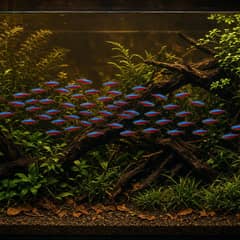
This is the detail that takes a neon tetra tank from adequate to great. Driftwood and Indian almond leaves release natural tannins that stain the water slightly and lower pH, mimicking the blackwater habitat this species evolved in.
Fish kept in tannin-stained, driftwood-conditioned water consistently show better color and confidence than fish in a bright, tannin-free setup, even though the water itself and diet are otherwise identical. Pair this with dense midground live plants and some floating plants to dim the light further, and this species goes from surviving to thriving.
Let the Tank Mature Before the Fish Go In
A tank that has just finished cycling is ready for hardy fish, and neons are not one of them. They react to shifts in water chemistry more than most community species, and a young tank still drifts in pH and hardness as the driftwood leaches, the substrate settles and the bacteria colony grows into its load. Give the cycled tank time to hold steady readings from one weekly test to the next before the school goes in.
The same sensitivity sets the size of every water change. Match the new water's temperature and chemistry to the tank, and keep changes modest and regular, so the school never meets a sudden jump.
Always quarantine new fish for at least 30 days before adding them, given the disease risk this species carries, and keep them well fed on a proper micro-pellet or micro-crisp food sized for their small mouths. Always use a water conditioner on tap water before it goes in the tank, dechlorinating and neutralizing chloramine and heavy metals that are otherwise harmful to fish.
The Neon tetra encyclopedia profile has more on the species itself.
Sources & Further Reading
Last reviewed 24 Sep 2026 · 3 sources
Frequently Asked Questions
What size tank does a school of neon tetras need?
10 gallons for a school of 6, which is the practical floor. For the better group of 10 to 15, move up to a 20-gallon long. Schooling happens sideways, so favor length over height.
What temperature do neon tetras need?
70 to 81°F works, and 72 to 78°F is the usual target. A heater is necessary in any tank of 10 gallons or more, and holding the temperature steady matters as much as the number itself, since swings stress this fish more than a slightly imperfect setting.
What water chemistry do neon tetras need?
Soft and slightly acidic: pH 6.0 to 7.0, low hardness. That's a real step away from the harder, more alkaline water species like guppies tolerate, so test your source water before assuming it fits. Ammonia and nitrite both need to read zero.
What kind of filtration is best for a neon tetra tank?
Gentle flow, since neons dislike strong current. A sponge filter is the common choice, and a hang-on-back works if you baffle or reduce the output.
What's the non-obvious detail that makes the biggest difference in a neon tetra tank?
Recreating blackwater conditions. Driftwood and Indian almond leaves release tannins that tint the water and lower pH, which is the habitat this species evolved in, and fish kept that way show better color and confidence. Add dense midground plants and floating plants to dim the light.
More on the Neon Tetra
Neon Tetra care guide
🐠 How Much Does Neon Tetra Ownership Really Cost?
🐠 Neon Tetras Aren't Handled, But the School Size Isn't Optional
🐠 Common Neon Tetra Health Issues (Including the Disease Named After This Fish)
🐠 Neon Tetra Feeding: Schedule, Diet, and the Rule That Prevents an Outbreak
🐠 Neon Tetra Enrichment: Someone Counted, and the Number Is Ten
Recommended Gear
As an Amazon Associate I earn from qualifying purchases through the links above, at no extra cost to you.

Written by Michael Ryan
Mike keeps two rescued bearded dragons, Dex and Cera, and writes the care guides on BeastlyFacts from his own research and mistakes. He is not a veterinarian.
More about Michael Ryan →