Can a Manta Ray Sting You? Meet the Gentle Giant of the Rays
On This Page▾

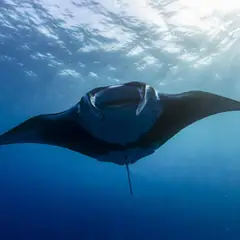
No. A manta ray cannot sting you. Unlike many rays, its short, whip-like tail has no working barb, and it is of little danger to people. The biggest ray in the ocean spends its days eating some of the smallest food there is.
So if a manta glides over you on a dive, you can relax. You are not on the menu. Mantas have the largest brain for their body size of any cold-blooded fish, they are curious, and the right response to one is to give it space, not to fear it.
How Is a Manta Ray Different From a Stingray?
Mantas and stingrays are both rays, but only one of them has a sting. A stingray's tail carries the barb that made the family infamous. A manta's tail does not.
The giant manta does keep a leftover of that spine. It sits buried in a lump of hardened cartilage at the base of the tail, with only about an eighth of an inch of its tip showing. The lump is not even fixed to the tail: it sits under the skin and comes loose easily once the skin is off. Oddly, the buried spine still has the serrated edges of a stingray's barb, but with nothing to drive it into anything, it is a relic, not a weapon. The reef manta, the other manta species, does not have the spine at all, and the giant manta's is so well hidden that some field guides describe its tail as having no spine either.
Rays are close cousins of sharks, which is part of how the manta ends up on lists of scary sea animals. Even there the fear runs well ahead of the numbers: sharks are far less dangerous than their reputation, and a manta is less dangerous than that.
Can a Manta Ray Bite You?
Not in any way that matters to you. A manta has teeth, but they do nothing when it feeds. A manta ray eats like a whale shark: it is a filter feeder. It swims along with its mouth open, straining huge amounts of zooplankton, the tiny drifting animals of the ocean, out of the water.
The two "horns" on its head help with that. They are flaps called cephalic lobes, and they funnel plankton into the manta's mouth. They are also the reason mantas got the nickname devil fish.
Do Manta Rays Drown Swimmers or Sink Boats?
Neither. One old story says mantas wrap their wings around swimmers and drown them. Another says they leap out of the water and crash down on boats hard enough to flip them. Both are myths.
The leaping part is real, though. Mantas have been seen jumping as high as 7 feet out of the water. They just come back down in the sea, not on top of a boat.
How Big Do Manta Rays Get?
Very big. The giant manta is the world's largest ray, with wings that can stretch up to 26 feet across, and the very biggest may reach 29 and weigh as much as 4,000 pounds. Most are smaller. Males usually measure about 17 to 20 feet from wingtip to wingtip, and females about 18 to 22. That is still 20 feet of ray without a sting anywhere on it.
Is a Manta in More Danger From You?
Yes. Divers meet mantas most often at cleaning stations on the reef, where small wrasse fish pick parasites and dead skin off them like a car wash for rays. Mantas will come over to divers on their own, and the ones that meet people often learn to keep their distance. Every manta has its own pattern of spots on its belly, like a fingerprint, which is how researchers keep track of them. NOAA's advice is simple: never try to lure one closer.
The real danger is fishing. Mantas are caught for their gill plates, which are traded internationally, and they cannot replace their losses quickly. A manta can live at least 45 years, but a female usually has only one pup every two to three years. In the United States, the giant manta ray is listed as threatened under the Endangered Species Act.
So the devil fish has horns for scooping plankton, teeth it does not use and a spine buried under its skin. Of the two of you, you are the dangerous one.
Sources & Further Reading
Last reviewed 25 Nov 2026 · 6 sources
- NOAA Fisheries: Giant Manta Ray
- Animal Diversity Web, University of Michigan: Manta birostris
- National Geographic: Manta Ray; New manta ray species discovered
- National Marine Sanctuary Foundation: Manta Rays vs. Stingrays
- Marshall, A.D., Compagno, L.J.V. & Bennett, M.B. 2009. Redescription of the genus Manta with resurrection of Manta alfredi. Zootaxa 2301:1-28 (species treatment on Plazi)
- Florida Fish and Wildlife Conservation Commission: Giant manta

Written by Michael Ryan
Mike keeps two rescued bearded dragons, Dex and Cera, and writes the care guides on BeastlyFacts from his own research and mistakes. He is not a veterinarian.
More about Michael Ryan →You May Also Like


More on the Giant Manta Ray
Beastfiles

More wild reads