Are Pet Poison Dart Frogs Poisonous? The Toxin Comes From Their Food
On This Page▾

No. A poison dart frog raised in captivity is not poisonous. The frog does not make its own toxins. It eats them, from the wild ants and mites on the forest floor, and stores them in its skin. A frog that grows up on fruit flies and crickets has nothing to store.
That is why a poison dart frog can sit in a glass tank at a zoo or in someone's living room and harm nobody.
Where Does the Poison Come From?
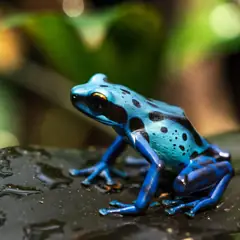
From dinner. Wild dart frogs, the blue poison dart frog among them, eat a steady diet of tiny ants, mites and other small arthropods, and some of those carry chemical defenses called alkaloids. The frog keeps the alkaloids instead of breaking them down, and stores them in its skin.
The name for this is sequestration: taking another animal's chemical weapon and making it your own. Poison dart frogs were the first animals with four legs found doing it. Ants and mites turned out to be the most important suppliers.
For one group of these toxins, the pumiliotoxins, the exact source is known. They come from two kinds of tiny ants, and when researchers checked the stomachs of a small dart frog from the same forest, the ants were in there. So far those ants are the only known food source for that group of toxins.
What Happens When the Menu Changes?
The poison goes away. Dart frogs raised in captivity have no detectable alkaloids at all. They still have the machinery to collect toxins, though. Feed a captive frog alkaloids in its diet, and it stores them just like a wild one would. It is choosy about it, too: the frog does not keep everything it swallows, only certain alkaloids.
So the poison is not in the frog. It is in the frog's menu.
Dart frogs are not alone in this. Another group of frogs, the mantellas, works the same way: raised in captivity they carry no detectable toxins, and given the right food they start storing them.
A captive frog keeps its color, though. The bright blue is a warning sign the frog wears whether or not it has anything to back it up, and in the wild, predators learn to leave that color alone.
Not every dart frog collects toxins, either: many do, but not all. And a wild-caught frog can still carry the toxins it collected in the forest, which is one more reason captive-bred frogs are the only ones that belong in a home.
Were Dart Frogs Used on Darts?
Yes, but only a few of them. The Emberá Chocó, an Indigenous people of western Colombia, rely on three local and highly toxic frog species to poison their blowgun darts. Hunters rub their handmade darts along a frog's back. A single golden poison frog can supply enough toxin for 30 to 50 darts, and the darts stay potent for about a year. One raised on fruit flies could not arm a single one.
Out of the many dart frog species, those three are the ones that earned the family its name. The blue poison dart frog is not one of them. Most dart frogs never came anywhere near a dart.
Why Would a Frog Eat Poison?
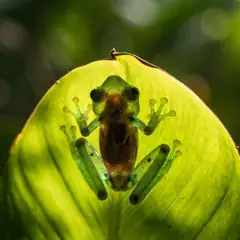
Because it pays. A small frog hopping around in the open, in daylight, should be an easy meal. Some frogs solve that problem by disappearing: a sleeping glass frog hides its own blood to turn see-through. A dart frog goes the other way and advertises. Predators learn that the brightest frogs taste terrible, or worse, and they stop trying. The frog gets that protection for free, from food it was going to eat anyway.
It is a clever trick: let the ants do the chemistry, then wear the result. A blue poison dart frog raised on fruit flies keeps the color and the attitude, and skips the poison.
Sources & Further Reading
Last reviewed 24 Nov 2026 · 3 sources
- Saporito, Garraffo, Donnelly, Edwards, Longino and Daly, "Formicine ants: An arthropod source for the pumiliotoxin alkaloids of dendrobatid poison frogs," PNAS 101(21), 2004
- Savitzky et al., Chemoecology, 2012, on toxins that animals sequester from their food
- American Museum of Natural History: Dart Poison
Written by Michael Ryan
Mike keeps two rescued bearded dragons, Dex and Cera, and writes the care guides on BeastlyFacts from his own research and mistakes. He is not a veterinarian.
More about Michael Ryan →You May Also Like
More on the Blue Poison Dart Frog
Beastfiles
More wild reads