The Giraffe Heart Myth, and What Is Actually Extreme About Giraffe Circulation
On This Page▾

Ask anyone why a giraffe needs a special heart and you will get the same answer. The blood has to travel two meters straight up to reach the brain, so the pump has to be enormous. Most sources put it at 11 kg, about 25 pounds, roughly the weight of a car tire.
It is a good story. It is also not what the measurements show, and the researchers who did the measuring have been saying so for a while now.
Where the 25 Pound Heart Came From
The claim traces to a 1955 report by Goetz and Budtz-Olsen, who concluded that the giraffe's famously high arterial pressure was achieved by way of an exceptionally large heart. That framing stuck, and it has been copied forward ever since.
The awkward detail is that it was already contradicted. Edward Crisp had reported normal mammalian heart size in giraffes back in the middle of the nineteenth century, a century before Goetz. The 1955 paper appears to have been simply wrong, and nobody rechecked for decades.
When people finally did, the answer was unambiguous. Smerup and colleagues, publishing in the Journal of Experimental Biology in 2016, measured giraffe hearts at 0.53 percent of body mass, plus or minus 0.05. Typical mammals sit at 0.5 to 0.6 percent. A giraffe's heart is exactly the size you would predict from its body weight and nothing more.
The 11 kg figure is not invented, incidentally. A very large bull giraffe really can have a heart in that range, because a very large bull giraffe weighs close to 2,000 kg. The error is not the number. The error is the word "exceptionally". Scale it against the animal and the heart is ordinary.
What Is Actually Extreme
The pressure is real, and it is the genuinely remarkable part.
Mean arterial pressure in the giraffes Smerup's team studied ran 224 mmHg, with left ventricular systolic pressure at 234 mmHg. A healthy human sits near 90 mmHg mean. So a giraffe runs at roughly two and a half times human pressure as its normal, resting, healthy state. In a person those numbers would be a hypertensive emergency.
The adaptation that makes this survivable is not size but wall thickness. The septal wall measured 2.9 cm in diastole and 3.6 cm in systole, with a wall-to-cavity ratio far above what other mammals show. A thick wall spreads the tension across more muscle, which is what lets the chamber hold that pressure without tearing.
There is a cost, and it is the part almost nobody mentions. That thick wall leaves less room inside. Stroke volume came in at 0.59 ml per kg, and cardiac output at roughly 33 ml per kg per minute, about half what you would expect from a mammal that size. The giraffe heart is not a bigger pump. It is a higher pressure, lower volume pump, which is a genuinely different piece of engineering.
| Measure | Giraffe | Typical mammal |
|---|---|---|
| Heart mass as share of body mass | 0.53% | 0.5 to 0.6% |
| Mean arterial pressure | 224 mmHg | ~90 to 100 mmHg |
| Cardiac output per kg | ~33 ml/kg/min | roughly double the giraffe figure |
| Septal wall thickness (diastole) | 2.9 cm | proportionally much thinner |
The Drinking Problem, and Why the Usual Answer Is Wrong
Here is the second myth, and it is repeated even more confidently than the first.
A giraffe lowering its head to drink drops its brain about two meters below its heart. The standard explanation says one-way valves in the jugular veins snap shut to stop blood flooding the skull, and a siphon effect handles the return trip, so the energy spent lifting blood up the neck is recovered coming down.
A 2025 review by Aalkjær and colleagues rejects the siphon idea outright. Theoretical and mechanical models do not support it, for a straightforward reason: a collapsed vein cannot sustain a siphon. The pressures were measured directly, and distal jugular venous pressure during drinking, while markedly elevated, was not enough to drive blood back toward the heart against gravity.
The valves are real but less tidy than advertised. Surveys of jugular anatomy found no uniform pattern in whether valves are bicuspid or tricuspid, and at least one giraffe examined had no valves at all in its left jugular vein. Whatever the valves do, an animal missing them on one side was walking around drinking normally.
What actually happens when the head goes down is that blood pools. Roughly 1.4 liters, about 5 percent of total blood volume, sequesters in the jugular veins. Heart rate drops by around 14 beats per minute. The system is running much closer to its limits than the confident textbook diagram suggests, and the review notes that a 10 percent reduction in circulating blood volume cuts proximal carotid pressure by 30 percent.
The 2025 review proposes something genuinely new for how that pooled blood gets home: the act of swallowing. Esophageal peristalsis running down the neck appears to squeeze the adjacent valved jugular veins, pushing blood back toward the heart. The authors call it a mechanism unique to this species. A drinking giraffe may be pumping its own neck veins every time it swallows.
As for staying conscious when the head comes back up, there is no single trick. The review credits a combination: raised cerebrospinal fluid pressure, myogenic vasoconstriction in the cerebral arteries strongest around 100 mmHg, sympathetic innervation, and a transient drop in vascular resistance on elevation. It is layered redundancy rather than one clever valve, which is usually how real physiology turns out. The same thing happened with the wombat's cube-shaped droppings, where the neat single-cause explanation was wrong and the real answer took a decade to assemble.
The Neck Bone Fact, With the Interesting Half Restored
Giraffes have seven cervical vertebrae, the same as humans and nearly every other mammal. That one is true and correctly repeated.
The part that gets dropped is that anatomists have argued for years about whether seven is the honest count. Solounias proposed in 1999 that the giraffe escapes the rule of seven entirely, with an extra vertebra inserted and the whole arrangement of muscle attachments and the brachial plexus shifted back by one position. The current view, supported by Danowitz and Solounias in 2015 and Müller and colleagues in 2021, is subtler: the giraffe keeps seven true cervicals, but the first thoracic vertebra has been functionally converted into a neck bone. It still bears ribs, so it is technically thoracic, yet it carries a functional transverse foramen and an elongated flat transverse process, and it moves with the neck.
So the fact survives, with an asterisk that is more interesting than the fact. Seven vertebrae, plus one doing the job of an eighth.
Two More That Hold Up
There are four species of giraffe, not one. Genetic work led by Fennessy in 2016 found four deeply distinct lineages that do not interbreed in the wild, separated by differences comparable to those between polar and brown bears. This stayed contested for years, but in August 2025 the IUCN's Giraffe and Okapi Specialist Group completed a taxonomic assessment and formally recognized all four: northern, reticulated, Masai and southern giraffe. Anything published before late 2025 calling the giraffe a single species is simply out of date.
Giraffes hum at night. Researchers at the University of Vienna recorded more than 947 hours of audio across zoos in Berlin, Copenhagen and Vienna, and found sustained, harmonic humming that occurs only after dark. Mean fundamental frequency was 92 Hz, ranging from 35 to 144 Hz. Note what that rules out: 92 Hz is not infrasound. It sits squarely in human hearing range, which quietly contradicts the popular claim that giraffes communicate below our hearing threshold. They were audible the whole time. Nobody had spent 947 hours listening.
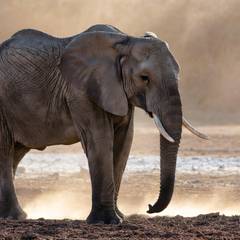
The infrasound claim had to come from somewhere, and it did: elephants really do talk below human hearing, at frequencies that carry for miles. The trait got borrowed by a neighboring animal it does not belong to.
That is the pattern with giraffes, and with the alpha wolf story before it. The famous version of the fact is usually a real observation that got compressed, then repeated until the compression became the claim. The heart is normal and the pressure is extraordinary. The valves exist and the siphon does not. Seven vertebrae, and an eighth that is pretending.
The full profile is in the Beastlypedia giraffe file.
Sources
Last reviewed 23 Jul 2026 · 10 sources
- The thick left ventricular wall of the giraffe heart normalises wall tension, but limits stroke volume and cardiac output, Journal of Experimental Biology 219:457-463 (Smerup, Damkjær, Brøndum, Baandrup, Kristiansen, Nygaard, Funder, Aalkjær, Sauer, Buchanan, Bertelsen, Østergaard, Grøndahl, Candy, Hasenkam, Secher, Bie and Wang, 2016)
- Hemodynamics and Drinking in the Giraffe (Aalkjær et al., 2025, PMC12012874)
- An allometric analysis of the giraffe cardiovascular system, Comparative Biochemistry and Physiology Part A (Mitchell and Skinner, 2009)
- Jugular venous pooling during lowering of the head affects blood pressure of the anesthetized giraffe, American Journal of Physiology (Brøndum et al., 2009)
- Four giraffe species officially recognised in major conservation reclassification (IUCN press release, August 2025)
- An Evaluation of the Taxonomic Status of Giraffe (Giraffa spp.), IUCN SSC Giraffe and Okapi Specialist Group Taxonomic Task Force, August 2025
- Nocturnal "humming" vocalizations: adding a piece to the puzzle of giraffe vocal communication, BMC Research Notes 8:425 (Baotic, Sicks and Stoeger, 2015)
- The Cervical Osteology of Okapia johnstoni and Giraffa camelopardalis, PLOS ONE 10(8):e0136552 (Danowitz, Domalski and Solounias, 2015)
- Pushing the boundary? Testing the "functional elongation hypothesis" of the giraffe's neck, Evolution 75(3):641-653 (Müller et al., 2021)
- The remarkable anatomy of the giraffe's neck, Journal of Zoology 247:257-268 (Solounias, 1999)

Written by Michael Ryan
Mike keeps two rescued bearded dragons, Dex and Cera, and writes the care guides on BeastlyFacts from his own research and mistakes. He is not a veterinarian.
More about Michael Ryan →Comments
No comments yet - be the first!