Beastfile · Marine Life
Octopus
Octopus vulgaris
Also known as Common Octopus
Three hearts, blue blood, and most of its neurons outside its head.
On This Page▾
Overview
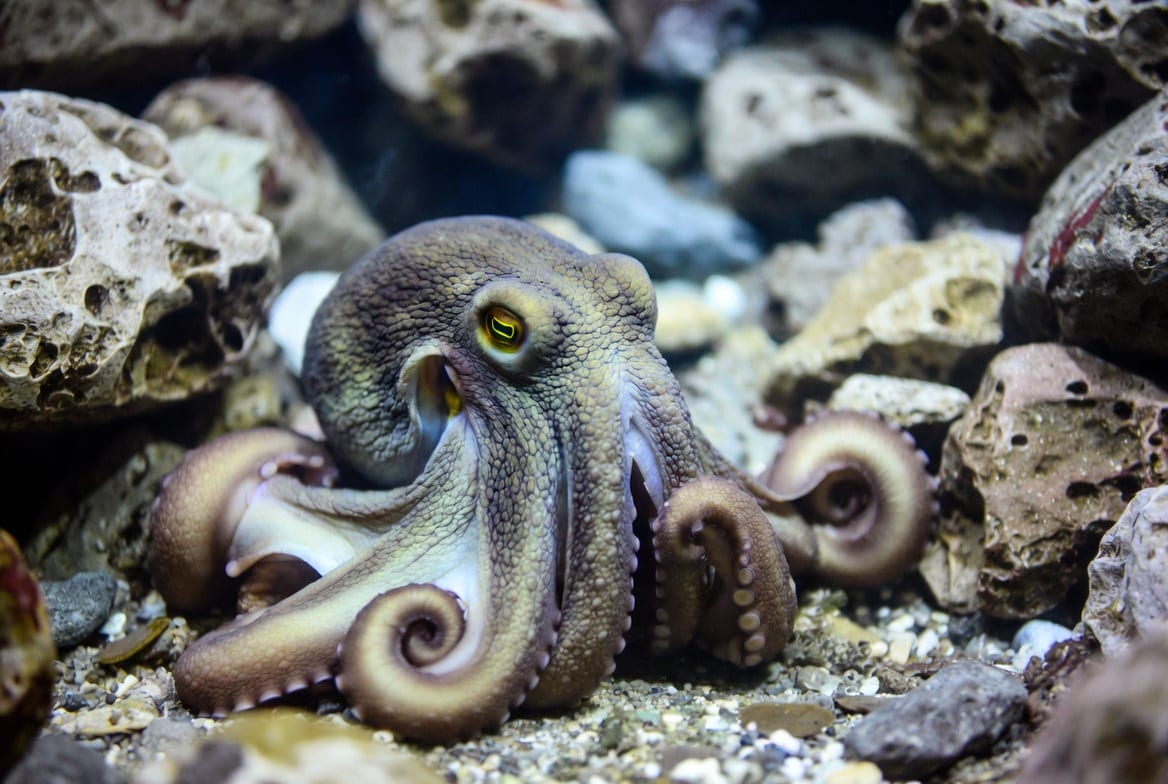
An octopus runs on a body plan assembled on a completely different branch from ours. Three hearts: two pump blood through the gills, one pumps it to the body, and that third one stops whenever the animal swims, which is part of why octopuses would rather walk. The blood is blue because it carries oxygen on copper-based hemocyanin rather than iron. Around two thirds of its neurons sit in the arms rather than the brain, so an arm can solve a good deal of a problem on its own. It has no bones at all, so anything its beak fits through, it fits through.

Origin
Temperate and tropical seas worldwide, in rocky reef, seagrass and rubble in shallow coastal water, denning in crevices.
Habitat
OceanNotable Traits
- •Three hearts, one of which stops while swimming
- •Blue, copper-based blood
- •Two thirds of its neurons are in its arms
- •No bones, so it fits through any gap its beak clears
- •Changes color and skin texture in under a second
Conservation
Least Concern, and heavily fished. The species is widespread and fast-growing, which buffers it, but octopus fisheries are expanding quickly and are largely unmanaged.
🤯 Fun Facts
📁 Related Files
An octopus has nine brains, one in each arm.
It has one, a ring around its throat, plus a nerve cord running down every arm. That is remarkable enough without the upgrade.


10 Surprising Octopus Facts
Think you know octopuses? These 10 facts reveal their three hearts, blue blood, and remarkable problem-solving
🐾 More Beastfiles
Marine Life
Cuttlefish
It puts on the best color display in the ocean and probably cannot see color.
Marine Life
Humpback Whale
Every male in an ocean sings the same song, and the song changes together.
Marine Life
Giant Manta Ray
Seven meters across, filter-feeding, and one of the few fish to pass a mirror test.
Marine Life
Leafy Sea Dragon
A relative of the seahorse pretending, very convincingly, to be seaweed.