Is a Leafy Sea Dragon a Seahorse? Close Family, Very Different Fish
On This Page▾

A seahorse can hold on. A leafy sea dragon can only drift. It is not a seahorse, but it is a close cousin. Both belong to the same family of fish, about 278 species of seahorses, pipefish, pipehorses and seadragons, and only three of them are seadragons, all of them Australian.
Put a seahorse and a leafy sea dragon side by side and you would not guess they were relatives. They share the tube snout and one famous family habit, and then they go their separate ways.
How Is a Leafy Sea Dragon Different From a Seahorse?
Start with the way it floats. A seahorse hangs upright in the water. A leafy sea dragon swims level, like an ordinary fish, and it has no tail fin at all.
Then the tail. A seahorse uses its curly tail like a hand to grab onto plants and stay put. A leafy sea dragon's tail cannot coil, so it has nothing to hold on with. Instead of anchoring itself, it goes where the water goes, using its tail as a rudder.
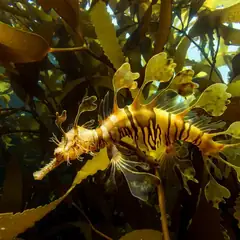
And the outfit. A leafy sea dragon is covered in flaps that look like leaves, sprouting from its head, its body and its tail. Some seahorses grow a few skin filaments, but nothing like this. A leafy sea dragon can reach about 14 inches long, which is a lot of fish to hide, and that is where the leaves come in.
What Are the Leaves For?
Hiding. The leafy flaps are not fins and they do not help the animal swim. They make a sea dragon look like a drifting clump of seaweed, so it can float through kelp and weed beds without anything noticing it is a fish. The real swimming is done by two tiny fins so thin they are nearly see-through, which only adds to the trick.
The disguise is built for one coastline. The leafy sea dragon lives only along the southern and western coasts of Australia, in kelp beds, seagrass meadows and rocky reefs, where the water is cool and fairly shallow. That is a small address, and a risky one: its kelp and seagrass sit close to shore, right where people build, and habitat damage tops the list of threats it faces, along with pollution and fertilizer runoff.
Did Sea Dragons Lose the Gripping Tail?
They never had it. The gripping tail is not an old family heirloom that seadragons threw away. It evolved several separate times inside the family, in seahorses and again in their cousins the pipehorses, and the leafy sea dragon's line simply never got one.
The family can go either way, and the proof turned up recently. In 2015, scientists named a third seadragon, the ruby seadragon, the first new one in about 150 years. A specimen had been sitting unrecognized in the Western Australian Museum since 1919. When the ruby seadragon was finally filmed alive in 2017, in water more than 160 feet deep, it had a curled tail like a seahorse's and no leafy flaps at all.
Does a Leafy Sea Dragon Have Teeth?
No teeth, and no stomach either. A sea dragon eats by sucking up tiny critters through its long snout, like a living straw. Nothing gets chewed. That snout is one of the features it shares with the seahorse and the pipefish: all three are built to slurp, not bite.
Do Male Sea Dragons Carry the Eggs?
Yes, and this is where sea dragons stay true to the family. Just like a seahorse, it is the father who looks after the eggs. The female lays 250 to 300 of them, and the male carries them on the underside of his tail.
How he carries them is the difference. Across the family, fathers range from ones that simply glue the eggs to their bodies to seahorses, which have a fully sealed pouch for their pregnancy with one small opening. A leafy sea dragon father has no pouch. His eggs sit out in the open on a spongy patch of skin under his tail.
He carries them for about four to eight weeks, and they change color as they go, from bright pink to purple or orange. When they are ready, he does not let them all go at once. He pumps his tail and pushes the babies out a few at a time, and each one lives off its yolk for about two days before it starts hunting.
So a sea dragon dad drifts through the kelp disguised as seaweed, unable to grab onto anything, with a few hundred color-changing eggs riding along underneath.
Sources & Further Reading
Last reviewed 25 Nov 2026 · 6 sources
- Aquarium of the Pacific: Leafy Seadragon
- Ocean Conservancy: 7 Spectacular Facts About Seadragons
- Oceana: Leafy Seadragon
- Project Seahorse: Biology of seahorse relatives
- Neutens, C., Adriaens, D., Christiaens, J., et al. 2014. Grasping convergent evolution in syngnathids: a unique tale of tails. Journal of Anatomy 224:710-723
- UC San Diego News: the ruby seadragon named (2015) and first seen alive (2017)
Written by Michael Ryan
Mike keeps two rescued bearded dragons, Dex and Cera, and writes the care guides on BeastlyFacts from his own research and mistakes. He is not a veterinarian.
More about Michael Ryan →You May Also Like


More on the Leafy Sea Dragon
Beastfiles
More wild reads