Beastfile · Marine Life
Leafy Sea Dragon
Phycodurus eques
Also known as Leafy Seadragon, Glauert’s Seadragon
A relative of the seahorse pretending, very convincingly, to be seaweed.
On This Page▾
Overview
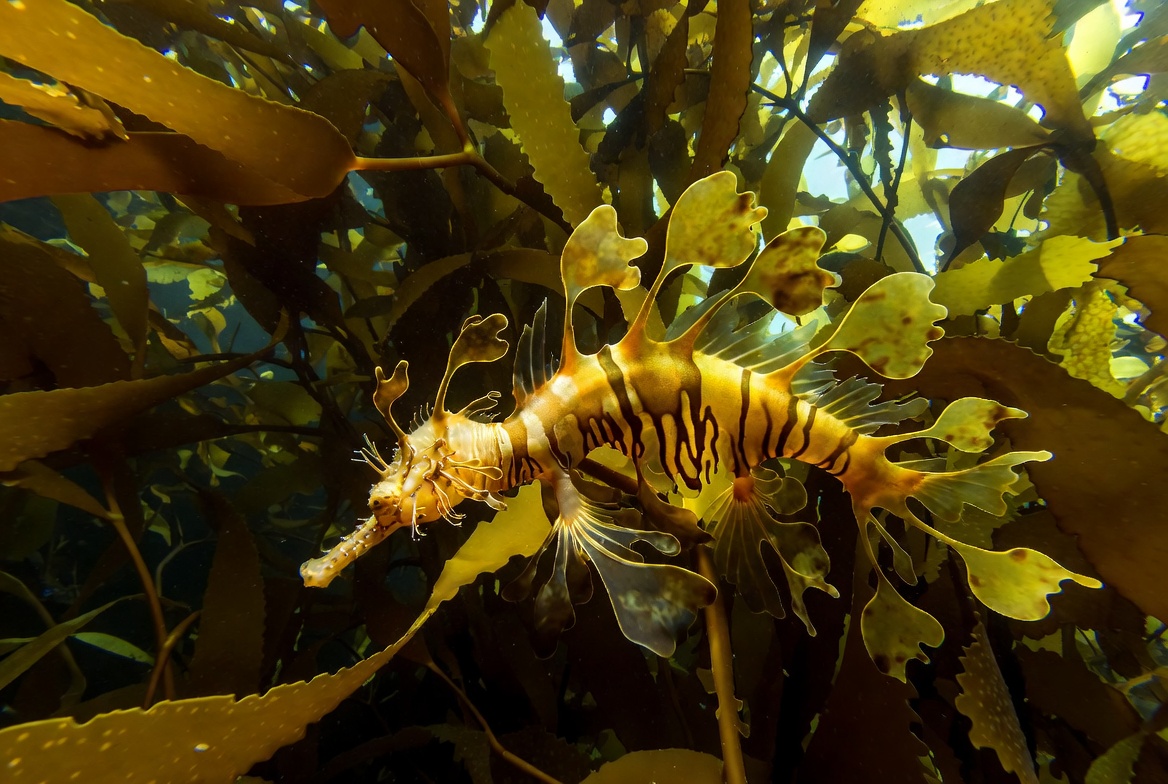
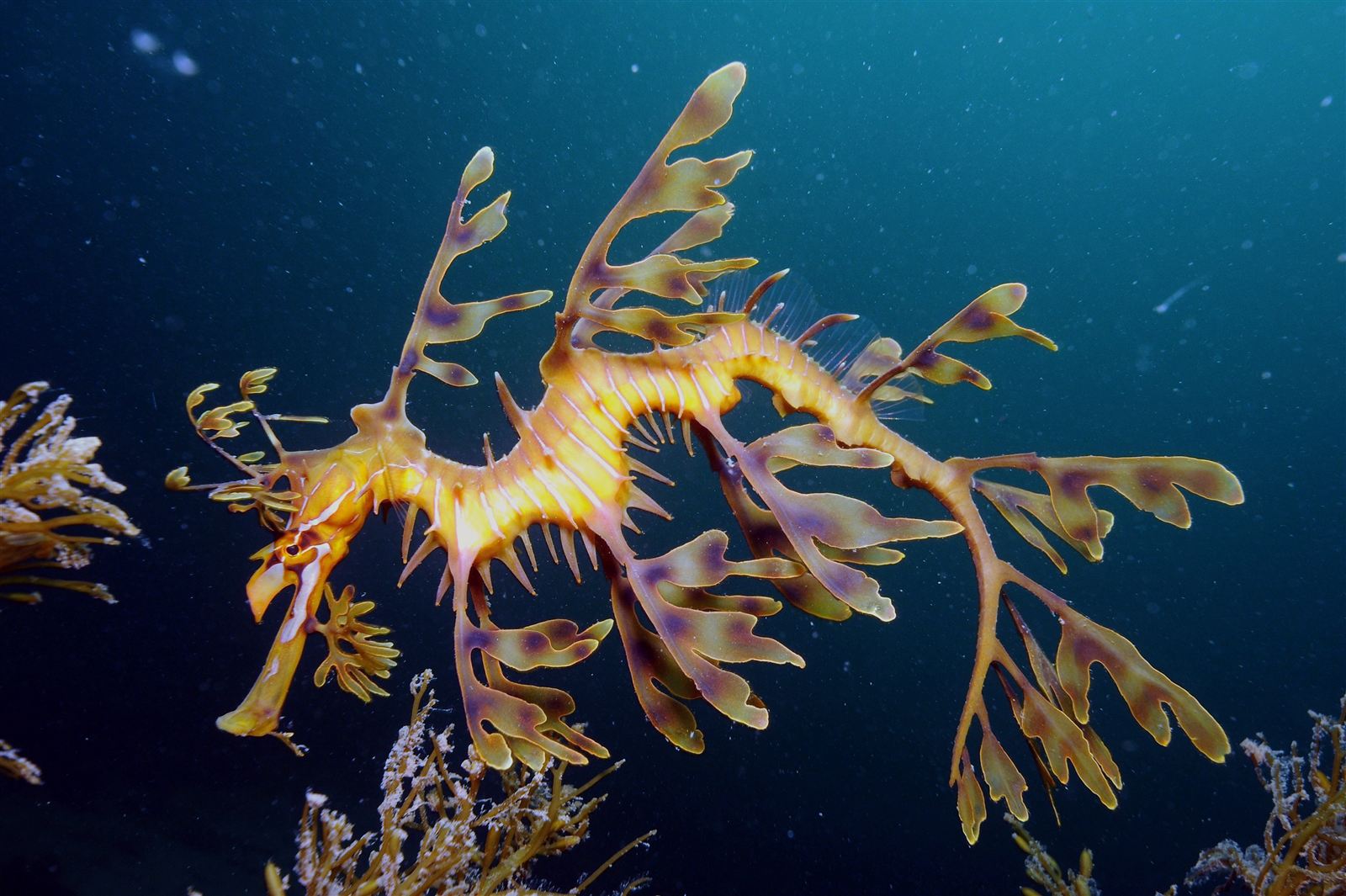
The leafy sea dragon is a southern Australian fish related to seahorses and pipefish, and its whole strategy is imitation. Leaf-shaped lobes sprout along its body and do nothing for swimming; they exist to break up its outline among kelp and seagrass. Movement comes from two nearly transparent fins that beat fast enough to be almost invisible, so the animal appears to drift. It has no teeth and no stomach, and feeds by sucking tiny crustaceans through a long snout, eating more or less continuously. As with seahorses, the male carries the eggs, in his case fixed to a spongy patch under the tail.
Origin
Endemic to the southern and western coasts of Australia, in kelp beds, seagrass meadows and rocky reef in relatively shallow, cool water.
Habitat
OceanNotable Traits
- •Leaf-shaped lobes for camouflage that play no part in swimming
- •Moves using two near-invisible transparent fins
- •No teeth and no stomach, so it must feed almost constantly
- •The male carries the eggs beneath his tail
- •Cannot curl its tail to grip, unlike a seahorse
Conservation
Least Concern on current assessment but protected under Australian law, with collection restricted. Its narrow range makes it sensitive to habitat damage, pollution and warming water.
🤯 Fun Facts
🐾 More Beastfiles
Marine Life
Clownfish
Every clownfish is born male, and the largest one becomes female.
Marine Life
Immortal Jellyfish
It can run its own life cycle backwards, which is not the same as not dying.
Marine Life
Seahorse
The male gets pregnant, and it is a real pregnancy, not just carrying eggs.
Marine Life
Sharks
Older than trees, older than Saturn’s rings, and barely a threat to anyone.