How to Handle a Madagascar Hissing Cockroach (And How That Hiss Works)
On This Page▾

Madagascar hissing cockroaches are docile for an insect, more so than most people expect, but this is fundamentally a display and observation pet, not a handling-focused one.
What Handling Looks Like
They don't bite, aren't aggressive, and move slowly enough to make gentle handling manageable, which is exactly why this species is a classroom and educational staple. The correct technique is to pick one up gently around the thorax, or let it walk from hand to hand instead of gripping it. Never jerk or pull, their sticky foot pads and leg hooks grip surfaces tightly, and pulling against that grip can genuinely injure the insect.
Their sharp leg spines are a real defensive feature, and can scratch or draw a small amount of blood if the roach is held down or restrained against its will. Wash your hands before and after handling: they can carry Salmonella like most reptiles and invertebrates.
The Hiss, Explained Properly
This is the detail that makes the species interesting, and it's worth getting the mechanism right. The hiss comes from air being forced through a modified spiracle, a breathing pore, on the side of the abdomen, not from vocal cords and not from rubbing body parts together the way crickets or cicadas produce sound. This is a respiratory mechanism, genuinely unusual among sound-producing insects, most of which use friction or vibrating membranes instead.
Both sexes can produce a disturbance hiss when startled, but a mating hiss and a fighting hiss are male specific. So the hiss you hear when you first pick one up is a shared, sex-neutral alarm response, while the more elaborate hisses used in courtship and rivalry are strictly a male behavior.
Signs It Is Stressed by You
The disturbance hiss is the stress sign, and it is graded. Varnon's 2025 habituation study of the hiss in PeerJ quotes Nelson and Fraser's 1980 description: a weak stimulus may produce a single hiss, while a strong one may cause a long series of hisses as the animal flees. A roach that hisses once when you lift the lid is noting you. One that hisses in a run and bolts for the substrate is telling you the approach was too fast or too much.
The same study is the reason the hiss stops meaning much in a settled pet. It cites Davis and Heslop (2004), who found the disturbance hiss habituated to handling in ten of twelve roaches, with another eight that never hissed at all, and four resumed hissing for a new handler. So a roach that has gone quiet in your hands has not stopped noticing you. It has stopped classing you as a threat, and a stranger's hand can bring the hiss back. The study also cites a finding that contact with a potential predator made the roach go still, with no hiss. A roach that freezes flat when touched is at least as stressed as one that hisses.
The colony context matters too: aggressive hissing and posturing is used to warn intruders away, and between males the larger one that hisses more usually wins. So a hiss aimed at your hand from a male on his log may be territory as much as fear, and the answer is the same either way: slow down, come in from the side, and let it walk onto the hand. A new arrival may skip meals while it settles, but beyond that, refusing food is not a recognized handling stress sign for this species.
Pet or Feeder? Same Species, Different Purpose
This exact species is sold both as a pet and as a feeder insect for larger reptiles, and it's worth understanding the distinction. As pets, they're valued for their manageable size, calm temperament, genuine longevity, and the hiss itself. As feeders, they're valued for their large body size and how well they gut-load nutrients for whatever's eating them. If you're keeping them as pets and not as feeders, a males-only group is a common, sensible choice, since it avoids the rapid breeding that feeder colonies are built for.
Keeping an All-Male Group
Adult males do fight. Each male claims a territory on a piece of bark or a rock and holds it for months, leaving only to find food and water. Females and nymphs are let in. Another male is not, and an intruder gets hissing, posturing, ramming with the horns on the pronotum and shoving with the abdomen until one of them backs off. The larger male usually wins, and the fights do not usually cause bodily harm. Occasional fighting is normal behavior for a male with room to hold a territory.
No published figure gives a safe number of males per tank. The limit is crowding: a high density of males raises aggression and the risk of injury, and in lab groups of 5 and of 10 males, the more crowded group shoved significantly more. What lets more males share a tank is structure. Horizontal cork bark and egg-crate stacks break the floor into more territories, each male does best with a piece he can hold plus a few spare, and a colony with many territorial males needs more than one food and water point so that no male can guard the only one. Add males only as fast as the shelters and floor space grow with them.
Sexing takes a glance once they are adults. Males carry a pair of large horns on the pronotum just behind the head, and females have only small bumps there.
First-Timer Mistakes
- Pulling a roach off a surface instead of letting it release its grip naturally.
- Handling too roughly or too frequently.
- Not applying an escape barrier around the enclosure.
How This Compares to Other Invertebrates
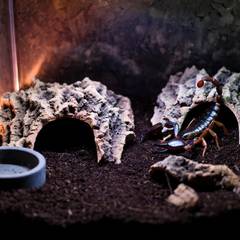
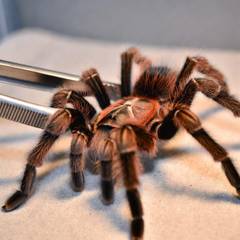
It stays a display pet first, but it is one of the few invertebrates in the hobby that takes routine, gentle handling well, rather than a look-don't-touch relationship built around a fall risk or a defensive bite. A tarantula or emperor scorpion both carry real risk in one direction or another during handling, while a hisser's biggest handling risk is being dropped or pulled against its own grip. It's still worth respecting, just a different category of interaction.
The Madagascar Hissing Cockroach encyclopedia profile covers the species itself.
Sources & Further Reading
Last reviewed 8 Sep 2026 · 4 sources
- Animal Diversity Web, University of Michigan: Gromphadorhina portentosa
- Varnon, PeerJ (2025): Habituation but not classical conditioning of the disturbance hiss of the hissing cockroach
- Clark and Moore, Journal of Insect Behavior (1994): Social interactions and aggression among male Madagascar hissing cockroaches in groups
- Association of Zoos and Aquariums: Madagascar Hissing Cockroach Ambassador Animal Guidelines
Frequently Asked Questions
Can you handle a Madagascar hissing cockroach?
Yes, more easily than most insects. They don't bite, they aren't aggressive, and they move slowly enough for gentle handling, which is why classrooms use them. Pick one up around the thorax, or let it walk hand to hand.
Why does a Madagascar hissing cockroach hiss?
Air forced through a modified spiracle, one of the breathing pores on the side of the abdomen. No vocal cords, and no rubbing body parts together the way a cricket does. Both sexes hiss when startled, while mating and fighting hisses are male specific.
Is it safe to handle a hissing cockroach?
Generally, yes. The sharp leg spines can scratch or draw a little blood if the roach is held down against its will, which is the main thing to avoid. Wash your hands either side of handling, since they can carry Salmonella.
Are pet hissing cockroaches the same as feeder roaches?
Yes, exactly the same species, sold for two different purposes. As pets they're valued for manageable size, calm temperament, longevity, and the hiss itself, as feeders they're valued for their large body size and how well they gut load nutrients. A males-only group is a common, sensible choice for pet keepers, since it avoids the rapid breeding that feeder colonies are specifically optimized for.
What mistakes do first-time keepers make when handling this species?
Pulling a roach off a surface instead of letting it let go on its own. Handling too roughly or too often. And skipping an escape barrier around the enclosure, since these are capable climbers.
More on the Madagascar Hissing Cockroach
Madagascar Hissing Cockroach care guide
🪳 How Much Does a Madagascar Hissing Cockroach Cost?
🪳 Common Madagascar Hissing Cockroach Health Issues (Prevention Does Almost All the Work)
🪳 Madagascar Hissing Cockroach Enclosure Setup: Humidity, Substrate, and Keeping Them From Climbing Out
🪲 Madagascar Hissing Cockroach Feeding: Schedule, Diet, and Why They Stop Eating
🪳 Hissing Cockroach Enrichment: Somebody Built Them a Welfare Framework

Written by Michael Ryan
Mike keeps two rescued bearded dragons, Dex and Cera, and writes the care guides on BeastlyFacts from his own research and mistakes. He is not a veterinarian.
More about Michael Ryan →