10 Surprising Madagascar Hissing Cockroach Facts

Say "cockroach" and most people picture something to avoid, not something to keep. Madagascar hissing cockroaches are a different animal, literally the loudest, cleanest, and most surprising member of the family.
-
They hiss through their abdomen, not their mouth. The sound comes from air forced rapidly through modified breathing holes (spiracles) on the fourth segment of their abdomen, a trick almost no other insect uses to make noise.
-
Their hiss can hit around 90 decibels and be heard from roughly 12 feet away, genuinely startling for an insect that's barely 2 to 3 inches long.
-
There isn't just one hiss. Researchers have identified four distinct types: a disturbance hiss when startled, a loud alarm hiss meant to scare off predators, and two separate hisses males use during courtship and combat with rival males.
-
Males do most of the hissing. They also carry raised "horns" behind the head, used to headbutt and wrestle rival males over territory and mates, something females don't do.
-
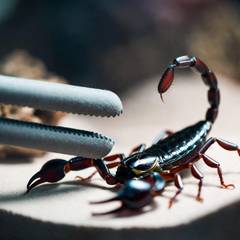
They give birth to live young. Most cockroach species lay a hardened egg case and abandon it, but hissing cockroaches keep the case inside the body until the nymphs are ready, then release them live, a strategy called ovoviviparity. Another popular invertebrate pet, the emperor scorpion, also gives birth to live young, then carries them on its back. A brood usually holds 15 to 40 nymphs, and a big female can reach about 60. The young molt six times over about seven months to reach adult size, and adults can live 2 to 5 years, long for an insect.
-
They live in stable, family-like colonies. Groups include overlapping generations living together with a recognizable social structure, rather than the solitary lives most insects lead.
-
They can't fly, and they're slow, but they are not escape-proof. Sticky pads and small hooks on their feet let them walk up smooth glass, which is why keepers rely on a tight lid and a band of petroleum jelly near the rim.
-
Many carry passengers that live nowhere else. A small mite, Gromphadorholaelaps schaeferi, spends its entire life on a single hissing cockroach, clustered between the legs. It is not a parasite: it eats the cockroach's saliva and the moist debris that collects there. The mite dries out so easily that it dies after losing about 20 percent of its water, and the cockroach's body is the humid microhabitat that keeps it alive. Its larva has no working mouthparts, so it molts almost at once to a stage that can feed.
-
They're endemic to Madagascar and can't survive outside a warm, humid climate. In the wild, they live in and under rotting logs, helping break down decaying plant matter as part of the local ecosystem.
-
Despite the reputation cockroaches have, they're surprisingly clean animals. They groom themselves regularly, don't carry the disease-vector reputation of pest cockroach species, and need real tropical heat and humidity to survive, so an escapee has no shot at becoming a household infestation.
That 90-decibel hiss is made entirely without vocal cords, since insects don't have any. It's pure airflow, forced through the same spiracles a cockroach normally just breathes through, repurposed into one of the loudest sounds any insect on Earth produces.
Which fact surprised you the most? Let me know in the comments.
Sources
Last reviewed 6 Jul 2026 · 4 sources
- Franklin Park Zoo: Madagascar Hissing Cockroach
- University of Kentucky Entomology: Madagascar Hissing Cockroaches
- Cockroach Care: Madagascar Hissing Cockroach Care, Size, and Facts
- Yoder et al. (2009), Role of permanent host association with the Madagascar hissing-cockroach on the developmental water requirements of the mite Gromphadorholaelaps schaeferi, Journal of Comparative Physiology B
More on the Madagascar Hissing Cockroach
Madagascar Hissing Cockroach care guide
🪳 How Much Does a Madagascar Hissing Cockroach Cost?
🪳 How to Handle a Madagascar Hissing Cockroach (And How That Hiss Works)
🪳 Common Madagascar Hissing Cockroach Health Issues (Prevention Does Almost All the Work)
🪳 Madagascar Hissing Cockroach Enclosure Setup: Humidity, Substrate, and Keeping Them From Climbing Out
🪲 Madagascar Hissing Cockroach Feeding: Schedule, Diet, and Why They Stop Eating
Written by Michael Ryan
Mike keeps two rescued bearded dragons, Dex and Cera, and writes the care guides on BeastlyFacts from his own research and mistakes. He is not a veterinarian.
More about Michael Ryan →