How Do Octopuses Change Color When They Are Colorblind?
On This Page▾

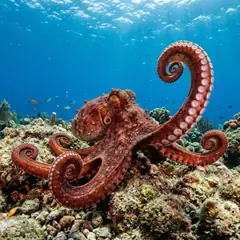
With its skin. An octopus's skin is packed with tiny sacs of pigment, each one pulled open by its own set of tiny muscles. Open the sacs and a color spreads across the skin. Relax the muscles and it vanishes. An octopus can do this in about half a second.
The puzzle is that the octopus doing it is almost certainly colorblind.
What Is in an Octopus's Skin?
Three kinds of cells, stacked in layers:
- Chromatophores are elastic sacs filled with pigment.
- Iridophores are stacks of thin, reflective plates that make shimmering colors by bending light.
- Leucophores are plain white reflectors that bounce back whatever light falls on them.
The chromatophores do most of the fast work. Each one is a pigment sac with 15 to 25 tiny muscle fibers around it, like spokes on a wheel. When those muscles pull, the sac stretches from a speck too small to see into a flat disk about a hundredth of an inch wide. That is roughly 30 times wider.
An octopus has about 150,000 of these sacs in every square inch of skin. Each one is a pixel, and the octopus is running the screen.
How Fast Can an Octopus Change Color?
Very fast. A small octopus foraging on a reef was recorded sending 33 pulses of color across its body, each lasting about 0.55 seconds. Its cousins can be quicker still: part of a cuttlefish hunting display takes under a quarter of a second.
It is not cheap, though. Running the whole color system at full blast costs almost as much energy as the octopus uses just resting. Looking like a rock is hard work.
Can Octopuses Change Their Texture Too?
Yes, and this might be the more impressive trick. Octopuses have papillae, bumps in the skin that muscles can raise into fine bumps, high ridges or even spiky horns. A smooth octopus resting on a reef can turn lumpy like the coral or seaweed around it in moments.
The papillae work the same way as the octopus's arms and our tongues: muscle pushing against muscle, with no bones involved. One set of muscles lifts the bump, another shapes it into a round bulge or a tall spike, and a third pulls it flat again. Flattening matters when it is time to flee, because smooth skin cuts drag while swimming.
Wait, Octopuses Are Colorblind?
Most likely. The vast majority of cephalopods, the group that includes octopuses, squid and cuttlefish, have only one kind of visual pigment in their eyes. One pigment means no color vision as we know it. (The firefly squid is a rare exception, with three.)
So how does a colorblind animal match its background so well? Nobody knows for sure. There are two leading ideas.
The first is that the skin helps. Researchers cut small pieces of skin from an octopus and shone light on them. The chromatophores expanded on their own, with no eyes or brain attached, and they reacted fastest to blue light. The skin itself can sense light, and that might play a role in camouflage. It has not been shown in a living, hunting octopus.
The second idea is that their oddly shaped pupils let them pick up color from the way light blurs. That looks unlikely, or at best of limited use in the wild. The question is still open.
Is It All Camouflage?
No. Hiding is the part everyone knows, but a lot of color change is talk: warnings, threats, courtship and mood. Many cephalopod displays are messages to other animals, not disguises.
Some of it may not be for anyone at all. Octopuses change color in their sleep. In the lab, bright colors raced across sleeping octopuses' bodies in episodes lasting about 40 seconds, roughly every half an hour.
The Octopus That Does Impressions
Then there is the mimic octopus, a long-armed species from Indonesia, discovered only in 1998. It does not just blend in. It pretends to be something else.
It can flatten out and swim like a poisonous flatfish. It can flare its striped arms like the venomous spines of a lionfish. And when a damselfish pesters it, it has been seen poking six arms down a burrow and waving the other two, banded like the sea snakes that hunt damselfish.
It may pick the act to suit the threat. That is hard to prove, because we cannot see the world the way other animals do. Either way, it is a colorblind animal doing impressions of other animals' colors, which is about as octopus as it gets.
Sources & Further Reading
Last reviewed 26 Nov 2026 · 5 sources
- How, M.J., Norman, M.D., Finn, J., Chung, W.-S. & Marshall, N.J. 2017. Dynamic skin patterns in cephalopods. Frontiers in Physiology 8:393
- Sonner and Onthank 2024, PNAS, on the energy cost of octopus color change
- Ramirez, M.D. & Oakley, T.H. 2015. Eye-independent, light-activated chromatophore expansion (LACE) and expression of phototransduction genes in the skin of Octopus bimaculoides. Journal of Experimental Biology
- Courage 2014. How the octopus creates instant 3-D camouflage on its skin. Scientific American
- Science News: It's a snake! No, a fish! An octopus? (Milius, 2001) and Octopus sleep stages (Sanders, 2021)
Written by Michael Ryan
Mike keeps two rescued bearded dragons, Dex and Cera, and writes the care guides on BeastlyFacts from his own research and mistakes. He is not a veterinarian.
More about Michael Ryan →You May Also Like
More on the Octopus
Beastfiles
More wild reads