How Does a Thorny Devil Drink? The Lizard That Drinks Through Its Skin
On This Page▾

A thorny devil drinks through its skin. Between its scales run tiny channels, less than a hundredth of an inch wide, and when the lizard touches water those channels pull it in and carry it across the body to its mouth. The lizard never has to lower its head.
It is a plumbing system built into a lizard covered in spikes, and it is how one of Australia's strangest animals gets by in the desert.
How Does the Water Move Across Its Body?
The same way water climbs a paper towel dipped in a glass: capillary action. In a narrow enough space, water clings to the walls and pulls itself along, and the thorny devil's channels are hair-thin gutters, just right for the job.
It moves fast. Put a drop on a thorny devil's skin and it races off at about half an inch a second at first, spreading more than a third of an inch in every direction within about 10 seconds. It even runs uphill: stand the lizard in a puddle and the water climbs its legs against gravity.
The skin does all the carrying. At the mouth, the lizard works its jaws to pull the water in, one tiny sip at a time.
How Much Can a Thorny Devil Drink?
More than you would guess from sips that small. In one experiment, six thorny devils stood with their feet in a shallow puddle for an hour, and they seemed perfectly content to stay there. They drank up to 3.3 percent of their body weight, in gulps of less than a thousandth of a teaspoon each, about the size of a pinhead.
The skin held about as much again. Once the channels are full, a thorny devil is carrying a thin coat of water across its whole body, ready to drink.
Why Can't a Thorny Devil Just Drink Normally?
Because its mouth is built for something else. A thorny devil's mouth and tongue are made for eating small ants, and the lizard cannot drink directly the way most animals do. So instead of bringing its mouth to the water, it brings the water to its mouth.
And ants are the whole menu. The thorny devil lives in the dry interior of Australia, from Western Australia across to western Queensland, and it eats nothing but ants: about 750 a day by one estimate, and thousands in a single day by others. It picks them off about three a minute on average, and has been clocked at one a second. Even Australia's other famous insect eater draws the line there: the numbat lives on termites and only swallows ants by accident.
Can a Thorny Devil Drink From the Air?
No, and this is the myth worth busting. It sounds like a perfect desert trick: dew forms on the spikes, then trickles down the channels. Dew was long the standard answer. Put to the test in a humid room, though, the condensation only wet the surface of the skin. It could not fill the channels at all, and without full channels the lizard cannot drink.
Damp sand needs help. Standing on even the wettest sand tested filled only 59 percent of the channels, not enough to drink from. So the lizard flicks moist sand onto its back, which helps fill the rest. Rain, puddles and moist sand are its main water sources.
Did Any Other Lizard Come Up With This?
Yes, on another continent. The Texas horned lizard, a spiky North American lizard that is no relation, evolved almost the same skin plumbing. There is one difference. A horned lizard's channels send water one way, toward the mouth. A thorny devil's spread it in every direction, so a drop landing anywhere on its body can reach the mouth.
Why Is a Thorny Devil Covered in Spikes?
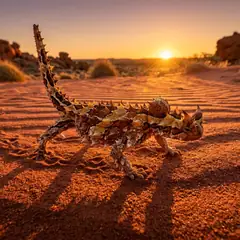
For the same reason it looks like a desert plant: to make itself a bad meal. Its body is covered in densely packed spikes, and the knob on its shoulders is a false head, a spare target for anything that bites. It walks with a rocking motion that probably confuses birds of prey, and its color shifts with the weather, pale yellow and red when warm and darker when it is cold or alarmed.
A thorny devil looks like it was built to be left alone, and it mostly is. It goes all in on ants, and drinks through its skin to wash them down.
Sources & Further Reading
Last reviewed 25 Nov 2026 · 5 sources
- Comanns et al., Royal Society Open Science, 2017, on water transport in the thorny devil's skin
- University of Western Australia: Flat out lizard drinking, thorny devil's remarkable desert survival (2016)
- Parks Australia, Uluru-Kata Tjuta National Park: Thorny devil
- Animal Diversity Web, University of Michigan: Moloch horridus
- EurekAlert, on Comanns et al. 2016, Journal of Experimental Biology: the thorny devil puddle and sand tests
Written by Michael Ryan
Mike keeps two rescued bearded dragons, Dex and Cera, and writes the care guides on BeastlyFacts from his own research and mistakes. He is not a veterinarian.
More about Michael Ryan →You May Also Like

More on the Thorny Devil
Beastfiles
More wild reads