Why Do Octopuses Die After Laying Eggs? Inside the Octopus Self-Destruct Switch
On This Page▾

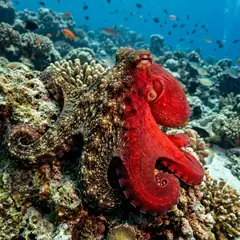
Because a gland near her eyes tells her to. After a female octopus lays her eggs, her optic gland switches her body into a self-destruct program. She stops eating, guards her eggs, wastes away and dies around the time they hatch.
It sounds like a mother too devoted to leave her eggs for a meal. The truth is stranger: it is a built-in program, and it can be switched off.
What Happens to a Mother Octopus?
Take the giant Pacific octopus. A female lays somewhere between 18,000 and 74,000 eggs, occasionally up to 100,000. She hangs them from the ceiling of her den in hundreds of strands of about 250 eggs each, like a beaded curtain.
Then she stays. For up to six months she guards the eggs, and she does not eat the whole time. By the end she is worn out. She dies around the time they hatch, and the hatchlings that drift away are about the size of a grain of rice.
For a giant Pacific octopus, which lives about three to five years, that one clutch is the whole point. The father does not last much longer: a male giant Pacific octopus usually dies within weeks to a few months of mating.
What Is the Optic Gland?
It is a small gland near the eyes, and it works a bit like our pituitary gland: it helps control reproduction and aging. Its role in the death spiral was proved in 1977 by Jerome Wodinsky, working with the Caribbean two-spot octopus. He removed the optic gland from mothers guarding eggs. They abandoned their eggs, started eating again and lived for months longer.
So the mother is not starving because she is busy. Something is telling her not to eat. It does not happen at once, either: a California two-spot octopus keeps feeding for the first few days on her eggs, then after about four days stops completely.
That something is chemical. In the California two-spot octopus, the optic gland makes a massive shift in how it handles cholesterol after egg laying. It starts making more of certain steroid hormones through at least three different chemical pathways.
The effects can be grim. In captivity, mothers near the end have been seen injuring themselves and twisting their arms into a tangled mess.
Who Holds the Record for the Longest Wait?
A deep-sea octopus off California. Researchers from the Monterey Bay Aquarium Research Institute found a female Graneledone boreopacifica guarding her eggs on a rock about 4,600 feet down, and kept checking on her. She was still there, month after month, year after year.
She guarded about 160 eggs for 53 months, nearly four and a half years. That is by far the longest any animal has ever been recorded guarding its eggs. There was no sign she ever ate, and she turned down crab offered on a robot arm. Over time she shrank, her skin went slack and her eyes clouded over. Shallow-water octopuses usually brood for one to three months, and even the giant Pacific octopus in its cold water tops out around six.
A Rescue Mission With a Turkey Baster
Sometimes people step in. Scientists at Scripps Institution of Oceanography in San Diego once rescued a North Pacific bigeye octopus that was brooding eggs and kept her in an aquarium. The eggs took about 10 months to hatch, and she died before they did.
So the researchers took over her job. To copy the way a mother's arms keep water moving over the eggs, they used a turkey baster to puff water across them. A kitchen tool standing in for an octopus mom.
Does Every Octopus Die After Laying Eggs?
Not quite. The lesser Pacific striped octopus, Octopus chierchiae, does not follow the program. In the lab, eight females each laid two or three clutches of eggs, with 30 to 90 days between them, and went on living. The species can reach two years in captivity, and the oldest on record lived 742 days.
Why Would Evolution Do This?
Nobody knows for sure. One idea is that it keeps mothers from eating their own young, since octopuses eat other octopuses. Another is that clearing out the adults stops a few huge individuals from dominating the area.
The why is still open. The how is not. Take one small gland away, and a mother octopus walks off her eggs and goes looking for dinner.
Sources & Further Reading
Last reviewed 26 Nov 2026 · 6 sources
- Robison, B., Seibel, B. & Drazen, J. 2014. Deep-sea octopus (Graneledone boreopacifica) conducts the longest-known egg-brooding period of any animal. PLoS ONE 9:e103437
- University of Chicago News: What causes the octopus death spiral? (2022, on Wang, Pergande, Ragsdale and Cologna, Current Biology) and Why motherhood sends octopuses into a death spiral (2018)
- Grearson, A.G. et al. 2021. The lesser Pacific striped octopus, Octopus chierchiae: an emerging laboratory model for the study of octopuses. Frontiers in Marine Science 8:753483
- Monterey Bay Aquarium: Giant Pacific octopus
- Alaska Department of Fish and Game: Giant Pacific octopus species profile
- Scripps Institution of Oceanography: Rescued octopus provides rare chance for researchers to understand life cycle
Written by Michael Ryan
Mike keeps two rescued bearded dragons, Dex and Cera, and writes the care guides on BeastlyFacts from his own research and mistakes. He is not a veterinarian.
More about Michael Ryan →You May Also Like
More on the Octopus
Beastfiles

More wild reads