Corn Snake Enrichment: The Species With the Most Research Behind It
On This Page▾

Corn snakes are the best-studied of the commonly kept snakes, and the findings contradict the single most repeated line in snake keeping.
Given enclosures either two thirds of their body length or longer than their body, corn snakes stretched out fully when they could and preferred the larger option. "Snakes like tight spaces" is not a finding, it is an assumption, and a preference test went the other way.
What the Research Says
Hoehfurtner and colleagues published three separate papers on this species in 2021. The one that matters most tested enclosure size: twelve snakes were housed in enclosures either two thirds of their body length or longer than their body length. When they had room to stretch out completely, they did, and they showed a clear preference for the larger enclosure. The authors' recommendation is that captive snakes be kept in enclosures that allow them to stretch.
A second paper asked whether added environmental complexity affected behavior and welfare. A third found that enrichment changed how well the snakes discriminated familiar from unfamiliar human odor, which is a cognitive result rather than an activity count.
Almli and Burghardt tested enriched against unenriched housing in ratsnakes, which is the group corn snakes belong to. Note the genus: the paper says Elaphe, which is the old name for what is now Pantherophis. Enriched snakes showed different behavioral profiles and performed differently on problem solving, feeding and field tasks.
Floor Space Is the Enrichment
For most animals, enclosure size and enrichment are separate line items. For corn snakes the research collapses them, because stretching, exploring and moving between microclimates all require length before they require anything else.
The practical read is that upgrading a corn snake from a cramped enclosure to one longer than the snake does more than anything you could put inside the smaller one. A 4x2x2 foot enclosure suits most adults, though a 5-foot snake is happier in something longer, our enclosure setup guide has the full size breakdown by life stage. The ball python housing study came at the same question from the other side, comparing rack systems against furnished terrariums, and landed against the racks.
Cover Across the Whole Floor
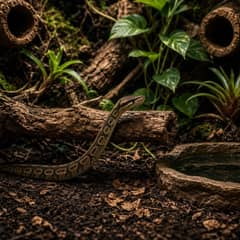
More space only helps if the snake will cross it. A corn snake in a large bare enclosure will use two hides and nothing else, which looks like proof it wanted a small enclosure and is actually proof it wanted cover.
Break the floor up with cork tubes and flats, leaf litter, and plants dense enough to interrupt sightlines. The snake should be able to move from one end to the other without ever being fully exposed.
Climbing, Which They Will Do
Corn snakes are semi-arboreal and will use height when it is stable. A firmly braced branch or a stack of cork gives them a second usable level. Height does not substitute for length, but on top of adequate floor space it is well used.
Scent, the Free One
Because these are chemosensory animals, novel scent is the closest thing to a puzzle you can offer without buying anything. A shed from another enclosure, a scent-marked object, or prey dragged across the substrate before it is offered all invite investigation. The odor-discrimination study is at least suggestive that this channel is worth using.
Priority Order
- An enclosure longer than the snake, which is the finding with a preference test behind it
- Cover distributed across the entire floor
- A stable climbing structure
- Scent novelty
- Rearrangement and new objects, last
What Not to Do
Do not use "snakes feel secure in small spaces" to justify a small enclosure, because a preference test disagrees. Do not add space without adding cover, since that produces an unused enclosure and then gets read as evidence the snake wanted less room. Do not treat handling as enrichment. And do not rearrange constantly, since novelty is the lowest-value item here and a rebuilt enclosure every week removes the familiarity the snake is navigating by.
Sources & Further Reading
Last reviewed 9 Sep 2026 · 4 sources
- Hoehfurtner et al. (2021). Does enclosure size influence the behaviour and welfare of captive snakes (Pantherophis guttatus)? Applied Animal Behaviour Science
- Hoehfurtner et al. (2021). Does the provision of environmental enrichment affect the behaviour and welfare of captive snakes? Applied Animal Behaviour Science
- Hoehfurtner et al. (2021). Environmental enrichment impacts discrimination between familiar and unfamiliar human odours in snakes. Applied Animal Behaviour Science
- Almli LM and Burghardt GM (2006). Environmental enrichment alters the behavioral profile of ratsnakes (Elaphe). Journal of Applied Animal Welfare Science
Frequently Asked Questions
Do corn snakes prefer a bigger enclosure?
Yes, and it has been tested. Hoehfurtner and colleagues housed corn snakes in enclosures either two thirds of their body length or longer than their body length. Given the opportunity to stretch out fully, the snakes did so, and they showed a clear preference for the larger enclosure. The authors recommend enclosures that allow a snake to stretch.
Is a bigger tank enrichment, or just better housing?
For this species the research treats it as both. Floor space is what makes stretching, exploring and using multiple microclimates possible at all, so it functions as the enabling condition for almost every other enrichment item rather than as a separate category.
Does enrichment change anything measurable in corn snakes?
A separate 2021 study found that environmental enrichment affected corn snakes' ability to discriminate between familiar and unfamiliar human odors, which is a cognitive outcome rather than just an activity count. Earlier work by Almli and Burghardt on ratsnakes, the group corn snakes belong to, found enriched housing altered their behavioral profile and performance on problem solving and feeding tasks.
Do corn snakes climb?
Readily. They are semi-arboreal in the wild and will use branches, cork and any stable elevated structure you provide. A tall enclosure is less useful than a long one, but adding height on top of adequate floor space is well used.
What is the lowest-effort enrichment that works?
Scent. Corn snakes navigate chemically, so a shed skin from another enclosure, a scent-marked object, or dragging prey across the substrate before offering it gives them something to investigate with their primary sense. It costs nothing.
Will a hiding snake in a large enclosure be stressed?
Not if the enclosure has cover throughout. The mistake is giving a snake more space without giving it more places to be concealed, which produces an animal that uses only the two hides. Clutter the whole floor and the space gets used.
More on the Corn Snake
Recommended Gear
As an Amazon Associate I earn from qualifying purchases through the links above, at no extra cost to you.
Written by Michael Ryan
Mike keeps two rescued bearded dragons, Dex and Cera, and writes the care guides on BeastlyFacts from his own research and mistakes. He is not a veterinarian.
More about Michael Ryan →