Cardinal Tetras Aren't Handled Either, But the School Size Rule Is Even Stricter
On This Page▾

Cardinal tetras are an observation pet. Nobody picks one up, and the two handling questions that decide how the fish does are how many share the tank and how it gets from the shop bag into the water.
The Number That Matters, and It's a Bit Higher Than You'd Guess
Cardinal tetras are obligate schooling fish: they need a group to feel secure and behave normally. The workable minimum is 10, and fish kept in smaller groups tend to develop sickness from stress. Ten in a mixed-sex group is where natural schooling settles in, a firmer bar than the six-fish floor usually cited for neon tetra. A group that's too small produces fish that are pale, constantly hiding, and more vulnerable to illness.
What a Properly Schooled Group Looks Like
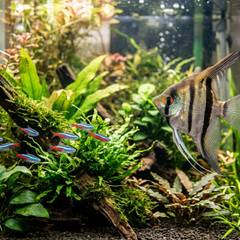
Confident, brightly colored fish swimming together in a loose group, working the mid-water of the tank instead of hiding in corners. It is one of the more rewarding things to watch in a community aquarium, and it only happens reliably once the school is big enough.
Bringing Cardinals Home
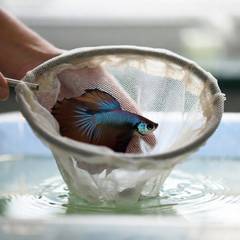
The float, the net transfer, and the two cases where a slow drip earns its time are the same for every freshwater fish, and the stocking and acclimation guide sets out that sequence. What is specific to cardinals is which of those two cases they tend to hit.
pH is less of a danger than its reputation. In laboratory tolerance testing, every cardinal survived 96 hours at any pH from 4.0 to 8.5. Hardness and temperature are the likelier problems. Cardinals are kept in soft water, 1 to 12 dGH and toward the bottom of that range for wild fish, so a batch going from soft shop water into hard tap water is the chemistry mismatch that calls for the slow method. Cold is the other one. Deaths in the same testing rose once water fell below 19°C (66°F), and a bag that sat in a cold car or a winter shipping box can arrive well under that. Check the bag against the tank before deciding how long to take.
Wild-caught cardinals, still a large share of the fish sold, cope worse with deteriorating water than commercially bred ones. That makes a quiet, dim tank and a stable first few weeks more important than the transfer itself.
First-Timer Mistakes
- Buying just a handful of cardinal tetras and assuming that's enough.
- Adding them to a tank that hasn't finished cycling. Nitrite is the compound this species tolerates worst, and it is what an incompletely cycled tank produces.
- Mixing them with fin-nipping tankmates, which disrupts normal schooling behavior even in an otherwise adequate group.
Telling Males From Females
Sexing a cardinal comes down to body shape, and only once the fish are mature. A sexually mature female is noticeably rounder through the body and a little larger than a male, and the gap widens when she is full of eggs. A male stays slimmer, and in breeding condition he shows his best color. Young fish at the store are hard to sex, and a mixed school does not need to be: the difference matters only to a keeper setting up a breeding pair in a separate spawning tank.
How to Tell Cardinal Tetra and Neon Tetra Apart
The two fish get confused constantly, and the reliable tell is the red stripe. On a cardinal tetra it runs the full length of the body, from the gills all the way to the tail. On a neon tetra, the red only covers roughly the back half, with the front half showing just the blue stripe. Cardinals also run slightly larger and tolerate noticeably warmer water, useful to know if you're stocking a warmer community tank where straight neon tetra would struggle.
That vivid red-and-blue stripe isn't just decorative. In the dim, tannin-stained water this species evolved in, the metallic stripe actually functions as a kind of camouflage, reflecting available light in a way that can create false or confusing targets for predators. What looks like the showiest feature in a home aquarium is doing real defensive work back in a blackwater stream.
The Cardinal tetra encyclopedia profile covers the species itself.
Sources & Further Reading
Last reviewed 7 Sep 2026 · 4 sources
Frequently Asked Questions
Do you handle cardinal tetras the way you'd handle a hamster or a bird?
No. This is an observation fish. The only handling it gets is the net or cup that moves it, and the move that matters most is the first one, from the shop bag into your tank.
How many cardinal tetras should I keep together?
Ten is the number to plan for. Smaller groups turn pale, hide, and get sick more often from the stress.
What does a properly schooled group look like?
A loose, confident group working the mid-water of the tank instead of hiding in corners, carrying the color that comes with feeling secure. It shows up reliably only once the school is big enough.
What's the most common cardinal tetra beginner mistake?
Buying too few fish for the tank. Adding them to a tank that hasn't finished cycling, and mixing them with fin-nipping tankmates, round out the list.
How can I tell a cardinal tetra apart from a neon tetra?
By the red stripe. It runs gills to tail on a cardinal, and covers only the back half on a neon, whose front half shows blue alone. Cardinals also run slightly larger and take warmer water.
More on the Cardinal Tetra
Cardinal Tetra care guide
🐠 How Much Does Cardinal Tetra Ownership Really Cost?
🐠 Common Cardinal Tetra Health Issues (Including a Disease Named After a Different Fish)
🐠 Cardinal Tetra Tank Setup: Soft Water, Warmer Temps, and a Blackwater Feel
🐠 Cardinal Tetra Feeding: Schedule, Diet, and the Rule That Prevents an Outbreak
🐠 Cardinal Tetra Enrichment: Most of Them Are Still Wild

Written by Michael Ryan
Mike keeps two rescued bearded dragons, Dex and Cera, and writes the care guides on BeastlyFacts from his own research and mistakes. He is not a veterinarian.
More about Michael Ryan →