Cardinal Tetra Enrichment: Most of Them Are Still Wild
On This Page▾

Nearly every fish in a modern aquarium shop was bred in a tank. This one usually was not.
A large share of cardinal tetras are still caught in the Rio Negro rather than bred, which makes settling conditions matter more than for almost anything else in the shop. On top of that, the closest group size evidence says ten, not six, and cardinals want soft, warm, tannin-stained water that most tanks do not provide.
What the Neon Tetra Study Found
Nothing on cardinals specifically. The borrow is from the neon tetra work, covered in full in our Neon Tetra enrichment guide.
Saxby, Adams, Snellgrove, Wilson and Sloman studied group size in four species commonly kept in home aquaria, tracking darting, aggression, shoaling and latency to feed. Groups of ten neon tetras showed improved welfare compared with smaller groups, with the lowest aggression and darting in the larger groups and feeding latency falling as group size rose.
The same study found no group size effect for angelfish, which our Angelfish enrichment guide covers. The effect was species-specific, so a neon result is a lead for a close relative rather than a proof. Cardinals are a closer match to neons than anything else in that study.
The Rio Negro ornamental fishery is one of the few places where the aquarium trade is regularly argued to be a conservation positive, on the grounds that a living fishery gives river communities an economic reason not to clear the forest. It is a genuinely contested claim and it is not a marketing line.
Settle Them Properly
The part that is specific to a wild-caught fish. Cardinals often arrive after a long chain of transfers, already stressed, and losses in the first fortnight are common.
Acclimate slowly. Have the tank cycled and stable before they arrive, dim the lights, and leave them alone. Quarantine matters more with wild stock than with tank-bred fish because of what can come in with them.
Buy from a shop that has held them a while, not one that got them yesterday.
Ten, Not Six
The borrowed number. A 20 gallon long tank supports a proper group, and cardinals shoal more tightly and color more strongly in numbers.
One species of ten beats two species of five. A cardinal shoals with cardinals.
Blackwater Conditions
The thing that separates a cardinal tank from a neon tank. Soft, warm, acidic water, ideally stained with tannins.
Driftwood and leaf litter release tannins as they break down, tinting the water and lowering pH gently. The tint is not a cosmetic choice, it is the light environment the fish evolved in, and cardinals in tea-colored water look like different animals to cardinals under a bright light in clear water.
Dense live planting around the sides and back, with open swimming space through the middle.
Shade
Blackwater fish under a bright aquarium light spend their time near the bottom and stay pale. Floating plants, tannin staining, or a less powerful light all fix it.
Color is the immediate readout. A cardinal that feels covered is a brighter fish, which makes this a welfare improvement you can see the same evening.
Feeding a Shoal
Small mouths that lose out to faster fish. Spread food across the surface, never into one spot.
Frozen and live foods get a much stronger response than flake.
Priority Order
- A cycled, stable, dimly lit tank waiting before they arrive
- Slow acclimation and quarantine, given the wild-caught supply chain
- Ten or more of one species
- Soft, warm, tannin-stained water from wood and leaf litter
- Dense planting at the sides with open swimming space
- Subdued lighting or floating cover
- Food spread across the surface, varied with frozen foods
What Not to Do
Do not add wild-caught fish to a new or unstable tank. Do not skip quarantine. Do not stop at six. Do not keep them in hard alkaline water and expect them to thrive because neons managed, and hardness is GH, which is not the same measurement as pH. Do not run a bright light over a bare tank.
Sources & Further Reading
Last reviewed 14 Sep 2026 · 2 sources
- Borrowed evidence. No group size study covers cardinal tetras. The findings below are from neon tetras, the closest studied relative, and are covered in full in our Neon Tetra enrichment guide.
- Saxby A, Adams L, Snellgrove D, Wilson RW and Sloman KA (2010). The effect of group size on the behaviour and welfare of four fish species commonly kept in home aquaria. Applied Animal Behaviour Science
- The effects of mixed-species assemblage on the behaviour and welfare of fish held in home aquaria. Applied Animal Behaviour Science
Frequently Asked Questions
Is there enrichment research on cardinal tetras?
Not on the species. The closest evidence is the 2010 home aquarium study by Saxby and colleagues, which found groups of ten neon tetras showed improved welfare over smaller groups, with lower aggression and darting and faster feeding.
How are cardinals different from neon tetras?
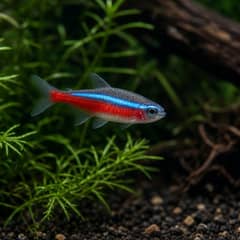
Larger, longer lived, more expensive, and considerably more demanding on water. The red stripe runs the full length of the body rather than half of it. They also want softer, warmer, more acidic water than neons tolerate.
How many cardinal tetras are wild caught?
A large proportion still are, from the Rio Negro in Brazil, unlike almost everything else in a modern fish shop. That matters practically, because a wild fish arriving from a long supply chain needs settling time and stable conditions more than a tank-bred one does.
Is buying wild caught fish a problem?
It is more complicated than it sounds here. The Rio Negro ornamental fishery is frequently cited as a case where the trade gives local communities an economic reason to keep the forest and river intact. That is a genuine argument and not a blanket endorsement of wild collection.
How many should I keep?
Ten or more, following the neon tetra finding, and cardinals shoal more tightly and color up better in bigger groups. Six is a floor rather than a target.
What water do they need?
Soft, warm and acidic, ideally tannin-stained by wood and leaf litter. They tolerate harder water and they do not thrive in it, and this is the main reason cardinals fail in tanks where neons would have been fine.
More on the Cardinal Tetra
Cardinal Tetra care guide
🐠 How Much Does Cardinal Tetra Ownership Really Cost?
🐠 Cardinal Tetras Aren't Handled Either, But the School Size Rule Is Even Stricter
🐠 Common Cardinal Tetra Health Issues (Including a Disease Named After a Different Fish)
🐠 Cardinal Tetra Tank Setup: Soft Water, Warmer Temps, and a Blackwater Feel
🐠 Cardinal Tetra Feeding: Schedule, Diet, and the Rule That Prevents an Outbreak
Recommended Gear
As an Amazon Associate I earn from qualifying purchases through the links above, at no extra cost to you.

Written by Michael Ryan
Mike keeps two rescued bearded dragons, Dex and Cera, and writes the care guides on BeastlyFacts from his own research and mistakes. He is not a veterinarian.
More about Michael Ryan →