Red-Footed Tortoise Enrichment: Enriched Tortoises Are More Optimistic
On This Page▾

Most tortoise care writing treats the animal as a slow, simple herbivore that needs heat and greens. The research on this particular species says something quite different.
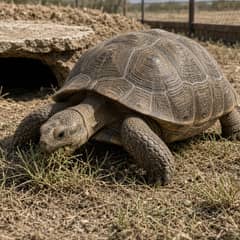
Fifteen red-footed tortoises were given a cognitive bias test, the standard method for assessing affective state. Those housed in enriched environments were more likely to judge ambiguous situations optimistically. Separately, this species has been trained on touchscreens and shown transferring a spatial solution to a physical arena.
What the Research Says
Three strands, all on this species.
Mood. A 2025 study used a cognitive bias test on 15 red-footed tortoises to see whether they responded optimistically or pessimistically depending on their state. Tortoises housed in enriched environments were more likely to judge ambiguous situations optimistically, which is read as a positive affective state.
Cognition. Red-footed tortoises have been successfully trained to use a touchscreen, with two individuals learning a spatial task and transferring that knowledge from the screen to a physical arena. Further work shows them anticipating cyclical resource availability, which has implications for their role as seed dispersers in the wild.
Navigation. Wilkinson's radial maze work found a tortoise visiting maze arms in an orderly, logical sequence, then switching to a landmark-based strategy when visual cues were made available.
The methodology point matters as much as the results. Wilkinson tested at around 29 degrees Celsius to ensure the animals were fully alert. Older reptile cognition work tested ectotherms in cool laboratories, got sluggish and unresponsive animals, and concluded reptiles could not learn. The failure was in the thermometer.
Browse Instead of a Bowl
A tortoise fed one chopped salad in one dish gets no foraging behavior at all, which is most of what these animals do with their day in the wild.
Scatter food across the enclosure. Vary what appears and where. Better still, grow edible planting inside the enclosure so grazing is continuous rather than an event, which a tortoise forage seed mix sown in a tray or the substrate does directly.
Target and Station Training
This is the item the cognition research most directly supports, and it is nearly free. A clicker and target stick and a few minutes a day teaches a tortoise to move to a station, which makes weighing, health checks and moving the animal dramatically less stressful for both of you.
It is enrichment and cooperative-care husbandry at the same time, and it is a genuinely appropriate suggestion for this species and not an anthropomorphic one.
Floor Space and Terrain
Red-foots walk. Floor area matters far more than height, and a tortoise table or a large enclosure gives them ground to cover. Varied terrain, leaf litter, logs to navigate around and different substrate textures all turn a floor into a route.
Secure outdoor time in suitable weather is the highest-quality enrichment available: real UV, real weather, real terrain, real browse. Doing it safely is a build problem, and the outdoor reptile housing guide has the predator-proofing and shade requirements.
Humidity and Somewhere to Soak
The most common error with this species is treating it like an arid grazer. Red-foots are tropical forest-floor animals, and a humid substrate with damp retreats is a welfare input rather than a refinement. A dish large enough to walk into and soak is used regularly. A tortoise without one gets a lukewarm, elbow-deep soak of 10 to 30 minutes, 2 to 3 times a week.
Priority Order
- Correct humidity and a soaking dish, which outrank everything else
- Floor space and varied terrain
- Scattered, varied browse and growable planting
- Target and station training
- Outdoor time where climate and security allow
- Food puzzles and novel food problems
- Novel objects, last
What Not to Do
Do not keep a red-foot dry, since arid husbandry is the standard mistake with this species. Do not feed from one dish in one place. Do not assume slow means simple, because the cognition research on this exact species says otherwise. Do not train at cool temperatures and conclude the animal cannot learn.
Sources & Further Reading
Last reviewed 24 Sep 2026 · 5 sources
- Evidence of mood states in reptiles, the cognitive bias work in red-footed tortoises. Animal Cognition
- New study shows tortoises experience feelings similar to our own, the University of Lincoln's summary of that work
- Touchscreen performance and knowledge transfer in the red-footed tortoise. PubMed
- Anticipation of cyclical resource availability in the red-footed tortoise. Learning and Behavior
- Case BC, Lewbart GA and Doerr PD. Enriched environment in the eastern box turtle. Applied Animal Behaviour Science
Frequently Asked Questions
Is there research on tortoise mood?
Yes. A study of 15 red-footed tortoises used a cognitive bias test, a standard method for assessing affective state, and found that tortoises housed in enriched environments were more likely to judge ambiguous situations optimistically. Optimistic judgment bias is one of the closest things animal welfare science has to a mood measure.
What else has this species been shown to do?
Red-footed tortoises have been trained to use touchscreens, with individuals learning a spatial task on the screen and transferring that solution to a physical arena. Further work shows them anticipating cyclical resource availability. Wilkinson's radial maze work also showed a tortoise switching navigation strategy when visual landmarks were made available.
Why does the testing temperature matter?
Because earlier reptile cognition research got it wrong. Wilkinson tested tortoises at around 29 degrees Celsius specifically to make sure they were fully alert. Flawed older studies tested ectotherms in cool laboratory conditions, produced sluggish and minimally responsive animals, and concluded reptiles were poor learners.
Can a tortoise be target trained?
Yes, and it is one of the better-supported enrichment approaches for the group. Target and station training works as cognitive enrichment and cooperative-care husbandry at once, making routine weighing and health checks much less stressful.
How should a red-footed tortoise be fed for enrichment?
Scattered and varied rather than presented in one dish. These are foraging animals that cover ground searching, and a single bowl of chopped salad compresses that into a couple of minutes. Growing edible planting inside the enclosure extends it further.
Do they need more humidity than other tortoises?
Considerably. Red-foots are tropical forest-floor animals rather than arid grazers, which is the most common husbandry error with this species, and a humid substrate with damp retreats is a welfare input rather than a refinement.
More on the Red Footed Tortoise
Red Footed Tortoise care guide
🐢 How Much Does a Red-Footed Tortoise Really Cost?
🐢 How to Handle a Red-Footed Tortoise
🐢 Common Red-Footed Tortoise Health Issues and What Causes Them
🐢 Red-Footed Tortoise Enclosure Setup: A Humid Tropical Setup, Not a Desert One
🐢 Red-Footed Tortoise Feeding: Diet, Schedule, and Why Protein Isn't Optional
Recommended Gear
As an Amazon Associate I earn from qualifying purchases through the links above, at no extra cost to you.

Written by Michael Ryan
Mike keeps two rescued bearded dragons, Dex and Cera, and writes the care guides on BeastlyFacts from his own research and mistakes. He is not a veterinarian.
More about Michael Ryan →