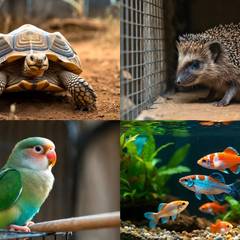
Hedgehogs Are Lactose Intolerant (Despite What Cartoons Show)
On This Page▾

A saucer of milk by the back door is the most familiar way people have fed hedgehogs, and it is the wrong one. Hedgehogs are lactose intolerant. Like many mammals, they lack enough lactase, the enzyme that splits lactose, the sugar in milk. Undigested lactose passes into the gut, where bacteria ferment it into gas, and the result is cramping and diarrhea. In a small animal, diarrhea means fast dehydration, and it can kill.
Where the milk habit came from
Bread and milk is still a common "treat" left out for hedgehogs in British gardens, and it is the picture the cartoons keep drawing. The habit persists because it seems to work: hedgehogs eat and drink it readily. Willingness is not tolerance. Greenish diarrhea has been recorded in captive hedgehogs fed on cow's milk and bread, and bread adds nothing useful, since it is low in energy for an insect eater.
The habit is not only British. When researchers in Finland examined the stomachs of 33 hedgehogs, nearly all held human-provided food, with milk, fish and meat the most common items.
Wildlife rescues that have to feed orphaned hoglets use a milk substitute or goat's milk, whose lower lactose causes noticeably fewer digestive problems. That is a rescue measure for animals too young to eat solid food, not something to put out in a garden.
What to leave out instead
For a wild hedgehog visiting a garden, the hedgehog charities' advice is short:
- Water, in a shallow dish, especially in cold or dry spells when natural food is scarce.
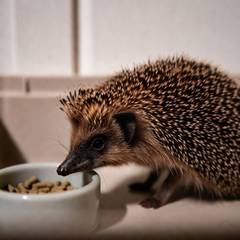
- Meat-based wet dog or cat food, hedgehog food, or cat biscuits, put out in a shallow dish in a sheltered spot around sunset.
- No milk and no bread.
Pet hedgehogs: the same rule
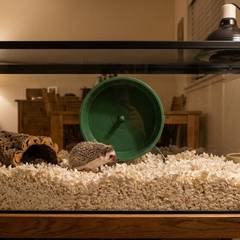
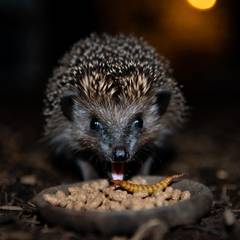
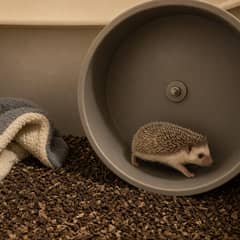
The pet species is the African pygmy hedgehog (Atelerix albiventris), and veterinary feeding advice for it lists milk among the foods to avoid because hedgehogs cannot digest it. The base of the diet is a high-quality hedgehog food mixed with a high-quality, low-fat cat food. Gut-loaded mealworms and crickets can be offered two to three times a week. The rest of the avoid list is avocado, raw meat and raw eggs, nuts, seeds and hard foods such as raw carrot that can lodge in the roof of the mouth, and sweets and chocolate. Lettuce and celery are not dangerous, just close to worthless nutritionally.
The bigger everyday risk for a pet is quantity rather than dairy. Hedgehogs become obese easily when food is not measured, so portions matter as much as the ingredient list.
The rest of the hedgehog
A few facts that are well established:
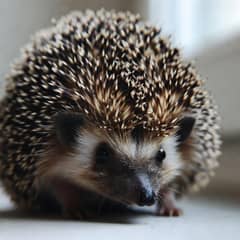
- Spines. An adult has between 5,000 and 7,000 spines, made of keratin, the same protein as hair and nails. They are shed and replaced individually over time, so a hedgehog is never left bare.
- Senses. Eyesight is relatively poor. Hedgehogs find prey in the dark mostly by smell and hearing.
- Self-anointing. Faced with a new or strong smell, a hedgehog sniffs, licks and chews the source, then contorts its body and spreads the frothy saliva over its spines and fur with the underside of its tongue. Triggers have included fox fur, human sweat, carpet, varnish and even plain water. Young males do it far more often than adults: in one study of European hedgehogs, subadult males accounted for 35 percent of observations and adult females 4 percent.
Nobody has settled why hedgehogs anoint. Scent masking against predators, grooming, making the spines more painful to a predator, and scent communication have all been proposed. The strongest single experiment is from 1977, when Edmund Brodie Jr. showed that African hedgehog spines coated in cane toad secretions, whether applied by hand or by the hedgehog anointing itself, caused immediate and intense burning when jabbed into volunteers' arms. That shows anointing can arm the spines. It does not show that is what it is for, since hedgehogs also anoint with harmless substances. Extracts of hedgehog salivary glands injected into mice had no toxic effect, so the saliva itself is not a weapon.
The pet hedgehog is probably not a pure African pygmy at all but a descendant of hybrids with the North African hedgehog, a history the hedgehog encyclopedia entry traces back to the 1980s.
Sources
3 sources
- Hedgehog Street: What should we be feeding hedgehogs?; Hedgehog biology
- Wildlife Online: European hedgehog: interaction with humans, supplemental feeding; European hedgehog behaviour: self-anointing
- VCA Animal Hospitals. Feeding Hedgehogs
More on the Hedgehog

Written by Michael Ryan
Mike keeps two rescued bearded dragons, Dex and Cera, and writes the care guides on BeastlyFacts from his own research and mistakes. He is not a veterinarian.
More about Michael Ryan →You May Also Like




Subscribe - it's free
An occasional email when something new is worth your time. No spam.
Deep Dive
Health and More