Flying Squirrel Enrichment: A Rodent That Solved the Same Problem
On This Page▾

The nearest comparison for this animal is a marsupial from the other side of the world. That is stranger than it sounds and it works.
A flying squirrel and a sugar glider are not related. One is a rodent, the other a marsupial, and gliding evolved separately in each lineage. They converged on the same body plan, the same nocturnal arboreal life and, for a keeper, very nearly the same enclosure.
What the Research Says
Nothing on pet flying squirrel enrichment specifically. The borrow is from the sugar glider, covered in full in our Sugar Glider enrichment guide.
That guide's picture is: colonial animals where solitary housing is treated as a major welfare risk, height and glide routes over floor space, a pouch or cavity to sleep in through the day, foraging presented at height, and a solid-track wheel.
The usual warning about borrowing across a taxonomic gap does not really apply here, because the gap is the interesting part. Convergent evolution means the two animals face the same problems in captivity even though they are separated by roughly the whole mammal family tree. What transfers is the ecology, not the physiology, and ecology is what an enclosure has to answer.
Where it does break down: flying squirrels are rodents with continuously growing incisors. Gnawing is a requirement here in a way it is not for a glider.
Gliding has evolved independently at least half a dozen times in mammals, in rodents, marsupials and colugos among others. It is one of the clearest cases in biology of the same solution being found repeatedly, which is why a sugar glider care sheet transfers so well to an animal that is not remotely a sugar glider.
Height, and Real Glide Routes
The structural item. A tall cage such as a large flight cage gives the vertical dimension, and what you put in it decides whether the animal can use it.
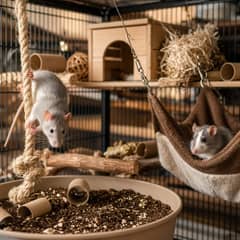
Branches at varied heights and angles, ropes, and separated launch and landing points so short glides are possible rather than only climbing. Height without structure is wasted, and this is the species where that matters most, since the whole animal is built around crossing gaps.
Free-roam time in a squirrel-proofed room is genuinely valuable here, supervised, because no cage sold provides real gliding distance.
A Nest Cavity
Cavity nesters that sleep the day enclosed and in contact with each other. A nest box mounted high, plus a hanging fleece sleeper or two, gives them the dark enclosed space the day requires.
Provide more than one and site them high. Check fabric for loose threads, since toes and gliding membranes catch easily.
Company
Social animals that nest communally, sometimes in substantial huddles when it is cold. Same-sex pairs or small groups, and a single flying squirrel is a compromise.
Introductions take time. Bonding with a fast nocturnal animal takes more patience than most people expect.
Gnawing, Which the Borrow Does Not Cover
The rodent difference. Continuously growing incisors that need constant work: untreated branches, nuts in shell, hard chews and cuttlebone.
Nuts in shell do double duty, since getting into one is both a gnawing task and a foraging problem.
Foraging at Height
Wild flying squirrels forage across a home range for nuts, seeds, fungi and insects. Put food high so getting to it involves climbing, hide portions in paper parcels and foraging containers, scatter the rest, and vary where it appears.
Live insects are worth including. The calcium balance is the part most improvised diets get wrong.
Priority Order
- Height, filled with branches and separated glide points
- A pair or small group
- Nest boxes and hanging sleepers mounted high, more than one
- Constant gnawing material
- Foraging presented at height and hidden
- Supervised free-roam in a proofed room
- Novelty and rearrangement, last
What Not to Do
Do not keep one alone. Do not buy a tall cage and leave the height empty. Do not use fabric with loose threads. Do not skip gnawing material, which is the one thing the sugar glider comparison will not warn you about. Do not improvise the diet without getting the calcium side right. Do not handle during the day as a routine. And check our legal guide first, since they are regulated or prohibited in many places and are native wildlife in others.
Sources & Further Reading
Last reviewed 8 Sep 2026 · 2 sources
- Borrowed evidence, across a very wide gap. No enrichment study exists for pet flying squirrels. The findings below are from sugar gliders, an unrelated marsupial that converged on the same body plan and lifestyle, and are covered in full in our Sugar Glider enrichment guide.
- Establishment of hematological and plasma biochemical reference values and analysis of risk factors for pet sugar gliders (Petaurus breviceps)
- Overview of sugar gliders. Merck Veterinary Manual
Frequently Asked Questions
Is there enrichment research on flying squirrels?
No. Nothing has been published on pet flying squirrel enrichment. The closest usable comparison is the sugar glider, which is not a relative at all: one is a rodent and one is a marsupial, and gliding evolved separately in each. Their captive requirements end up almost identical anyway.
Why is that a reasonable borrow if they are unrelated?
Because convergent evolution produced the same problem and the same solution. Both are small nocturnal gliding mammals that live in trees, sleep in cavities, forage across a home range and are social. What a captive enclosure has to provide follows from that, not from taxonomy.
How tall should the cage be?
As tall as you can manage, and filled. Height is the only dimension that lets a gliding animal do anything glide-like indoors, and a tall empty cage is worse than a shorter well-furnished one.
Should flying squirrels be kept in pairs?
Yes. They are social and nest communally in the wild, sometimes in large huddles in cold weather. A single flying squirrel is a poorer setup, and same-sex pairs or small groups are the sensible default.
Are they nocturnal?
Strongly, with large eyes built for it. They are active at night and sleep the day in a cavity, so most enrichment gets used while you are asleep and daytime handling means waking the animal.
What do they need to gnaw on?
Plenty. They are rodents with continuously growing incisors, unlike sugar gliders, which is the one place the borrow breaks down. Untreated branches, nuts in shell and hard chews all need to be available constantly.
More on the Flying Squirrel
Flying Squirrel care guide
🐿️ How Much Does a Pet Flying Squirrel Really Cost?
🐿️ How to Handle a Flying Squirrel (Bonding Starts in the Pouch, Not Your Hands)
🐿️ Common Flying Squirrel Health Issues (Diet Drives Almost Everything)
🐿️ Flying Squirrel Cage Setup: Tall, Not Wide
🐿️ Flying Squirrel Feeding: Diet, Schedule, and the Calcium Ratio That Prevents Paralysis
Recommended Gear
As an Amazon Associate I earn from qualifying purchases through the links above, at no extra cost to you.

Written by Michael Ryan
Mike keeps two rescued bearded dragons, Dex and Cera, and writes the care guides on BeastlyFacts from his own research and mistakes. He is not a veterinarian.
More about Michael Ryan →