Fire Skink
Lizards
Beastly Facts · Updated
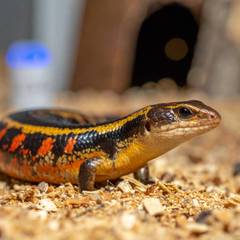
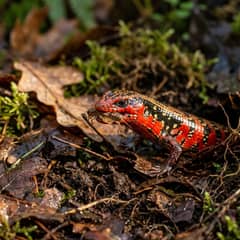
Dressed in red and gold, and determined to stay underground!
On This Page▾

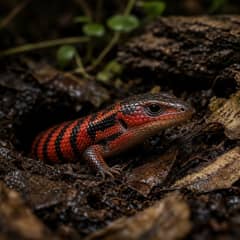
Did you know? Fire skinks are one of the most brightly colored lizards in the hobby and one of the most rarely seen in their own enclosure. Give one a shallow scattering of substrate and it will vanish; give it the 4 to 6 inches it can actually tunnel through and it will build a burrow system, come out to bask, and behave like a completely different animal.
The first week
The numbers a new owner needs in the first week, each from the article it links to. Rows with no link come from the encyclopedia.
- Day one
- Quarantine 3 to 6 months away from any reptile you already keep, with parasite screening, since most fire skinks in the trade are wild-caught.Quarantine guide →
- Enclosure
- 36 by 18 by 18 inches minimum for a single adult, floor space over height. One per enclosure: two males fight.Setup guide →
- Temperature
- Ambient 80 to 86°F, a basking spot of 92 to 96°F from a halogen on a dimming thermostat, and a night drop to about 70°F, 65°F acceptable.Setup guide →
- The thermostat
- A dimming model for the basking bulb, $25 to $35. A $130 on/off unit is the wrong buy: its maker says not to run a basking bulb on one.Cost guide →
- Humidity
- 60 to 70% ambient, higher overnight, from misting once or twice daily, moist substrate, and a sphagnum humid hide, on a digital probe hygrometer.Setup guide →
- Substrate, the whole job
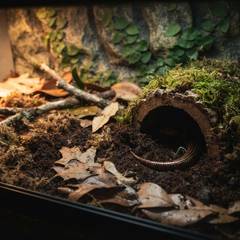
- 4 to 6 inches of a tropical mix, roughly 40% topsoil, 40% coconut fiber, 20% fine sand, under leaf litter. Damp enough to hold a burrow, never waterlogged. No dry sand-only setups.Setup guide →
- UVB
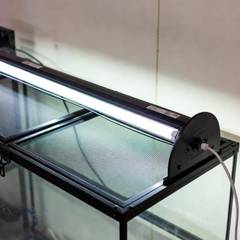
- Real benefit, technically optional with proper supplementation: a 5 to 6% tube with the basking area 7 to 10 inches below it, replaced every 12 months.Setup guide →
- Feeding
- Adults two to three times a week, juveniles daily to every other day, as many insects as it eats in about five minutes, none wider than its head. Released into the leaf litter so finding them is the activity.Feeding guide →
- What to feed
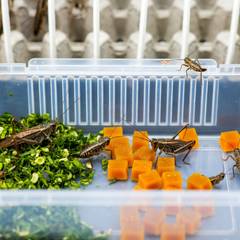
- Crickets, dubia and discoid roaches, mealworms, superworms, earthworms, hornworms, silkworms, isopods, varied across the week.Feeding guide →
- Supplements
- Calcium powder at nearly every feeding, and a reptile multivitamin in the rotation.Feeding guide →
- Retained shed
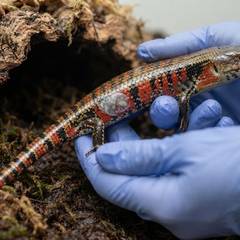
- From low humidity, and it constricts toes and tail if left. Fix the humidity and the humid hide at home; retained eye caps or a severe case go to a vet.Health guide →
- Handling, honestly
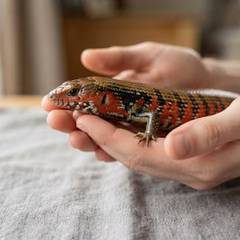
- Skittish, fast, and quick to burrow out of sight: a display animal you occasionally interact with. Never by the tail, which drops under grasping pressure, and low over a soft surface.Handling guide →
- Why you never see it
- Semi-fossorial, and hiding looks identical to having nothing to do. Deep damp coconut fiber that holds a tunnel, and cork cover at both ends of the gradient so it never trades temperature for security.Enrichment guide →
- Budget
- $25 to $40 for a wild-caught skink, more for captive-bred, which tames better. Setup roughly $465 to $680 with a dimming thermostat, then $40 to $65 a month. An annual exotic checkup, with parasite screening for a wild-caught animal.Cost guide →
- Lifespan
- 15 to 20 years, a two-decade commitment for a cheap lizard.Cost guide →
- Adult size
- 12 to 15 inches (30 to 38 cm) including tail.
- Hygiene
- Wash hands with soap after any contact, keep the skink out of the kitchen, and never clean the enclosure where food is prepared. A laundry sink or bathtub works only if it is disinfected afterward.Hygiene guide →
Emergency card
Call the vet now if you see any of these.
- Open-mouth breathing, mucus, and wheezing
- Bloating or no stool: substrate impaction
- Retained eye caps, or a severe retained shed after home correction has failed
- An open or infected wound where the tail dropped
- Soft or swollen limbs or a soft jaw: bone disease, less common here but possible with weak UVB and calcium
Low humidity is behind the respiratory infection and poor shedding that make up most of this species' real risk, and dry substrate behind the impaction.
Where to go next
How Much Does a Fire Skink Really Cost?
$25 to $40 for the skink, $465 to $680 for the setup, and the thermostat line people try to skip.
Fire Skink Enclosure Setup: Deep, Moist Substrate Above Everything Else
36x18x18 as a floor, 92 to 96F basking, 60 to 70%, the 4 to 6 inch mix, and what to feed.
How to Handle a Fire Skink (This Isn't the Blue-Tongued Skink)
Why this is not the blue-tongued skink, and why the tail is the part to leave alone.
Fire Skink Feeding: Five Minutes of Insects in the Leaf Litter, Twice a Week as an Adult
Five minutes of insects scattered in the litter, daily young and twice a week adult, dusted every time, and pinky mice monthly at most.
Common Fire Skink Health Issues
Respiratory infection, retained shed, impaction, and the humidity underneath all three.
Fire Skink Enrichment: The Study Where Skinks Stopped Hiding
The blue-tongue study where skinks stopped hiding, and what it asks of a burrowing lizard's enclosure.
What to buy
As an Amazon Associate I earn from qualifying purchases. Underlined items are paid Amazon links, at no extra cost to you.
Prices and the reasoning behind each item are in How Much Does a Fire Skink Really Cost?.
Full Fire Skink gear listFrequently Asked Questions
What size enclosure does a fire skink need?
36 by 18 by 18 inches minimum for one adult, and bigger is worth it for an active species. Floor space beats height. Don't house two fire skinks together, especially two males: real fighting risk.
What does a fire skink enclosure setup cost?
Roughly $465 to $680: a 36x18x18 inch enclosure, T5 UVB kit, basking bulb and dome, dimming thermostat, eight or nine bags of coconut fiber, two hides, and a hygrometer. The enclosure dominates, and the thermostat has to be a dimming model, since an on/off unit's maker says not to run a basking bulb on one.
What causes respiratory infection in fire skinks?
Substrate or overall enclosure conditions running too dry, or occasionally too cold. Watch for open-mouth breathing, mucus, and wheezing. See a vet, this needs professional treatment, and prevention is straightforward, hold 60 to 70% ambient humidity with consistently damp substrate.
Subscribe - it's free
New care guides straight to your inbox. No spam.
Deep Dive
Health and More

Explore More