Do Honeyguides Lead Honey Badgers to Honey? The Famous Partnership Nobody Has Filmed
On This Page▾

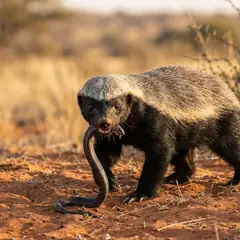
Maybe, but nobody has caught it on camera. The story of a little bird that leads a honey badger to a beehive is told in books, documentaries and nature trivia everywhere. The evidence for it rests on incomplete, secondhand accounts. It probably does happen, but only in a few places, or so quietly that almost nobody sees it.
The bird's real partner is much easier to find. It is us.
What Is the Honeyguide Story?
The greater honeyguide is an African bird that loves beeswax. The trouble is getting to it: on its own the bird can hardly reach any, because it cannot break open a bees' nest.
The story goes like this. The bird finds a nest, calls to a honey badger and leads it there. The badger rips the nest open and eats the honey and larvae. The bird eats the wax. Everybody wins.
It is an old story. The Swedish naturalist Anders Sparrman wrote in 1777 that an animal the Dutch settlers called a "Ratel," which he guessed was a new kind of badger, was "frequently conducted to wild bee-hives by this bird." It is one of the earliest accounts, and the idea has been repeated ever since.
Has Anyone Seen It?
Some people say they have. Researchers interviewed 394 honey hunters in 11 communities across nine African countries. In Tanzania, many said they had seen the two animals together: 61 percent of the Hadza hunters interviewed, half of the Maasai, and a third in southern Tanzania. Everywhere else, it averaged about 6 percent.
What nobody has is proof. There is no photo or video of it anywhere. Even people who have followed honeyguides hundreds of times in Mozambique and Tanzania have never seen one call to a badger, even though both animals are common there.
The closest anyone has come is a dawn scene. After a honey badger broke into a bees' nest in a tree one night, a honeyguide turned up at dawn and sat silently in the tree above. That was it. In 35 days of following a young male badger, it was the only time the two were seen together.
The Famous Film Was Fake
If you think you have seen it, you may have seen a movie. The 1974 comedy nature film Animals Are Beautiful People showed a honeyguide leading a badger. The scene was entirely staged, using a tame badger trained to follow a stuffed bird pulled along on a fishing line. At least one Tanzanian hunter said his belief came from a movie he saw at a local cinema.
Do Honeyguides Lead People to Honey?
Yes, and this one is proven. Written accounts of honeyguides leading people to bees' nests go back to 1588.
In Mozambique, Yao honey hunters call the birds with a loud trill followed by a grunt that sounds like "brrr-hm." When researchers played that call, about two-thirds of searches drew a honeyguide's help, and the hunters more than tripled their chances of finding a bees' nest. Nearly three-quarters of 149 nests found by the Yao involved a honeyguide.
In Tanzania, Hadza hunters use a melodic whistle instead, and the birds have learned the local dialect: they are far more likely to answer the local call than a foreign one. With a honeyguide's help, Hadza hunters found 3.3 bees' nests per hour. Without it, they found 0.5.
Payment varies. The Yao leave beeswax for the birds. The Hadza bury or burn much of it, which seems a little ungrateful.
The Honeyguide's Dark Side
The honeyguide is not so helpful to other birds. It is a brood parasite: it lays its eggs in other birds' nests and lets them raise its young. Its chicks hatch with sharp hooks on the tips of their bills, and they use them, in total darkness, to kill the host's chicks. One to five minutes of biting was enough. By the time the chick is about a month old, the hook has vanished into the growing bill.
Does a Honey Badger Even Need a Guide?
Not really. Honey badgers raid bees' nests on their own, with strong claws and a thick skin that gives some protection from stings. It is not a free lunch, though: the bees drive them off more often than not. When a mother and her large cub in the Kalahari broke into 13 hives over 37 visits, the swarm chased them away on 61 percent of those visits.
What Happened When Scientists Tested It?
Scientists have tested the idea with fakes. In one test, hand-raised badgers ignored recordings of the guiding call. Wild badgers might still learn it, so that settles nothing.
The other test was in Kenya in 1985. A researcher put a stuffed honey badger on a remote-controlled toy car and hid in a small tent. The honeyguide ignored the badger completely. It gave its guiding call to the hidden researcher.
Sources & Further Reading
Last reviewed 25 Nov 2026 · 5 sources
- van der Wal, J.E.M., Spottiswoode, C.N., Cram, D.L. et al. 2023. Do honey badgers and greater honeyguide birds cooperate to access bees' nests? Ecological evidence and honey-hunter accounts. Journal of Zoology 321:22-32
- Bower, B. 2016. Humans, birds communicate to collaborate. Science News
- Spottiswoode, C.N. & Wood, B.M. 2023. Culturally determined interspecies communication between humans and honeyguides. Science 382:1155-1158
- Spottiswoode, C.N. & Koorevaar, J. 2012. A stab in the dark: chick killing by brood parasitic honeyguides. Biology Letters 8:241-244
- Begg, C.M., Begg, K.S., Du Toit, J.T. & Mills, M.G.L. 2003. Sexual and seasonal variation in the diet and foraging behaviour of a sexually dimorphic carnivore, the honey badger (Mellivora capensis). Journal of Zoology 260:301-316 (PDF, downloads)
Written by Michael Ryan
Mike keeps two rescued bearded dragons, Dex and Cera, and writes the care guides on BeastlyFacts from his own research and mistakes. He is not a veterinarian.
More about Michael Ryan →You May Also Like


More on the Honey Badger
Beastfiles

More wild reads