Are Honey Badgers Immune to Snake Venom? Not Quite, but Close
On This Page▾

Not completely. A honey badger carries a small change in the receptor that cobra venom attacks, and that change keeps the venom from getting a grip. A lab test confirmed it in 2021. But "immune to snake venom" goes further than the evidence does, and the most famous bite story ends with a very swollen face.
What nobody doubts is that honey badgers eat a lot of snakes.
How Many Snakes Does a Honey Badger Eat?
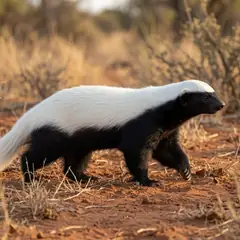
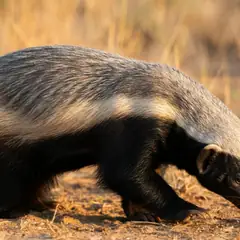
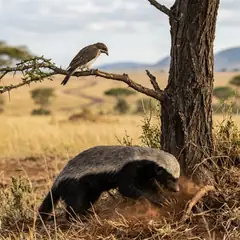
Plenty. Among wild honey badgers in the Kalahari, three snakes each made up more than a tenth of everything the badgers ate by weight: the mole snake (21.4 percent), the puff adder (12.5 percent) and the Cape cobra (10.5 percent). Together that is close to half the menu. In the hot, wet season, from January to April, large snakes supplied 58 percent of what the badgers ate.
One male, weighing about 24 pounds, ate at least 14 pounds of meat in a single day: four adult mole snakes, two adders and seven mice. The next day he caught two Cape cobras, killed them, left them lying above ground and went to sleep in a burrow.
And honey badgers do not pick around the dangerous bits. Large reptiles were eaten whole, including the heads of venomous snakes.
What Does Cobra Venom Do?
Cobra venom is mostly an attack on the nerves. Its main weapons, called alpha-neurotoxins, latch onto the receptor where a nerve tells a muscle to move. Block that receptor and the message never arrives. The muscles go slack, including the ones that work the lungs.
So the trick to surviving a cobra is not toughness. It is having a receptor the toxin cannot grab.
What Makes a Honey Badger Venom Resistant?
A tiny swap in that receptor. Honey badgers, hedgehogs and pigs have each, independently, put a positively charged amino acid right where the toxin binds. Mongooses, famous cobra fighters themselves, got there a different way: their version adds sugar chains at the same spot, which gets physically in the toxin's way. All told, resistance to these toxins has evolved at least four times in mammals, by two different methods.
All of that came from reading the receptor's genetic code, which is not the same as testing it. The test came in 2021, when researchers measured how well cobra-type toxins stuck to the binding site in the lab. The honey badger's swapped amino acid really did reduce binding. It had never been tested that way before.
The way it works is electric. These toxins carry a strong positive charge, which helps them stick to a negatively charged spot on the receptor. Put a positive charge in that spot and the two push apart, the way the matching ends of two magnets do.
So Is a Honey Badger Immune?
Resistant is the better word, for three reasons.
First, the lab test used the receptor's binding site, not a living animal. Nobody has given a honey badger a measured dose of cobra venom to see what happens, and nobody is lining up to try.
Second, the receptor trick is aimed at cobra-type nerve toxins. Puff adders are vipers, and their venom works mainly on blood and tissue. It is hemotoxic, causing extreme pain, swelling and dying tissue. Nobody has shown the honey badger's receptor helps with that.
Third, the bite on record does not look like immunity. Colleen Begg, who studied wild honey badgers in the Kalahari, once saw one bitten on the face by a puff adder. His cheek swelled up badly, and just five hours later he was up and chasing snakes again. That is a tough animal having a very bad afternoon, not a venom-proof one.
The Twist: The Favorite Snake Is Harmless
This is the bit the honey badger legend leaves out. The best-value prey in the Kalahari was not a cobra. It was the mole snake, which has no venom at all. Large snakes, the mole snake above all, were four to 10 times more profitable for a digging badger than the area's two common small mammals.
So the honey badger's reputation rests on the cobras and adders, but a big share of its snake dinner is harmless. It still eats the dangerous ones, heads and all, and gets away with it more often than it has any right to.
Sources & Further Reading
Last reviewed 25 Nov 2026 · 5 sources
- Drabeck, D.H., Dean, A.M. & Jansa, S.A. 2015. Why the honey badger don't care: Convergent evolution of venom-targeted nicotinic acetylcholine receptors in mammals that survive venomous snake bites. Toxicon 99:68-72
- Harris, R.J. & Fry, B.G. 2021. Electrostatic resistance to alpha-neurotoxins conferred by charge reversal mutations in nicotinic acetylcholine receptors. Proceedings of the Royal Society B 288:20202703
- Begg, C.M., Begg, K.S., Du Toit, J.T. & Mills, M.G.L. 2003. Sexual and seasonal variation in the diet and foraging behaviour of a sexually dimorphic carnivore, the honey badger (Mellivora capensis). Journal of Zoology 260:301-316 (PDF, downloads)
- Begg, C. Why are honey badgers so aggressive? BBC Wildlife (Discover Wildlife)
- Animal Diversity Web, University of Michigan Museum of Zoology: Mellivora capensis and Bitis arietans
Written by Michael Ryan
Mike keeps two rescued bearded dragons, Dex and Cera, and writes the care guides on BeastlyFacts from his own research and mistakes. He is not a veterinarian.
More about Michael Ryan →You May Also Like


More on the Honey Badger
Beastfiles


More wild reads