Livebearer Care: The Essentials
Fish
Beastly Facts · Updated
The fish that give birth to swimming young, and the four everyone starts with!
On This Page▾

Did you know? Swordtails share a genus with platies, Xiphophorus, Greek for "sword bearer", and the two are close enough that they have been crossed on purpose for almost a century.
Livebearer is a common name rather than one scientific group: fish in several families give birth to free-swimming young, from the splitfins of Mexico to the surfperches of the North Pacific. Guppies, mollies, platies and swordtails all belong to one family, the Poeciliidae, and all four come from the Americas: the guppy from northeastern South America and the nearby Caribbean islands, the others mainly from Mexico and Central America, with mollies ranging from the southern United States to northern South America. Fertilization is internal, and a male uses his gonopodium, an anal fin modified into a mating organ, to transfer sperm. A female can store that sperm for months, so one mating can fertilize several broods and a tank can fill with fry long after the last male is gone. All four want hard, alkaline water, and mollies tolerate brackish water and even full marine conditions.
Pick your livebearer
Same rules, different numbers. The figures under each species come from its own guides, and the row opens its full care guide.
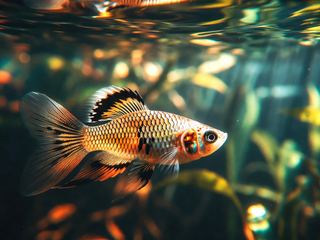
Guppy
The colorful, prolific livebearer that turns a starter tank into a thriving colony fast!
- Tank
- 18 x 12 in base
- Temp
- 72 to 82°F
- pH
- 7.0 to 8.5
- Size
- 1 to 2.4 in
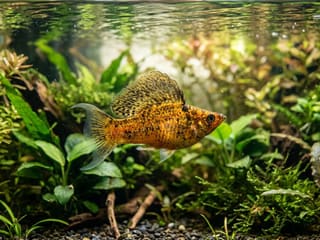
Molly
The big, grazing livebearer that thrives in hard, alkaline water and wants its greens!
- Tank
- 20 gallons for a small group
- Temp
- 70 to 82°F
- pH
- 7.5 to 8.5
- Size
- 3 to 6 in
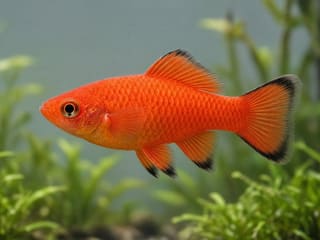
Platy
The endlessly colorful beginner livebearer that thrives when the water is hard enough!
- Tank
- 24 x 12 in base
- Temp
- 68 to 79°F
- pH
- 7.0 to 8.2
- Size
- 1.6 to 2.4 in
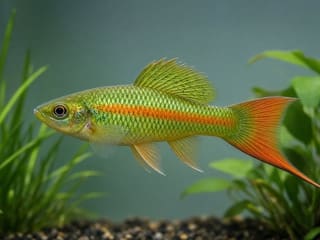
Swordtail
The active, sword-tailed livebearer that's basically a guppy's bigger, livelier cousin!
- Tank
- 36-inch tank or longer
- Temp
- 72 to 82°F
- pH
- 7.0 to 8.0
- Size
- Up to 6.3 in
Keeping livebearers together
Which livebearers can share one tank on water alone, worked out from the ranges above.
| Species | 1Guppy | 2Molly | 3Platy | 4†Swordtail† |
|---|---|---|---|---|
| 1 Guppy | Yes | Yes | Yes | |
| 2 Molly | Yes | Yes | Yes | |
| 3 Platy | Yes | Yes | Yes | |
| 4 Swordtail† | Yes | Yes | Yes |
Yes: temperature and pH ranges overlap.
†Swordtails and platies can hybridize: keep one or the other unless hybrid fry are fine.
All four together. Yes: the warm end of the platy's temperature range, at the less acidic end of the swordtail's pH range.
What every livebearer needs
Fry
One mating can give a female guppy up to about 8 broods. Adults eat fry, so dense cover decides how many survive.
Handling guide →
Sex ratio
Two to three females per male cuts the chasing. Separate tanks for the sexes, or a single-sex group, is the only way to stop breeding.
Handling guide →
Hard water
Livebearers want hard, alkaline water, the opposite of a tetra. GH and pH are separate measurements, so test both before buying fish.
Freshwater pH, GH, and KH →
Cycle first
Most fishless cycles finish in four to six weeks. No fish goes in until ammonia and nitrite read zero.
Cycling guide →
Quarantine
At least 30 days in a separate tank before a new fish joins the group.
Quarantine guide →
Ich
86°F held for two weeks kills most strains, and it sits above every livebearer here. Warm only to the top of the species' range and let medication do the killing.
Treating Ich →
Water changes
25 to 30% weekly. Test nitrate first: under 20 ppm the routine is right, past 40 ppm the next change is 50%.
Aquarium Water Changes →
Power outage
Oxygen is the threat, not darkness. Unplug the filter rather than letting it sit dead in the water, and keep the surface moving.
Power outage guide →
Frequently Asked Questions
How do I manage platy population if I don't want constant breeding?
Keep males and females in separate tanks to avoid breeding entirely, or keep a males-only group for a colorful, breeding-free tank. If you do want controlled breeding, a ratio of roughly two to three females per male cuts down on how much the females get chased and stressed by mating attempts.
How long should I quarantine a new fish before adding it to my main tank?
At least 30 days, and 30 to 60 days for a valuable fish you want to be sure about. Thirty days is the floor, not the target, since some parasites and infections take that long to show themselves.
How long does it take to cycle a fish tank?
Most fishless cycles finish in four to six weeks at a stable warm temperature, though a gene-sequencing study of real home aquarium biofilters found two tanks reaching undetectable ammonia and nitrite by week three while a third took until week eight. Cold water, no seeding, and an inconsistent ammonia dose all push a cycle toward the slower end of that range.
Encyclopedia
Subscribe - it's free
New care guides straight to your inbox. No spam.
Explore More