Uromastyx Enrichment: Heat and a Burrow Beat Every Object You Can Buy
On This Page▾

Two items on this page matter more than everything else combined, and neither of them is a toy.
A uromastyx needs a basking surface hotter than almost anything else kept as a pet, a genuinely cool end to retreat to, and enough substrate to dig a real burrow. Get those three right and the species behaves. Get them wrong and no amount of added decoration compensates.
What the Research Says
Nothing on Uromastyx. Two borrowed threads, both useful.
Thermal ranked first. Bashaw and colleagues tested five types of environmental enrichment on leopard geckos and found thermal and feeding enrichment produced the strongest responses, while mirror-based visual enrichment was the weakest.
Burrowing substrate was preferred. Nagabaskaran, Skinner and Miller gave western hognose snakes a choice between an enriched side with burrowing substrate and a standard side, with shelters and a thermal gradient on both. The snakes preferred the enriched side and the preference strengthened over time.
A snake and a gecko is an odd pair to build a desert lizard's guide on. What they share with uromastyx is the two behaviors this species is defined by: choosing a temperature, and going underground.
Uromastyx digest on heat. A basking site that is too cool does not simply make them less active, it leaves plant material sitting in a gut that cannot process it, which is why thermal enrichment for this genus is a digestive question as much as a behavioral one.
What a Wild Burrow Does
In North Africa, Uromastyx acanthinura lives mostly in rocky or semi-rocky sandy country, digging burrows under bushes or in banks and cliffs, and using natural cracks in the rock where the ground is too hard to dig. Temperatures in that habitat run from about 19°F to 140°F. The burrow stays near 68 to 77°F through all of it, and that is how the lizard holds its body temperature at or above about 68°F. A burrow is not a hiding place in the pet-store sense. It is the cool end of the gradient, the night refuge, and the humid pocket in a dry landscape, all in one.
That changes what "cool end" means in an enclosure. A slightly less hot corner is not it. The animal needs somewhere it can get well below basking temperature, underground or inside a crevice, without giving up cover to do it.
Digging, Crevices, or Both
Where the substrate can hold a tunnel, let it dig, and let it choose where. The point is that the animal makes the burrow itself: excavating is the behavior. A large dig box in one corner gives the same outlet in a contained area, which is how it is often handled for bearded dragons too.
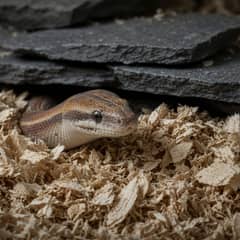
Where the keeper wants an easy floor, copy the rocky half of the habitat instead: a stack of flat slate or flagstone with spacers between the layers gives the lizard crevices at several temperatures under one basking lamp. Wild uromastyx use rock cracks exactly this way when they cannot dig. Anchor every piece, because a uromastyx will dig under a stack, and a collapse onto a burrowing lizard is a serious injury.
Foraging for a Herbivore
Feeding ranked second in the leopard gecko study, and for a plant eater it is easy to do well. Scatter greens rather than piling them, offer food in more than one place, rotate what appears across the week, and sow a forage seed mix in a tray so some of the diet is living plant the animal crops itself.
Seed and pollen material suits their natural diet and is worth working through rather than pouring out. A bee pollen topper scattered across greens gives them something to pick at, and a plant-eater supplement handles the calcium side that a herbivorous reptile under artificial light needs covered deliberately.
Height and Line of Sight
The top of the stack doubles as a lookout for a solitary, territorial lizard, so give it a view of the room. Keep cover at both ends too, so the animal never has to choose between being at the right temperature and feeling secure.
Priority Order
- A hot basking surface with a genuinely cool end
- Strong UVB across the basking zone
- Substrate deep enough to excavate, or a large dig box
- Scattered, varied plant foraging
- Anchored rock and height
- Cover available at both ends of the gradient
- Novelty, last, since visual enrichment ranked bottom in the closest study
What Not to Do
Do not run a hot enclosure with no cool end, which is the most common version of getting the gradient wrong. Do not give shallow substrate to an obligate burrower. Do not build a diet on insects for a herbivore. Do not raise humidity in a desert species, since damp is a far bigger risk here than dry. Do not stack unanchored rock over a digging animal. Do not treat handling as enrichment for a species that mostly wants to be left on its rock. And do not add a second uromastyx on impulse: males fight, a subordinate loses the basking spot, and a newcomer spends three to six months in quarantine in another room before it shares air or tools with the first.
Sources & Further Reading
Last reviewed 24 Sep 2026 · 5 sources
- Bashaw MJ et al. (2016). Does enrichment improve reptile welfare? Leopard geckos respond to five types of environmental enrichment. Applied Animal Behaviour Science
- Nagabaskaran G, Skinner M and Miller N (2022). Western hognose snakes (Heterodon nasicus) prefer environmental enrichment
- Burghardt GM (2013). Environmental enrichment and cognitive complexity in reptiles and amphibians
- ReptiFiles: Uromastyx Care Sheet
- Animal Diversity Web: Uromastyx acanthinura, by Megan Climans
Frequently Asked Questions
Is there enrichment research on uromastyx?
No. Nothing has been published on the genus. The two closest useful findings are the leopard gecko study that ranked five enrichment types, with thermal first and visual last, and the western hognose study showing a preference for enclosures with burrowing substrate.
Why does thermal enrichment matter so much for this species?
Because uromastyx bask hotter than almost any other reptile in the hobby, and they need somewhere cool to go afterwards. A single warm zone is not a gradient. Thermal choice is what the closest lizard study ranked first, and for a desert species the stakes are higher.
Do uromastyx need to burrow?
They dig extensive burrows in the wild and use them to escape both heat and cold. Giving them enough substrate to excavate rather than scratch at is one of the highest-value things you can do, and it is closer to a requirement than an extra.
What do you feed a herbivorous lizard for enrichment?
Scattered and varied greens, seed mixes offered so they have to be worked through rather than poured in a bowl, and edible flowers when you can get them safely. Uromastyx are seed and leaf specialists, and picking through material is the behavior that a single bowl removes.
Should uromastyx get insects?
Mostly not. They are herbivores and a diet built on insects causes real problems over time. Occasional insects are not a disaster in most keepers' experience, and they should not be a routine part of the plan or a substitute for varied plant material.
Can uromastyx live together?
Not casually. They are territorial, males will fight, and a subordinate animal in a shared enclosure loses access to the basking spot, which for this species means losing access to digestion. Solo housing is the safe default.
Recommended Gear
As an Amazon Associate I earn from qualifying purchases through the links above, at no extra cost to you.

Written by Michael Ryan
Mike keeps two rescued bearded dragons, Dex and Cera, and writes the care guides on BeastlyFacts from his own research and mistakes. He is not a veterinarian.
More about Michael Ryan →