Fire-Bellied Toad Enrichment: Plants Beat Pipes, and Someone Tested It
On This Page▾

Amphibian enrichment research is thin enough that a small preference test counts as a real result. This one is directly actionable.
Given a straight choice between artificial plants, PVC pipes and open space, aquatic frogs picked the plants, by around 40 percent over the pipes, with both beating open water. PVC is the default hide in amphibian keeping because it is cheap and hoses out. The frogs disagreed.
What the Research Says
Nothing on Bombina. Two borrowed threads, both from other frogs.
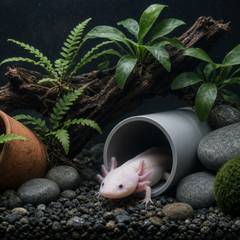
A preference test. Ramos and Ortiz-Díez divided tanks into six sections and rotated enrichment elements, counting where African clawed frogs positioned themselves three times a day for six weeks. The frogs preferred artificial plants over PVC pipes by around 40 percent, and preferred both over open space, regardless of where the items were placed. The authors concluded plants should replace the PVC that laboratory housing defaults to.
Cover does physiological work. In red-eyed tree frogs, providing plant cover changed body size, growth rate and the bacterial communities on the skin, the same result that shapes White's tree frog enrichment.
A clawed frog is fully aquatic and a fire-bellied toad is semi-aquatic, which makes this a shorter borrow than most. The shared question is what an amphibian does with a water section, and the answer is that it wants planting in it.
Preference tests are the honest way to ask an animal a question. You give it the options, you rotate them so position cannot explain the result, and you count. It cannot tell you why the frogs chose plants, and it can tell you they did, repeatedly, for six weeks.
What the Wild Toad Does
The toad's own natural history fills the gap the studies leave. The oriental fire-bellied toad spends most of its time in slow-moving streams and ponds, and breeds in still water: pools, paddy fields and ditches. Calling males float at the surface with their legs splayed. In the wild it spends the winter from September to May tucked into rotting logs or leaf piles, and it eats worms, snails and insects.
Each of those translates into a tank item. Still, shallow, planted water with no real current, because this is a pond animal. Floating cork or plant cover at the surface, where a floating toad spends its time. Leaf litter and a piece of cork or rotting-wood-style hide on the land side, the kind of cover it seeks for the winter. And more than crickets: earthworms and blackworms alongside the insects, closer to the wild menu.
A Real Land Section and a Real Water Section
The structural item. Fire-bellied toads use both, moving between them through the day, and the common failure is a token version of one of them.
A 10 gallon tank suits a small group, split so the water is deep enough to swim and rest in rather than a puddle, and the land side is more than a rock.
Plant the Water, Not Just the Land
Where the evidence points. Artificial plants were the tested item, they clean easily, and they are what the frogs chose. Put them in the water section as well as on land, because open water is what the study's frogs avoided.
Live planting works too and adds humidity and biological filtration. Either way the target is cover throughout, so a toad in the water has somewhere to be that is not the middle of an empty pool.
Water Quality as a Welfare Item
Amphibian skin is a respiratory and osmotic surface. A water conditioner on everything that goes in, plus regular changes and gentle filtration, does more for this species than any object.
Untreated tap water is the fastest way to harm one, and the skin problems that follow are the ones this species actually dies of.
A Group, Which This Species Suits
One of the few amphibians in the hobby routinely kept in groups. Similar sizes, enough space, enough cover, and you get considerably more behavior to watch than a single animal provides.
The cover requirement is not incidental. A group in a bare enclosure has nowhere to spread out to.
Feeding, Moved Around
Active diurnal hunters, which makes feeding presentation worth more here than in an ambush species. Release small live insects at the water's edge and into the planting, and vary where they go.
Changing where food appears is one of the few enrichment interventions actually tested in frogs: in dendrobatids, moving the position of the food dish increased activity. For an already active toad it is a free way to extend feeding into a search.
Priority Order
- A genuine land section and a genuine water section
- Planting in the water as well as on land
- Dechlorinated water, changed regularly
- A group of similar-sized animals
- Live prey released instead of presented
- Varying where and when food appears
- Novelty, last
What Not to Do
Do not default to PVC pipe as the hide when the tested alternative won by 40 percent. Do not leave the water section as open water. Do not use untreated tap water. Do not mix sizes in a group. Do not handle beyond what is necessary, since they secrete skin irritants and handling damages the mucus layer either way. And do not house them with other amphibian species, because those skin toxins are a real hazard in a shared water body.
Sources & Further Reading
Last reviewed 15 Sep 2026 · 5 sources
- Borrowed evidence. No enrichment study exists for this genus. The studies below are from other frogs; the natural history is the toad's own.
- Oriental Fire-Bellied Toad, Smithsonian's National Zoo and Conservation Biology Institute
- Ramos J and Ortiz-Díez G (2021). Evaluation of environmental enrichment for Xenopus laevis using a preference test. Laboratory Animals
- Michaels CJ, Antwis RE and Preziosi RF (2014). Impact of Plant Cover on Fitness and Behavioural Traits of Captive Red-Eyed Tree Frogs. PLoS ONE
- Hurme K et al. Environmental Enrichment for Dendrobatid Frogs
- The importance of enrichment for advancing amphibian welfare and conservation goals: a review of a neglected topic
Frequently Asked Questions
Is there enrichment research on fire-bellied toads?
No. Nothing has been published on Bombina. The nearest evidence is a preference test on African clawed frogs, where the animals were given a choice between artificial plants, PVC pipes and open space, and preferred plants by around 40 percent over the pipes, with both beating open water.
Why is that finding useful?
Because it compares two things keepers choose between. PVC pipe is the default hide in a lot of amphibian setups because it is cheap and easy to clean, and given the choice the frogs went for planting instead.
Are fire-bellied toads more active than other amphibians?
Considerably. They are diurnal and busy, moving between land and water throughout the day, which makes them one of the better amphibians to keep if you want to watch something. It also means an empty enclosure shows more obviously.
How should the land and water be split?
Both need to be real. A shallow water section they can swim and rest in, and a land section with proper cover, rather than a token strip of either. They use both parts of the enclosure and a setup that neglects one is only half a setup.
Can fire-bellied toads be kept in groups?
Yes, and they are better that way. They are among the few amphibians in the hobby that are routinely and successfully kept in groups of similar-sized animals, and a group is much more interesting to watch than a single toad.
Are they toxic?
They secrete irritant toxins through the skin, which is what the bright red belly advertises. It is not dangerous to a careful keeper and it is a reason to wash your hands, keep them away from your face, and avoid handling beyond what is necessary.
More on the Fire Bellied Toad
Fire Bellied Toad care guide
🐸 How Much Does a Fire-Bellied Toad Really Cost?
🐸 Fire-Bellied Toads Have Genuinely Toxic Skin, Here's What That Means
🐸 Common Fire-Bellied Toad Health Issues (Water Quality Is Everything)
🐸 Fire-Bellied Toad Enclosure Setup: Half Fish Tank, Half Terrarium
🐸 Fire-Bellied Toad Feeding: Live Prey It Has to Leap For, Two to Six Items Every Few Days, and Nothing Hard-Shelled
Recommended Gear
As an Amazon Associate I earn from qualifying purchases through the links above, at no extra cost to you.
Written by Michael Ryan
Mike keeps two rescued bearded dragons, Dex and Cera, and writes the care guides on BeastlyFacts from his own research and mistakes. He is not a veterinarian.
More about Michael Ryan →