Bengal Cat Enrichment: The Five Pillars, Turned Up
On This Page▾

A Bengal does not need a different framework from other cats. It needs the same one, delivered at a scale that catches most households out.
The AAFP and ISFM five pillars apply here as they do to any cat. The difference is magnitude: the third pillar, opportunity for play and predatory behavior, has to be provided several times a day, and the vertical territory has to be real: one cat tree in a corner does not do it.
What the Five Pillars Guidelines Say
The framework is the AAFP and ISFM Feline Environmental Needs Guidelines, covered in full in our cat enrichment guide. Five pillars:
- A safe place
- Multiple and separated key environmental resources
- Opportunity for play and predatory behavior
- Positive, consistent and predictable human to cat social interaction
- An environment that respects the cat's sense of smell
Nothing in that document is Bengal-specific, and nothing needs to be. The guidelines' own point is that environmental adequacy is linked to physical health, not only behavior, and the Bengal is simply the breed where inadequacy shows up fastest and most destructively.
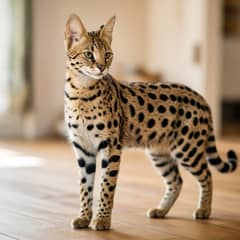
The breed traces to crosses with the Asian leopard cat, several generations back for the animals sold as pets. Whatever that contributes genetically, the practical result is a cat with more energy and more curiosity than the average household plans for.
The framework itself, and how it applies to any cat, is in that cat enrichment guide.
Vertical Territory, Properly
The most common shortfall. A single cat tree is a start and not an answer for this breed.
Build a route: wall shelves, window perches, the tops of furniture, connected so the cat can cross a room without touching the floor. Height serves the first pillar, a safe elevated place, and the third, since climbing and leaping are predatory movement.
A Bengal will use the vertical space in your home whether or not you designed it. Designing it means the route goes where you want rather than across the kitchen worktops.
Predatory Play, Several Times a Day
The third pillar at scale. Short wand toy sessions, multiple times daily, moved like prey with pauses, and ending in a catch the cat is allowed to have.
That ending matters. A sequence that never resolves leaves the cat wound up. That is the problem with laser pointers used alone. If you use one, land the dot on a real toy at the end.
Rotate toys and put the unused ones away. A Bengal habituates fast.
Food That Takes Work
A puzzle feeder, food hidden around the house, and treat balls turn feeding into hunting.
Start easy and escalate, since this is a breed that will solve a puzzle and then need a harder one. Take it from the daily ration rather than adding it, and score body condition using the pet obesity and body condition guide.
Water
Unusually among cats, many Bengals like it. Running taps, a circulating fountain, shallow water to bat at, and some will join you in the shower.
That is a free enrichment channel most cats do not offer. Use it.
Training and Harness Walking
Bengals take to clicker training, recall and harness work more readily than most cats, and structured sessions give a predictable task with social attention attached.
Harness walking suits some Bengals very well. Introduce it slowly indoors first, and accept that plenty of cats never take to it.
Separate the Resources
The second pillar, and it matters here for the same reason as in any cat home: food, water, litter, scratching and resting places in separate locations, never stacked in one corner.
One litter tray per cat plus one, sited apart. Two trays side by side are one resource.
Company, Considered
Many Bengals do well with a second active cat, and it is not automatic. A well-matched pair play with each other and take pressure off the household; a badly matched one adds a stressed cat to an already busy home.
Get it right and it can help a great deal, but it is not an automatic fix, since much of a Bengal's intensity is inherited temperament. If you are unsure, fix the environment first.
Priority Order
- A connected vertical route through the home, not one cat tree
- Several predatory play sessions a day, each ending in a catch
- The ration delivered through puzzles and hidden food, escalating in difficulty
- Key resources separated across the home
- Clicker training and, if it suits, harness work
- Water play, where the individual cat enjoys it
- A well-matched feline companion, if the match is right
What Not to Do
Do not keep a Bengal in an environment built for a quieter cat and treat the results as misbehavior. Do not rely on a laser pointer that never lets the cat catch anything. Do not leave the same toys out permanently. Do not stack all the resources in one corner. Do not buy one for the coat without planning for the animal. And do not add a second cat as a fix without considering whether the match is right.
The cat enrichment guide has the routine every cat needs under this one, and why cats need mental enrichment explains what boredom does to a cat with this much drive.
Sources & Further Reading
Frequently Asked Questions
Do Bengals need different enrichment from other cats?
Not different, more. The AAFP and ISFM five pillars apply to every cat, and a Bengal needs the third pillar, opportunity for play and predatory behavior, provided at a scale most households do not anticipate.
What are the five pillars?
A safe place. Multiple and separated key resources. Opportunity for play and predatory behavior. Positive, consistent and predictable human interaction. And an environment that respects the cat's sense of smell.
How much play does a Bengal need?
Several sessions a day rather than one, and each ending in a catch the cat is allowed to have. An under-stimulated Bengal is not a quiet cat, it is a cat that finds its own entertainment in your house.
Do Bengals like water?
Many do, unusually for cats. Running taps, dripping fountains and shallow water play are enriching for a lot of Bengals, which is a rare opportunity worth using rather than a quirk to manage.
Can Bengals be trained?
Yes, and it is one of the better outlets available. They take to clicker training, recall and harness walking readily, and structured training sessions give a highly active cat a predictable task.
Why do so many Bengals get rehomed?
Because they are bought for how they look and kept as ordinary cats. The behavior that follows, climbing everything, opening things, vocalizing, redirecting energy onto the household, is an active animal in an environment built for a less active one.
More on the Bengal Cat
Recommended Gear
As an Amazon Associate I earn from qualifying purchases through the links above, at no extra cost to you.

Written by Michael Ryan
Mike keeps two rescued bearded dragons, Dex and Cera, and writes the care guides on BeastlyFacts from his own research and mistakes. He is not a veterinarian.
More about Michael Ryan →