Amano Shrimp Tank Setup: Minimal Bioload, Real Current, and a Lid That Actually Seals
On This Page▾

Amano shrimp are native to fast-flowing freshwater streams in southwestern Japan and Taiwan, and that origin shapes their tank setup more than most keepers expect.
Tank Size and Stocking Density
A 10-gallon tank is a practical minimum. Stock it at one shrimp per 2 gallons, so five in a 10-gallon.
Their bioload is low enough that they can live in most nano tanks or larger as long as the lid is secure, and they do not need to be kept in groups. Low bioload is a real point, and it means a tank already fighting an algae outbreak can carry more than five without a water quality problem. It is not a license to pack one, though: a small group technically surviving in 5 gallons is not the same as thriving with room to forage, and more shrimp in the same algae only means the supply runs out sooner.
Temperature and Water Chemistry
64 to 82°F covers the tolerated range, but shrimp kept toward the cooler two-thirds of that band, roughly the upper 60s to mid-70s, tend to live longer, since warmer water speeds up metabolism and shortens lifespan. A heater set conservatively is usually the right call rather than one pushed toward the top of the range. Aim for pH 6.0 to 7.5.
General hardness (GH) deserves real attention here, not just clean water. Amano shrimp take a wide working range of roughly 5 to 15 dGH, and that hardness is what supplies the calcium and other minerals this species needs to build a new shell every molt. Too little GH and a shrimp can't successfully harden its new exoskeleton, too much and the old one can become too rigid to break out of cleanly. Carbonate hardness (KH) in the 2 to 8 dKH range is a reasonable target alongside it.
A pair of studies on wild Caridina larvae help explain why this species tolerates real current so well as an adult. Research in Crustacean Research found Caridina multidentata larvae can adapt across a genuinely wide salinity band, roughly 17 to 34 parts per thousand, wider than several lowland relatives in the same genus need. A related study in Hydrobiologia found a likely reason why: C. multidentata is one of the Caridina species that lives and breeds in the middle and upper reaches of rivers, real headwater country, so its larvae evolved to survive a longer, rougher journey downstream to the sea than a shrimp that already lives near the coast. A species built for that kind of current doesn't want still water as an adult either.
Filtration: Safe Intake, Not Necessarily Calm Water
This is worth correcting directly, since it's easy to assume "gentle filter" means "gentle current." A sponge filter matters for amano shrimp because it blocks a standard filter intake from pulling in or injuring a shrimp, particularly one that's just molted and is a weak swimmer for a short while afterward. It's an intake-safety choice, not a statement about how much flow the species can handle. A hang-on-back filter is a good fit for the extra flow it provides, which simulates the shrimp's natural home in a river. One filter does the job, and either kind works. A hang-on-back with a sponge pre-filter over its intake gives both the current this species evolved for and an intake it cannot be pulled into; a plain sponge filter, the gentlest filter type, gives the safety with less current. A bare hang-on-back intake is the one setup to avoid.
Substrate, Décor, and a Lid With No Gaps
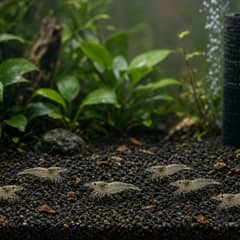
Driftwood, rocks, and live plants all do double duty here: they're grazing surface for biofilm and algae, and cover for a molting shrimp to retreat into. Driftwood especially gives them a stable, textured surface to work over.
The lid is not optional. Amano shrimp are well known escape artists, especially in their first few days in a new tank, and a gap of even a fraction of an inch around a cord or filter intake is enough for one to climb out and turn up dried out the next morning. A tight-fitting glass or acrylic lid, with any gaps sealed, is genuinely one of the most important pieces of equipment in this entire setup.
Algae Load: How Much Do They Need?
Not an endless supply, but more than a spotless, newly cycled tank usually has on hand. Algae functions as a starting food reserve the shrimp work through steadily rather than a self-renewing buffet, and when that reserve runs low it's time to add sinking wafers or blanched vegetables, lightly and every couple of days rather than heavily.
This is also, honestly, the most common real-world reason people buy amano shrimp at all. Far more often than being planned into a brand-new tank from day one, a group gets added specifically because a hair, thread, or beard algae outbreak has already shown up and the keeper wants a genuine cleanup crew rather than another chemical treatment. That's a legitimate strategy, amano shrimp are the strongest true algae eaters commonly sold in the hobby, but it's worth going in with a plan for the day the outbreak is actually under control and natural algae growth drops off, since that's exactly when supplemental feeding becomes necessary rather than optional.
Always run tap water through a water conditioner before it goes anywhere near the tank, dechlorinating it and neutralizing chloramine and heavy metals that are otherwise harmful to invertebrates.
The Amano shrimp encyclopedia profile has the full natural history.
If you're comparing setups, our Cherry shrimp encyclopedia profile covers a species with a similar footprint but a very different breeding outcome in the same kind of tank.
Sources & Further Reading
Last reviewed 24 Sep 2026 · 5 sources
- Care Guide for Amano Shrimp: Nature's Amazing Algae Eater - Aquarium Co-Op
- Amano Shrimp - Shrimp Science
- Amano Shrimp - Fishkeeping World
- Larval performance of three amphidromous shrimp species in the genus Caridina under different temperature and salinity conditions (Kondo, Hamasaki & Dan, 2021, Crustacean Research)
- Survival and development strategy of starved early-stage-zoeae of five amphidromous shrimp species in the genus Caridina under different salinity and temperature conditions (Hamasaki et al., 2023, Hydrobiologia)
Frequently Asked Questions
What size tank do amano shrimp need?
10 gallons is a practical minimum, even though a small group can technically survive in something as small as 5. Their bioload is low enough for a nano tank with a secure lid, but 10 gallons gives a group real room to forage, stocked at one shrimp per 2 gallons.
What water parameters do amano shrimp need?
64 to 82°F, pH 6.0 to 7.5, and a GH in roughly the 5 to 15 dGH range, which supplies the minerals this species needs to molt successfully. KH of about 2 to 8 dKH is a reasonable target. Shrimp kept toward the cooler two-thirds of that temperature range tend to live longer.
Does a tank need to be full of algae to keep amano shrimp?
No, and it's the opposite problem that trips people up: a very clean, heavily planted, or newly set up tank often doesn't have enough algae to sustain a group without supplemental feeding from day one. Algae is a starting food supply the shrimp work through, not an unlimited one.
What kind of filter is best for amano shrimp?
A sponge filter, but not because this species wants calm water. It comes from fast-flowing streams and tolerates, even likes, real current and good oxygenation. The sponge matters because it blocks a standard filter intake from pulling in or injuring a shrimp, especially one that's just molted and is a weak swimmer for a short while.
Why do people specifically add amano shrimp when they get an algae outbreak?
Because it's the most common real-world reason this species gets bought at all. Amano shrimp are the strongest true algae eaters commonly available in the hobby, so an existing hair, thread, or beard algae problem is the single most frequent trigger for a keeper deciding to add a group, rather than planning for them from the start of a new tank.
More on the Amano Shrimp
Amano Shrimp care guide
🦐 How Much Does Amano Shrimp Ownership Really Cost?
🦐 How to Handle Amano Shrimp (Minimal Contact, Careful Acclimation)
🦐 Common Amano Shrimp Health Issues (And Why 'Disease' Usually Isn't the Right Word)
🦐 Amano Shrimp Feeding: The Hobby's Best Algae Eater, With Real Limits
🦐 Amano Shrimp Enrichment: The Algae Runs Out and Nobody Notices
Recommended Gear
As an Amazon Associate, we earn from qualifying purchases through the links above - at no extra cost to you.
Written by Michael Ryan
Mike keeps two rescued bearded dragons, Dex and Cera, and writes the care guides on BeastlyFacts from his own research and mistakes. He is not a veterinarian.
More about Michael Ryan →