Rosy Boa Care Guide
Snakes
Beastly Facts · Updated
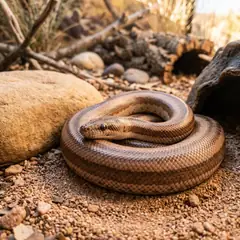
The docile, unhurried boa of the desert boulders!
On This Page▾

Did you know? Two rosy boas collected in 1965 were still alive in 2019, at 56 and 53 years old. The snake is small, but the commitment is two decades or more.
The first week
The numbers a new owner needs in the first week, each from the article it links to. Rows with no link come from the encyclopedia.
- Legal check
- Broadly legal, and the Boidae exemptions that clear the boa constrictor mostly clear it too. New York City bans the family, Colorado's 2026 rewrite dropped it from the exemption, New Jersey's exemption names a different genus, Delaware and West Virginia want permits, and Hawaii bans every snake.Legal guide →
- Quarantine
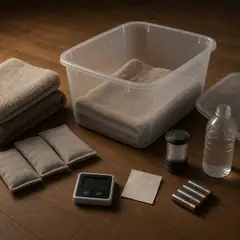
- 3 to 6 months in a different room. A second tank in the same room as your established reptile is proximity with a lid on it.Quarantine guide →
- Enclosure
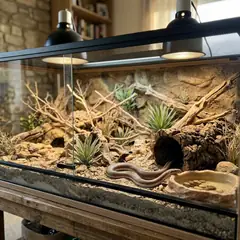
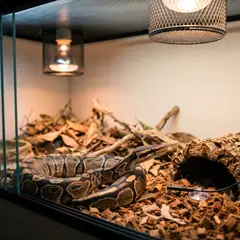
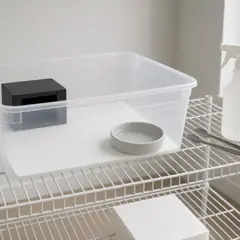
- 10 to 20 gallons for a young snake, a 20 gallon long for an adult up to about 30 inches, and 36x18 inches of floor (a 40 gallon breeder) for most adults. Housed individually with snug hides, under a fine-mesh screen lid held down with clips.Setup guide →
- Temperature
- A basking surface of 85 to 90°F and a cool side of 75 to 80°F, with the heat mat under one end on a thermostat whose probe sits under the bedding. Around 70 to 75°F at night, and a dip to 60°F does no harm. The same all year.Setup guide →
- Humidity
- 30 to 50 percent, always under 60, with a damp moss hide only during a shed. In this desert snake, damp is the usual care mistake behind respiratory infection.Setup guide →
- Substrate
- Dry aspen. No cypress mulch or coconut fiber, which suit tropical boas and are wrong here.Setup guide →
- Cover and rock
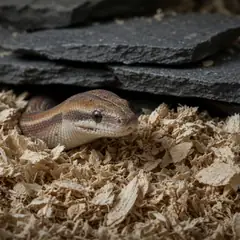
- Tight cover at both ends is first on the enrichment list, then 3 to 4 inches of dry bedding and the length to stretch out. Set stacked rock on the tank floor: a snake burrowed under a stack is under it when it shifts.Enrichment guide →
- Diet
- Frozen-thawed mice for life, pinkies or fuzzies up to small or medium adults, offered with tongs, never live. No supplements: whole prey is complete.Feeding guide →
- Feeding frequency
- Young snakes every 5 to 7 days, adults every 10 to 14. Less often is safer: most captive snakes are overfed.Feeding guide →
- Prey size
- 1 to 1.5 times the body's width at its thickest, and about 10 percent of its weight. Thawed in the refrigerator and warmed to about 100°F, never in the microwave.Feeding guide →
- Handling
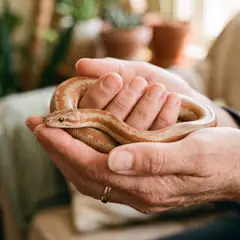
- Leave it alone for the first two weeks. Then lift with both hands, supporting the body at several points, and approach from the side. Wait 2 to 3 days after a meal, and never during a shed.Handling guide →
- Temperament
- Docile and very rarely bites. A bite is usually a feeding response, a hand mistaken for food.Handling guide →
- Budget
- $200 to $300 for a normal snake. Setup roughly $275 to $610, then $10 to $25 a month. Vet care comes on top: a wellness exam runs about $80 to $130, so set aside $100 to $200 a year.Cost guide →
- Lifespan
- 18 to 22 years on average in captivity, with documented individuals past 30.Cost guide →
- Adult size
- Most adults 24 to 36 inches (60 to 90 cm), about 44 inches (112 cm) at most.
- First vet visit
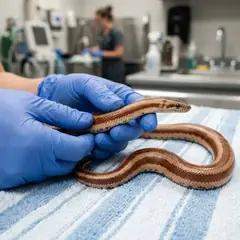
- Within one to two weeks of bringing it home, with a fresh stool sample. Find a vet who sees reptiles before the snake comes home.Health guide →
- Hygiene
- Children younger than 5 should not handle or touch reptiles or their environments at all.Hygiene guide →
Emergency card
Call the vet now if you see any of these.
- Open-mouth breathing, wheezing or nasal discharge.
- A bite from a rodent.
- A burn or blisters on the belly.
Book a vet visit promptly for these.
- Red spots, bleeding or discharge in the mouth.
- Mites, or a snake that soaks in its water dish for long stretches.
- An injured, raw nose.
- A second regurgitation.
- 3 to 4 weeks without eating outside winter.
- Discolored or damaged belly scales.
- Poor coordination, disorientation or an upturned, stargazing head. Keep it away from other snakes until it is seen.
- Weight gain or loss without a change in feeding.
A respiratory infection always needs a vet and antibiotics. Do not wait to see if it clears on its own, and fix the humidity so it does not come back.
Where to go next
How Much Does a Rosy Boa Cost?
$200 to $300 for a normal snake, roughly $275 to $610 for the setup, $10 to $25 a month, the vet set-aside and the lifetime total.
Rosy Boa Enclosure Setup: Warm at One End, Dry, and Locked Tight
Tank size by age, the heat mat and thermostat, optional UVB, the low humidity that runs opposite to most pet snakes, and the setup order.
Rosy Boa Feeding: Schedule, Prey Size, and Why Adults Eat So Rarely
Whole mice sized to the snake, every 10 to 14 days for an adult, thawing and offering, feeding a baby, refusals and why overfeeding is the bigger risk.
How to Handle a Rosy Boa: One of the More Docile Snakes
How to pick it up, the 2 to 3 day wait after a meal, whether rosy boas bite and what to do if one holds on.
Common Rosy Boa Health Issues (and Why Humidity Is the One to Watch)
What normal looks like, respiratory infection, mouth rot, mites, burns, obesity and IBD, and which signs need a vet the same day.
Rosy Boa Enrichment: Tight Cover, Deep Ground and Room to Stretch
Built on the wild snake: tight cover at both ends, dry bedding to burrow in, room to stretch and food in the evening.
Is It Legal to Own a Rosy Boa? State-by-State Guide
Where the family-wide Boidae exemptions catch this snake and where they drop it, state by state.
What to buy
As an Amazon Associate I earn from qualifying purchases. Underlined items are paid Amazon links, at no extra cost to you.
Prices and the reasoning behind each item are in How Much Does a Rosy Boa Cost?.
Full Rosy Boa gear listFrequently Asked Questions
How humid should a rosy boa enclosure be?
30 to 50 percent, and always under 60. During a shed, add a damp moss hide instead of raising the whole enclosure. Brief spikes, like a splash from the water dish, are fine as long as the enclosure dries back out.
How often should I feed my rosy boa?
Adults every 10 to 14 days, and young rosy boas every 5 to 7 days. When in doubt, less often is safer.
What causes respiratory infection in rosy boas?
Usually an enclosure kept too damp, which lets bacteria take hold. Wrong temperatures or a dirty floor make it worse. Open-mouth breathing, wheezing or nasal discharge needs a vet the same day.
Fillable forms for any pet

Universal Pet Kit
25 pages · PDF · $4.99
Deep Dive
Health and More

Fun Facts
🐍 The Same Defense, a Very Different Snake
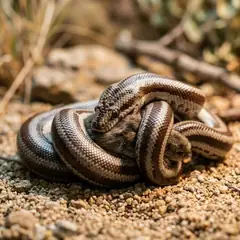
Rosy boas share their signature defensive move, curling into a ball with the head tucked in the center, with the larger ball python. A rosy boa is mild-mannered and saves it for when hiding isn't an option, then adds a trick: it waves its tail back and forth so the tail looks like a head ready to strike.
Explore More