Ghost Shrimp Care Guide
Invertebrates
Beastly Facts · Updated
The see-through scavenger that costs pennies and earns its keep!
On This Page▾

Did you know? Despite looking like a smaller, cheaper cousin of the cherry and Amano shrimp sold right next to them in the store, ghost shrimp aren't closely related to either. They belong to the family Palaemonidae, while cherry and Amano shrimp both belong to the unrelated family Atyidae, and each lineage independently evolved from marine ancestors into fresh water at a different point in history. Their famous hardiness is exactly why they're sold cheaply in bulk as feeder shrimp for larger fish, even though plenty of keepers keep them purely as pets.
The first week
The numbers a new owner needs in the first week, each from the article it links to. Rows with no link come from the encyclopedia.
- Where yours came from
- Many ghost shrimp move through the trade as live feed with no screening or quarantine. Lethargy, hiding, refusing food, and losses inside a small group shortly after purchase are feeder-tank stress.Health guide →
- Buy carefully
- Much of the supply is shipped in bulk as feeder stock, so the cheapest source is not always the healthiest, and a bag labeled ghost shrimp can hold whisker shrimp, which have long, heavy front claws and kill small fish.Cost guide →
- Tank size
- 5 gallons at the least, 10 if you can. About 2 shrimp per gallon in a shrimp-only tank, fewer with fish.Setup guide →
- Temperature and water chemistry
- 72 to 82°F, pH 7 to 8, hardness 3 to 15 dGH. Ammonia and nitrite read zero before stocking.Setup guide →
- Filtration
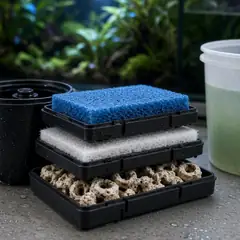
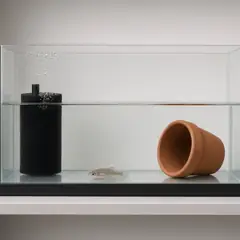
- A sponge filter. It has no intake tube to pull in a shrimp, freshly molted ones especially, the way a hang-on-back does.Setup guide →
- Copper
- The rule that never bends: in a four-day test on young ghost shrimp, half died at 0.79 mg/L of copper sulfate. That is not a safe level, and any reading above zero means act. Copper medications, some fertilizers and old copper plumbing are the usual routes.Health guide →
- Cover
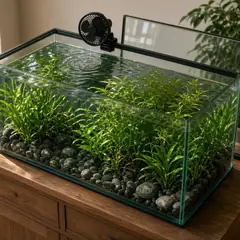
- Dense plants and driftwood, so a freshly molted shrimp can vanish for the hours to days it is soft. Fish and other ghost shrimp both target one.Setup guide →
- Molting, what normal looks like
- Going still and off food for an hour or more beforehand, then an empty shell in the tank. Young shrimp molt every 1 to 2 weeks, adults every 3 to 4 weeks. Leave the shell in for a day.Health guide →
- Molting, what failure looks like
- A solid white band where the shell should split cleanly at the head, trapping the shrimp between old and new shell, usually fatal. It traces to water and diet, low hardness above all.Health guide →
- Feeding
- Every day or two at lights out, a piece of sinking wafer small enough that nothing is left a few hours later. They graze surface film and detritus; they will not clear an algae problem.Feeding guide →
- They eat each other
- Freshly molted shrimp are the target, soft for hours to days. Dense cover and steady feeding both cut it.Feeding guide →
- Tankmates
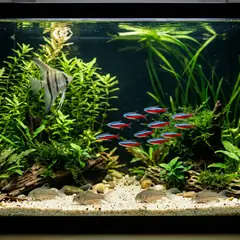
- Prey or predator by size. A shrimp past roughly 1.5 inches is too big for most bettas to bother with; juveniles are at risk. Think about size in both directions, not the word "peaceful".Setup guide →
- Getting them into the tank
- A soft net, never hands. Float the bag, then drip at about 1 to 2 drops a second until the volume doubles, about 1 to 2 hours. The bag water goes down the drain.Handling guide →
- Quarantine
- 30 days in a separate 10 gallon tank before new shrimp join an established one.Handling guide →
- Budget
- Well under $1 each in bulk, $1 to $3 individually as pets. Equipment roughly $165 to $375, plus a quarantine tank. Few vets treat shrimp.Cost guide →
- Lifespan
- About a year, so plan on replacing a group about once a year.Cost guide →
- Water changes
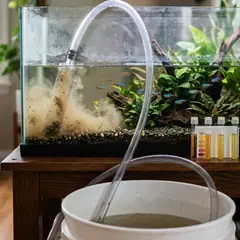
- Small and steady, since swings in hardness around a change trigger failed molts. Test nitrate rather than changing by the calendar.Aquarium Water Changes →
- A hot week
- Room air conditioning and a fan first, frozen bottles as a last resort, and the aeration running throughout: warm water holds less oxygen.Cooling an Aquarium Without a Chiller →
Emergency card
Test the water first, then act on these today. Few vets treat shrimp; prevention is the whole plan.
- A copper test above zero, or several shrimp dying at once: move the shrimp into water that tests zero
- A solid white band around the body: a failed molt, with no fix once it shows
- Hiding, lethargy or refused food that lasts past the first days after a move: test ammonia and nitrite
Four habits prevent nearly all of this: quarantine new arrivals, confirm the cycle before stocking, keep copper at zero, and hold water chemistry steady for reliable molts.
Where to go next
How Much Does Ghost Shrimp Ownership Cost?
$1 to $3 as pets, the setup and quarantine tank, and whisker shrimp in the bag.
Ghost Shrimp Tank Setup: Minimal Requirements, But Compatibility Is Where People Get Caught Out
How many per gallon, the setup order, and tankmates by size.
Ghost Shrimp Feeding: What They'll Actually Eat, Including Each Other
A wafer piece at lights out, the wild diet, babies, and why they eat each other.
Ghost Shrimp Aren't Handled by Hand, But Acclimation Is Where Many Losses Happen
Net rather than hands, the drip step by step, 30 days of quarantine and the first week.
Common Ghost Shrimp Health Issues (Many Trace Back to Where They Came From)
What normal looks like, when to act, copper and the white ring of death.
Ghost Shrimp Enrichment: A Night Forager From the Weed Beds
A weed bed to hide in, surfaces to graze, a night shift, and how to tell it is working.
What to buy
As an Amazon Associate I earn from qualifying purchases. Underlined items are paid Amazon links, at no extra cost to you.
Prices and the reasoning behind each item are in How Much Does Ghost Shrimp Ownership Cost?.
Full Ghost Shrimp gear listFrequently Asked Questions
What size tank do ghost shrimp need?
Five gallons at the least, and 10 if you can, since more water stays stable longer. Plan on about 2 shrimp per gallon in a shrimp-only tank and fewer when fish share it.
Why are ghost shrimp so sensitive to copper?
Copper is toxic to invertebrates, and shrimp have very little margin: young ghost shrimp died at under 1 mg/L in a four-day test. Keep copper at zero, read every medication and fertilizer label, and treat any reading above zero as an emergency.
Why does drip acclimation matter so much for shrimp specifically?
Because a sudden change in salts, pH and temperature is hard on a shrimp, and a slow drip lets it adjust gradually. Run the drip at about 1 to 2 drops a second until the water volume doubles, about 1 to 2 hours, and go slower when your water is much harder or softer than the shop's.
Fillable forms for any pet
Universal Pet Kit
25 pages · PDF · $4.99
Deep Dive
Health and More
Fun Facts
🦐 Same Shelf, Different Families
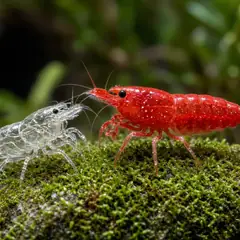
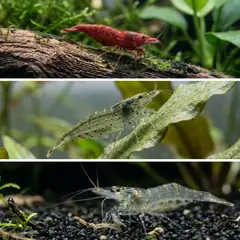
Ghost shrimp and cherry shrimp are not the cousins they look like. The American grass shrimp sold as ghost shrimp, Palaemon paludosus, belongs to the family Palaemonidae. Cherry shrimp and Amano shrimp both sit in a separate family, Atyidae. Same shelf, different branches of the family tree.
Explore More