Garter Snake Care Guide
Snakes
Beastly Facts · Updated
The backyard classic that eats fish and worms instead of mice!
On This Page▾

Did you know? Garter snakes give birth to live young instead of laying eggs, and a single litter can range from a handful of babies to as many as 80!
The first week
The numbers a new owner needs in the first week, each from the article it links to. Rows with no link come from the encyclopedia.
- Legal
- Native almost everywhere, so most states regulate it as wildlife, which can mean more paperwork. New York has no permit path at all, even for a snake bought at a pet store.Legal guide →
- Day one
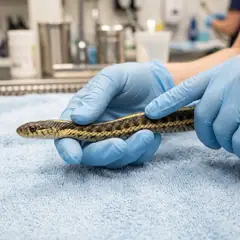
- Book a vet exam with a fecal screen within 72 hours, two weeks at most. If you keep other reptiles, quarantine the garter in a separate room for 3 to 6 months with its own tools.Quarantine guide →
- Enclosure
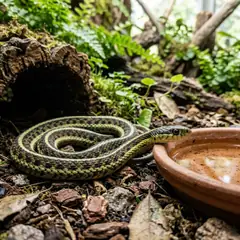
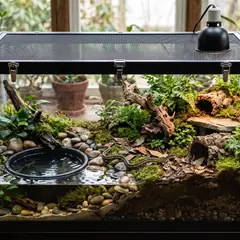
- A 36x18x18 inch enclosure or a 40-gallon breeder minimum for one adult. Common, checkered, wandering and coast garters are cannibalism-prone and live alone.Setup guide →
- Escape-proofing
- Fit a locking lid, and seal every vent gap and cord hole with mesh or silicone.Setup guide →
- Temperature
- Warm side 85 to 90°F, up to 95°F for reliable digestion, and never below 85°F. Cool side 70 to 75°F, nights to 64°F, with the heat left on its thermostat. Every heat source on a thermostat.Setup guide →
- Humidity and substrate
- 30 to 60%, raised slightly for a shed, over 1 to 2 inches of coconut fiber, cypress mulch, or leaf litter. No cedar, pine, or sand alone.Setup guide →
- The water feature
- A container the snake can fully submerge in, up to about 20 by 12 by 8 inches, on the cool side. Change it every day, and at once if it is soiled.Setup guide →
- Many will not eat mice
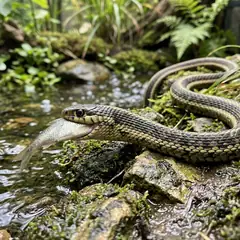
- Some specialize in fish and amphibians, some in worms and slugs, and some eat anything, with no way to know in advance. Plan on fish and earthworms as the default.Feeding guide →
- Feeding frequency
- Earthworm diets twice a week, fish every 5 to 7 days, mouse-eating adults about weekly, babies and juveniles every other day. Prey no more than 1.5 times the snake's width, or up to 10% of body weight.Feeding guide →
- The thiaminase problem
- Goldfish and rosy red minnows break down thiamine: feed thiaminase-free tilapia, salmon, or silversides, frozen and thawed, with B1 if fish exceed a quarter of the diet. Buy earthworms from a reptile food supplier, and never feed red wigglers.Feeding guide →
- Musk and bites
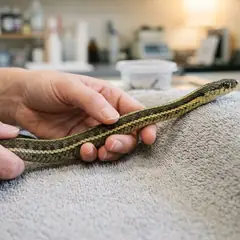
- A threatened garter musks rather than bites, and a bite is a light pinch. Musking fades with calm handling: a few minutes, a couple of times a week, after one to two weeks of settling.Handling guide →
- Enrichment
- A garter needs cover to cross the floor under: cork bark, flat stones, moss and dry leaves between a hide at each end. Add a basking spot, a low branch, and food set out in small pieces to find by scent.Enrichment guide →
- Weight checks
- Weigh monthly while growing. A rounded loaf in cross-section is right; a triangle with a ridge down the spine is underweight.Body condition guide →
- Budget
- $20 to $50 for a wild-type, $395 to $710 for the setup, then $235 to $385 a year. A routine exam is $50 to $100, a fecal test $25 to $50.Cost guide →
- Adult size
- 18 to 26 inches (46 to 66 cm) typical; large females occasionally exceed 3.5 feet (107+ cm).
- Lifespan
- 6 to 10 years in captivity, documented past 20, against 2 to 4 in the wild.Cost guide →
- Hygiene
- Wash hands with soap after any contact with the snake, its enclosure or its water, keep the snake out of the kitchen, and never clean the enclosure where food is prepared.Hygiene guide →
Emergency card
Take the snake to a vet today for any of these.
- Tremors, loss of coordination, a twisted neck or stargazing (an arched, rigid posture with the head pointing up)
- Open-mouth breathing
- Blisters on the belly, or a sore that is spreading
- Sudden inability to move part of the body
Book a visit within the week for these.
- Wheezing, gurgling, or mucus at the nose or mouth
- Red spots on the gums, swelling or discharge in the mouth
- Tiny black or red specks on the snake or in the water bowl
- Weight loss, abnormal droppings, or more than a couple of missed meals
- Eyes still cloudy after a shed, or an eye cap still in place
- A regurgitated meal
Find a reptile-experienced vet before you need one, and book a fecal exam for every new garter snake. Fish, earthworms and wild-caught prey bring in more internal parasites than frozen rodents do, and a wild-caught snake may already carry them.
Where to go next
How Much Does a Common Garter Snake Really Cost?
$20 to $50 for a normal, the $395 to $710 setup, and why a free wild-caught snake still costs the same to keep.
Garter Snake Enclosure Setup: Why the Water Bowl Isn't Really a Water Bowl
The 36x18x18 minimum, a water feature sized to swim in rather than sip from, the thermostat with zero exceptions, and the lid that has to latch.
Garter Snake Feeding: Fish, Earthworms, and Why So Many Refuse Mice
Why a real share of garter snakes never take a mouse, the frequency table by diet type, and the thiaminase problem behind the cheapest feeder fish.
How to Handle a Garter Snake (And Why It Might Musk on You First)
Musk before bite, the rear-fanged question answered plainly, and a settling-in timeline.
Garter Snake Health Problems and When to See a Vet
Thiamine deficiency, respiratory infection, mouth rot and a heavier parasite load than most pet snakes, with how fast each one needs a vet.
Garter Snake Enrichment: Cover, Water and Food to Find
Cover to move under, water to swim in, a sunny spot to bask and food to find, and how to tell it is working.
Is It Legal to Own a Garter Snake? State-by-State Guide
Why a native species is often harder to keep legally than an imported one, and the state that permits a pet-store animal the same as a wild-caught one.
What to buy
As an Amazon Associate I earn from qualifying purchases. Underlined items are paid Amazon links, at no extra cost to you.
Prices and the reasoning behind each item are in How Much Does a Common Garter Snake Really Cost?.
Full Garter Snake gear listFrequently Asked Questions
Why do some garter snakes refuse to eat mice?
Garter snakes fall into rough dietary groups: fish and amphibian specialists, worm and slug specialists, and generalists. That specialization is real enough that some individuals will refuse even a mouse scented with fish to disguise it, for their entire lives. New keepers who assume every snake eventually 'converts' to convenient frozen mice are often caught off guard. Plan for fish and earthworms as the default expectation, not a fallback.
How often should I feed a garter snake?
Frequency depends on what the snake eats. Earthworm-heavy diets need feeding roughly twice a week, fish-heavy diets about every 5 to 7 days, and mouse-eaters about once a week as adults, with babies and juveniles fed every other day. Two smaller items can substitute for one larger one.
Does a garter snake need a swimmable water feature?
Yes, not just a nice extra. Garter snakes are semi-aquatic and proficient swimmers in the wild, and captive individuals use a water feature sized for full submersion for soaking, drinking, and even defecating. A shallow dish that only lets the snake dip its head misses a real, natural behavior this species needs access to.
Fillable forms for any pet

Universal Pet Kit
25 pages · PDF · $4.99
Deep Dive
Health and More




Fun Facts
🐍 Snakes in Good Shape Stink More
Garter snakes in good shape may stink more. When researchers hand-caught two garter snake species near Denver, terrestrial garter snakes in better body condition were more likely to musk them. The team's take: the smelly defense looks resource dependent, with well fed snakes the readiest to let fly.
🐍 Tongue Sniffers
Snakes smell with help from their tongues! Each flick of that forked tongue grabs chemicals from the air or ground. The tongue can't smell a thing itself, though: it drops its haul onto pads on the floor of the mouth, which most likely pass it up to the Jacobson's organ in the roof of the mouth.
Explore More