Leaf-Tailed Gecko Enrichment: Camouflage Only Works With Something to Match
On This Page▾

This is the species where a sparse enclosure does the most obvious harm, because the animal's entire defense is being impossible to see.
A Uroplatus in a bare enclosure is a camouflaged animal with nothing to be camouflaged against. Cover for this genus is not a hiding place you provide in addition to the enclosure. It is the enclosure.
What the Research Says
Nothing on Uroplatus. Three borrowed gecko threads apply, none of them from an animal much like this one.
Social. The 2024 tokay pair-housing study found socially deprived geckos more likely to move and hide before feeding. Leaf-tails are generally kept singly or in carefully managed pairs, so this transfers poorly.
Novelty and stress. The crested gecko work found individuals engaging with novel objects sooner had lower baseline stress hormones.
Enrichment ranking. Leopard geckos ranked thermal and feeding highest, visual lowest.
These borrows stretch further than usual. A satanic leaf-tailed gecko and a leopard gecko are separated by an enormous amount of evolutionary distance and lifestyle, and this guide leans more on natural history than on transferred findings as a result.
Bark, Foliage and Depth
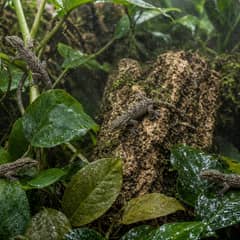
The core of the guide. Vertical cork slabs, branches of varied diameter, and dense live planting arranged in layers and not a single plane.
The test: can you always find the gecko instantly? If so, the layout is too sparse. An animal that can position itself against a matching surface and become difficult to see is doing the thing it evolved to do, and that is the behavior the enclosure exists to permit.
Live planting also holds humidity, which this genus needs a great deal of.
Cork tubes earn their place twice, as something to climb on and something to climb into. Match the structure to the species: the lined leaf-tail, U. lineatus, takes to bamboo, set singly or in rows along the back wall. Ficus, pothos, philodendron and dracaena are safe live plants; wash the leaves before planting, since nursery stock can carry pesticide residue. Artificial foliage needs a close look for sharp leaf edges and exposed wire, which can cut this thin skin badly.
Scatter dried oak or magnolia leaves and moss over the floor to hold humidity, and give the gecko somewhere to drink. Glass walls collect mist droplets on their own; a screen enclosure needs broad leaves placed to catch them. A photographic or 3D background covers the clear walls that otherwise leave an animal with nothing to match.
Humidity With Real Cycles
Uroplatus need high humidity and drying periods between mistings, and hand spraying several times a day is hard to sustain reliably. A misting system is one of the few pieces of equipment that genuinely changes outcomes for this genus rather than merely making keeping more convenient.
Constant saturation is as bad as constant dryness, so the cycle matters as much as the number.
Feeding at Height
Arboreal geckos that do not want to descend to a floor dish. A magnetic feeding ledge mounted high puts food where the animal already is.
Release live prey at night rather than presenting it. These are nocturnal ambush hunters, and prey that has to be located and taken is the behavior a dish removes.
Leave Them Alone
Worth stating as an enrichment item in its own right. Uroplatus are highly strung and easily stressed, and the wild-caught ones that still reach the trade carry the health problems that brings. Low traffic, low disturbance and minimal handling do more for this animal than anything you can add to the enclosure.
Priority Order
- Dense bark, foliage and layered cover, which for this genus is the enclosure
- Correct humidity with real drying cycles
- Vertical structure at varied diameters
- Feeding at height, with live prey to hunt
- Low disturbance
- Novelty, last, and gently
What Not to Do
Do not keep a cryptic species in a sparse enclosure, which is the failure this guide is built around. Do not maintain constant saturation instead of a misting cycle. Do not buy wild-caught if a captive-bred animal is available. And do not treat borrowed leopard gecko findings as though they were about this animal, because that borrow is a long one.
Sources & Further Reading
Last reviewed 15 Sep 2026 · 5 sources
- Borrowed evidence, and a long borrow. No enrichment study exists for Uroplatus. The findings below are from distantly related geckos.
- ReptiFiles: Leaf-Tailed Gecko Terrarium Decor
- Changes in enclosure use and basking behaviour associated with pair housing in tokay geckos (2024)
- Reaction to novel objects and faecal glucocorticoid metabolite levels in two species of nocturnal geckos
- Bashaw MJ et al. (2016). Leopard geckos respond to five types of environmental enrichment
- Burghardt GM (2013). Environmental enrichment and cognitive complexity in reptiles and amphibians
Frequently Asked Questions
Is there enrichment research on leaf-tailed geckos?
No. Nothing has been published on Uroplatus. The closest evidence comes from other geckos: a 2024 tokay study on pair housing, a crested gecko study on novel objects and stress hormones, and the leopard gecko study that ranked five enrichment types.
Why is cover more important for this species than most?
Because crypsis is their entire defense. A leaf-tailed gecko is built to be indistinguishable from bark or a dead leaf, and in a bare enclosure that adaptation has nothing to work against. The animal is exposed at all times, which for a species that relies on not being seen is a permanent stressor rather than a minor gap.
How much planting is enough?
The test is whether the gecko can position itself anywhere in the enclosure and be hard to spot. If you can always find it immediately, there is not enough bark, foliage or depth in the layout.
Do they need a misting system?
For most keepers it is the practical answer. Uroplatus need high humidity with proper drying cycles between mistings, and hand spraying several times a day is difficult to sustain. Automated misting is one of the few pieces of equipment that changes outcomes for this genus.
Are leaf-tailed geckos beginner animals?
No. They are demanding on humidity, temperature and stress management, and the wild-caught animals that still turn up bring real health problems with them. This is an advanced species and the enrichment picture assumes the husbandry is already right.
How should they be fed?
Live prey, at night, released so it has to be hunted rather than presented. A magnetic feeding ledge mounted high suits an arboreal gecko that does not want to come to the floor to eat.
More on the Leaf Tailed Gecko
Leaf Tailed Gecko care guide
🦎 How Much Does a Leaf-Tailed Gecko Really Cost?
🦎 Should You Handle a Leaf-Tailed Gecko? Almost Never
🦎 Common Leaf-Tailed Gecko Health Issues
🦎 Leaf-Tailed Gecko Enclosure Setup: Cool, Genuinely Humid, and Precisely Misted
🦎 Leaf-Tailed Gecko Feeding: As Much as It Eats in a Night, and the Insects Come Out by Morning
Recommended Gear
As an Amazon Associate I earn from qualifying purchases through the links above, at no extra cost to you.

Written by Michael Ryan
Mike keeps two rescued bearded dragons, Dex and Cera, and writes the care guides on BeastlyFacts from his own research and mistakes. He is not a veterinarian.
More about Michael Ryan →