Ember Tetra Tank Setup: A 10-Gallon School, Soft Water, and Dense Plants
On This Page▾

Ember tetras are a small South American characin from the Araguaia River basin in central Brazil, first described from the Rio das Mortes. They are thought to live in minor tributaries, backwaters and oxbow lakes rather than main river channels, in soft, weakly acidic water with dense plants and leaf litter. An adult reaches about 0.8 inch (2 cm), and the whole tank is built around that small fish living in a group.
Tank Size
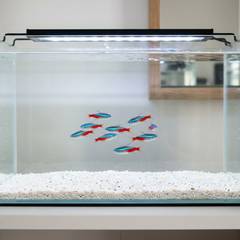
A 10-gallon tank is the size for a school of 10. The footprint guidance for this species is a base of at least 18 x 12 inches (45 x 30 cm) or the equivalent, set for the recommended purchase of 8 to 10 fish, and a 10-gallon roughly matches it. Aim for 10 or more.
A 5-gallon nano is sometimes suggested, but only with a smaller school. The school is the point of keeping embers, so the extra 5 gallons buy the group of 10 the species is kept in, and in the group-size study on neon tetras, groups of 10 shoaled the most.
Tankmates have to be small and calm, because an ember loses out to anything rowdy or much bigger than itself. Adult dwarf shrimp are safe with them; shrimplets are not.
Temperature
75 to 82°F (24 to 28°C) is the range, held by a submersible heater. 82°F is the ceiling, so the heater sits inside the range with room to spare above it.
That band overlaps a neon tetra tank, kept at 70 to 77°F, only between 75 and 77°F. At the top it stops short of a cardinal tetra, which tolerates water reaching 86°F. An ember tank treats 82°F as its limit.
Water Chemistry
Embers want soft water that runs from acidic to neutral: pH 5.0 to 7.0, with a general hardness of 1 to 10 dGH. That is the same pH range a cardinal tank is run at, so the two species differ on temperature far more than on chemistry.
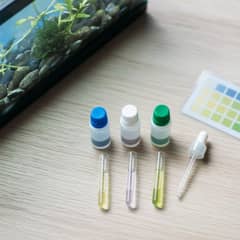
Test the source water before the tank is filled. Hard tap water comes down by blending it with RO water, which lowers GH and KH together so the pH follows and then holds. A bottled pH-down product forces the number for a while and leaves the hardness that set it untouched. Every top-off and water change is dechlorinated with a water conditioner and mixed the same way the tank was first filled.
Filtration
Keep the flow gentle. A little water movement does no harm, and a sponge filter fits that brief. It is also the gentlest intake for a tank that holds shrimp, which matters when dwarf shrimp share the tank. A hang-on-back works too when its output is baffled or turned down.
Plants and a Dark Substrate
Plant the tank heavily and lay a dark substrate under it. Dense stems and leaves recreate the planted backwaters the fish comes from and give the school cover.
Floating plants earn a place on the surface too. Leaf litter on the substrate is optional: as the leaves decay, colonies of microbes establish on them.
The ember tetra is rated Least Concern, with a wild population that can double in under 15 months, and it is both fished and kept commercially for the aquarium trade.
Cycle the Tank Before the School Goes In
An ember tank is cycled before any fish are added: ammonia and nitrite both read zero, and nitrate has started to build. Adding the whole school of 10 at once is one of the two safe ways to stock a newly cycled tank, as long as the water is tested every day until the readings settle.
New fish spend 30 days in a bare quarantine tank before they join a display tank that already holds fish or shrimp.
The ember tetra encyclopedia profile has more on the species itself.
Sources & Further Reading
Frequently Asked Questions
What size tank do ember tetras need?
A 10-gallon tank for a school of 10, on a base of roughly 18 x 12 inches (45 x 30 cm) or the equivalent. A 5-gallon only works with a smaller school, and 10 or more is the group to aim for.
What temperature do ember tetras need?
75 to 82°F (24 to 28°C), held steady by a heater. 82°F is the top of the range, so set the heater inside it and never above it.
What water chemistry do ember tetras need?
Soft, acidic to neutral water: pH 5.0 to 7.0 and a hardness of 1 to 10 dGH. Ammonia and nitrite both need to read zero in a fully cycled tank before the school goes in.
Do ember tetras need a planted tank?
Yes. Ember tetras are best kept in a heavily planted tank over a dark substrate, with floating plants as a useful addition and filtration kept gentle.
Can ember tetras live in a 5-gallon tank?
Only with a smaller school. A 5-gallon nano is sometimes suggested for a fish this small, but the group of 10 the species is kept in needs 10 gallons on an 18 x 12 inch base.
Do ember tetras need a filter?
Yes, a gentle one. A sponge filter fits a species that wants little water movement and is the safest intake where dwarf shrimp share the tank; a hang-on-back works once its output is baffled.
More on the Ember Tetra
Ember Tetra care guide
🐠 How Much Does Ember Tetra Ownership Cost?
🐠 Ember Tetras Are Never Handled, So the Trip Home Is the Part to Get Right
🐠 Common Ember Tetra Health Issues (and Why the Ich Heat Cure Stops at 82°F)
🐠 Ember Tetra Feeding: Diet, Food Size, and How Often to Feed
🐠 Ember Tetra Enrichment: Bright Orange, Built to Vanish
Recommended Gear
As an Amazon Associate I earn from qualifying purchases through the links above, at no extra cost to you.
Written by Michael Ryan
Mike keeps two rescued bearded dragons, Dex and Cera, and writes the care guides on BeastlyFacts from his own research and mistakes. He is not a veterinarian.
More about Michael Ryan →